
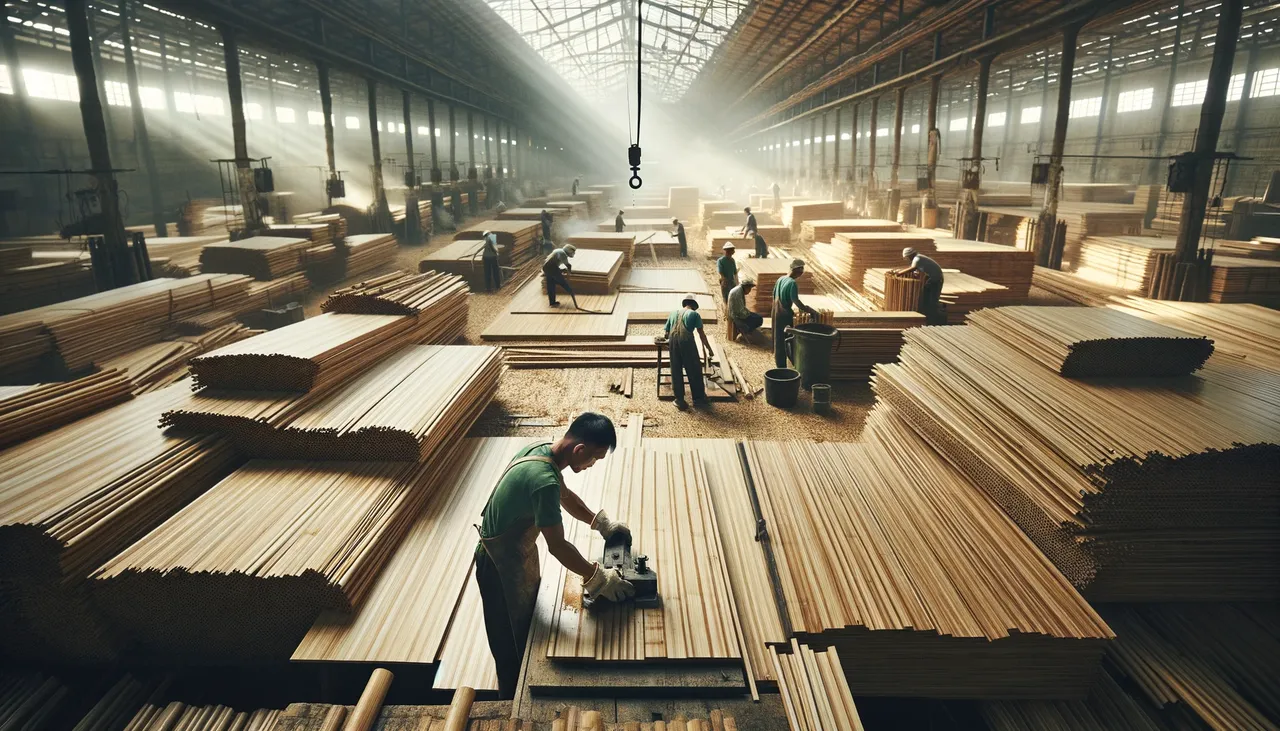
Bamboo flooring, an increasingly popular choice in modern homes, captivates many with its unique beauty and eco-friendly appeal. Originating from the tall, grassy culms of bamboo plants, this flooring option stands out for its distinct patterns and textures. Common questions often arise regarding its manufacturing process, especially considering bamboo’s lack of a traditional wood trunk. This article delves into the fascinating journey from bamboo plant to elegant floorboards, exploring the different types of bamboo flooring, their unique characteristics, and the intricate manufacturing techniques involved.
Key Takeaways
- Bamboo flooring is crafted from the culms of mature bamboo plants and comes in three main types: horizontal, vertical, and strand-woven.
- Each type of bamboo flooring has a unique manufacturing process and aesthetic, offering a range of options to suit different design preferences.
- The manufacturing process involves selecting the right bamboo species, treating the bamboo, and various methods of assembling the floorboards, each impacting the final product’s durability and appearance.
Manufacturing Bamboo Flooring 101
Bamboo floors are tough, durable, aesthetically pleasing, easy to clean, and (technically) sustainable. Unfortunately, they are also expensive, and if not processed correctly, it may result in boards shrinking.
Flooring made from these plants is technically not wood, as they belong to the Bambusoideae subfamily of the grass plants (Poaceae).
They occur globally in tropical, subtropical, and temperate regions, with the largest concentration of species and biomass in Asia (east, southeast, and the surrounding areas). Bamboo is used for various industries, of which flooring is a popular end-point.
Selecting The Correct Bamboo Plant
Although there are more than 1400 species, they are not all suitable for “timber” production.
The most commonly used flooring type is Moso Bamboo (Phyllostachys edulis); however, several other popular species belong to Bambusa, Dendrocalamus, Guadua, and Phyllostachys genera.
Using Moso Bamboo as an archetype for manufacturing, we see that the desirable characteristics to produce flooring include the following:
- Physically, a large species – larger plants means more resources for flooring.
- Hard “wood” – an essential characteristic of flooring material must be hard enough to resist wear and tear.
- They are aesthetically pleasing and have a fine grain and relatively small nodes, emphasizing the patterns.
- Widespread and fast-growing – to meet the growing demand for “green products,” bamboo must be of the fast-growing variety.
The most popular species for producing flooring in the Americas is Guadua angustifolia.
Mature plants produce the best material for processing, as they are naturally harder (lignin and cellulose), taller, and thicker. While it varies between species, plants are usually harvested at around 6 years old (younger plants tend to be softer, while older plants start to become brittle).
Harvesting Bamboo Plants
Plants are harvested with a machete (or other mechanical means) and “cleaned” of shoots, stalks, and the external green layer.
Once transported to a factory for processing, culms are cut into usable lengths and then cut according to the flooring style (fragments vs long, flat strips).
Cosmetic Treatments: Staining And Carbonizing
Before the fragments are further processed, manufacturers decide what cosmetic treatments they’ll receive. Natural-colored wood is popular, so many fragments don’t undergo changes.
However, if a darker-colored bamboo is required, the fragmented culms are often heat treated (with pressurized steam and added carbon) to carbonize the organic material.
This process produces a range of darker colors, from honey to light coffee hues.
The carbonizing process travels through the wood (as opposed to remaining on the surface) and, unfortunately, reduces the material’s strength (by up to 10%).
Alternatively, these fragments are stained to produce different colors. Staining allows for a plethora of colors, and it does not weaken the material in the process.
Bamboo “Purification”
Once the planks (logs) are at the desired size, they undergo “purification,” a process that involves boiling the plant material (often in boric acid or lime), which removes insects, starches, and sugars. This boiling also helps to preserve the wood.
Once boiled, the planks are divided according to their quality (A-grade or B-grade) and then dried in kilns before joining.
There are 3 types of bamboo flooring, which are determined by how the cut “planks” are put together. Each style produces a different aesthetic thanks to the grain.
Horizontal Bamboo Floorboard Manufacturing
These boards resemble “traditional” wood panels. The planks are laid side to side during production, producing larger gaps between the grains and showcasing the nodes.
Manufacturers produce this style of flooring by slicing flat sections out of the culm.
Planks are cut to length and “skimmed” to produce even/uniform sections. Once at the correct length and width, the outer layer of “bark” and nodes are removed.
Around 15 individual planks are laid side to side (with their faces – the outside of the culm – facing up), attacked with a strong adhesive, and put into a press that squeezes the planks together (usually with heat curing).
Horizontal flooring comprises 3 layers glued together to create the correct thickness for flooring.
Vertical Bamboo Floorboard Manufacturing
Manufacturing vertical boards from bamboo is almost identical to horizontal boards; however, the quintessential difference is how the planks are stuck together.
Vertical flooring gets its name from the vertical orientation of the planks. I.e., the flat planks are cut to shape, but they are turned 90° from the horizontal position, and the “faces” are glued together (with adhesives). Typically, 19 planks are glued together to create the correct width for flooring.
This technique produces flooring with thin/narrow grains that don’t feature the nodes that horizontal planks do. Vertical flooring appears more uniform as the lines are straighter at even spacings.
The significant drawback with horizontal and vertical flooring is that manufacturers can obtain a limited number of “flat” planks from a rounded culm. Larger specimens produce more planks, but significant “waste” is still produced.
Strand-Woven Bamboo Floorboard Manufacturing
While horizontal and vertical floors are similar, strand-woven fiber flooring differs considerably. The benefit of strand-woven flooring is that none of the culms are wasted.
The harvested culms are crushed, ripped, and shredded into long fragments. These fiber bundles are collected and mixed with adhesives (like urea formaldehyde or weaker formaldehyde).
The mixture is set under immense heat and pressure to produce incredibly strong flooring, harder than most hardwood floors (scoring up to 3270 on the Janka scale, while horizontal and vertical are typically around 1400).
After setting, the strand-woven material is in large blocks that are relatively thick and cut to size using specialized saws.
Mixing natural materials with synthetic products results in biocomposites, which have several advantages.
There are two styles of strand-woven bamboo flooring, which we’ll investigate below.
Solid Strand-Woven Flooring
In this layout, the fibers are arranged in a continuous direction (unidirectional), i.e., they all run in the same direction.
These planks are usually 3/8″ to 3/4″ thick and are most frequently used for nail-down flooring application (the unidirectional fibers allow a nail to pass through the material).
Engineered Strand-Woven Flooring
The alternative type of strand-woven flooring is engineered. These boards are also referred to as “cross-laminated.” Their diagnostic characteristic is that they have different “layers” in perpendicular directions.
I.e., The layers form a cross pattern with the bottom layer pointing in one direction, the next layer at 90°, the following layer in the same direction as the bottom, etc.
This pattern makes the flooring incredibly strong and stable in all directions.
Occasionally, these flooring panels are made from various layers of other woods, with a bamboo veneer on top. Aside from their immaculate strength, these floors do not expand and contract as much as proper wood floors.
These floorboards are also stained or carbonized as required, enhancing their aesthetics.
Milling And Finishing Touches To Bamboo Flooring
Once the boards are attached and the adhesive has set, the “blanks” are milled to form the desired finish.
This milling process smooths the edges and surfaces to produce professional end-products. The boards are also cut to the correct lengths and thickness with specialized saws (as bamboo flooring is incredibly hard and must be processed with the correct equipment).
Some floorboards are nail-in, and others are “click-in.” While the nail-in boards are relatively easy to ship, the click-in boards are cut with specific grooves that allow the boards to fit together.
Conclusion
Bamboo is an increasingly frequent choice for flooring thanks to its strength, durability, and aesthetic appeal. There are 3 types of bamboo flooring: horizontal, vertical, and strand-woven. Horizontal and vertical follow a similar process of cutting planks to size and gluing the pieces together. Strand-woven flooring involves shredding the bamboo into fibers mixed with resin/adhesives and set under heat and pressure, making them incredibly strong and durable.