

We all know the value of a good night’s sleep, and a decent pillow is integral to getting our 40 winks in. If you’re a picky sleeper like me, you’ll spend significant time and energy hunting for “the best” pillow and will likely stumble upon bamboo pillows.
I (for one) enjoy mine significantly, but if you’ve never tried it, you might be skeptical. So, to help those deciding, I’ll explore what makes these pillows good and bad, who might benefit from them, and how they compare to other pillows on the market.
Key Takeaways
- Bamboo pillows are ideal for hot sleepers as they wick moisture away from the sleeper, making them cool and breathable.
- The manufacturing process to turn bamboo plants into fabric involves dissolving the plant material and exuding it through spinnerets, allowing manufacturers to redefine its properties (softness, breathability, etc.).
- Bamboo pillows are usually constructed from a bamboo viscose outer cover with a memory foam filling.
- Choosing a pillow is a personal preference. Although bamboo pillows have wonderful properties, they are not necessarily the best material for everyone. Select a fabric that works for you, as a good night’s sleep is quintessential, no matter the fabric.
Do Bamboo Pillows Make A Good Night’s Sleep?
How long is a piece of string? Unfortunately, most products won’t satisfy everyone. While many people agree and swear by their bamboo pillows, many don’t find them comfortable and prefer to give them a pass.
For those people who do like them, they are fantastic. Sturdy, comfortable pillows that don’t get hot and that wick night sweat away.
Why Are Bamboo Pillows Good?
Bamboo pillows are great because they are comfortable (subjective to whom you ask), breathable, thermoregulating, naturally hypoallergenic, antibacterial and antifungal properties, and moisture-wicking.
These astounding properties are due to the original plant and the manufacturing process.
Bamboo pillows are not 100% bamboo. The outer cover is made from bamboo rayon/viscose (which is important as that’s the part that comes into contact with the sleeper). The inner “stuffing” is memory foam, flax, bamboo fibers, or other products.
The materials used to make up the filler are essential in determining the pillow’s overall comfort. Certain materials are harder, while others may cause allergic reactions, so choosing the best stuffing for you influences the value the pillow adds.
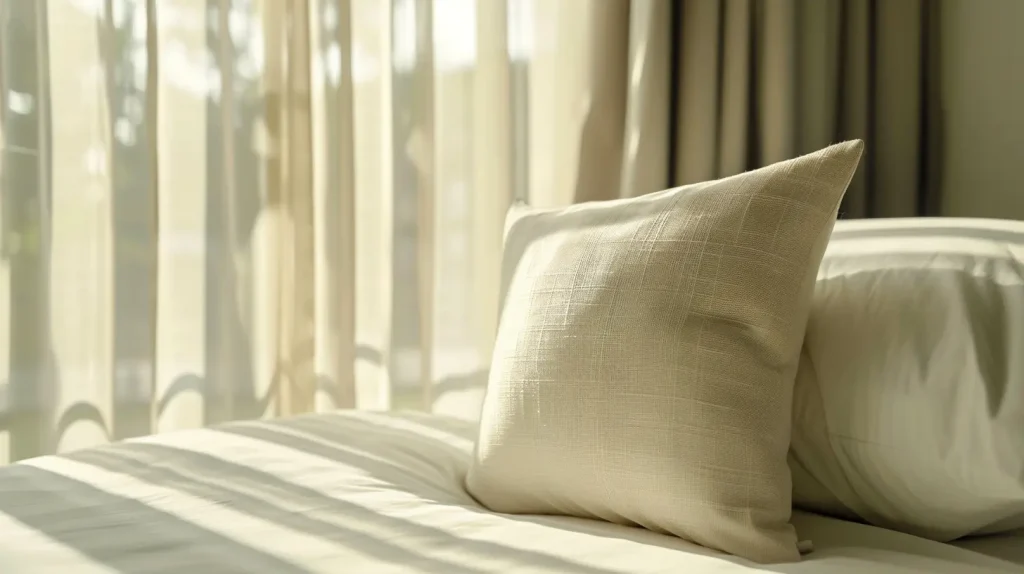
The most commonly used materials include:
- Memory foam – this is the most commonly used stuffing. It is relatively affordable, and many find it comfortable. However, memory foam is a type of plastic that may contain various chemicals, which can vary in toxicity depending on its production process.
- Bamboo fibers – occasionally, manufactures use bamboo fibers inside the pillow, but it is less common.
Bamboo Products Inherit Traits From The Plant
Living plants contain tiny holes (micropores) in their culms. These pores scattered amongst the fibers excel at extracting moisture from the air (hygroscopic), which, when used in fabrics, results in superior wicking abilities.

Moisture wicking is when sweat is pulled away (by capillary action) into these tiny holes, allowing the sleeper to remain cool without becoming too cold.
Sweat is the body’s natural mechanism for keeping cool; however, too much sweat accumulated might reduce the sleeper’s temperature too much, making sleep uncomfortable. Bamboo pillows allow the sleeper’s body to regulate without shifting to extremes (hot to cold) by removing this sweat.
Bamboo Pillows Are A Product Of Their Manufacturing
If you’ve looked at textiles made from these plants and wondered how hard grass becomes a soft fabric, you’re not alone! Once harvested, the plant parts (mostly the stems, called culms) are crushed into smaller fragments.
These fragments are treated with some chemicals like sodium hydroxide (NaOH) and carbon disulfide (CS2). The plant material is melted into a liquid mass, treated through several processes, and eventually exuded through spinnerets to form long strands (called filaments).
The chemicals break down the organic compounds that make the plant rigid through this process, producing a soft, smooth yarn spun into various fabrics.
Alternatively, bamboo is subjected to a mechanical process (crushing, shredding, pulping, grinding, etc.) followed by exposure to enzyme-rich baths, which break down the plant material into a usable form (similar to the chemical process, but without chemicals).
The resultant material is generally “harder,” and is considered a type of linen/fiber.

The type of weave plays a fundamental role in the fabric’s end properties.
There are 3 primary weaves used in making bamboo fabrics like pillows, including:
- Sateen – one of the most popular weaves- is soft, fits the body’s shape, and allows a significant amount of moisture wicking and breathability.
- Twill – another popular weave, is the “thickest” of weave styles, giving it the most durability. However, it is generally significantly less breathable.
- Percale – unfortunately, this weave is not as common as the other two; however, it produces the most breathable material and is excellent for hot sleepers.
Percale and sateen weaves provide sleepers with a softer, more breathable experience, while twill weaves are more durable and the least likely to misshapen.
The Health Benefits Of Bamboo Pillows
Although manufacturers make lofty claims about their product’s health benefits, the truth is there is too little evidence to substantiate most claims to be more than “they might have that effect.”
One of the significant “selling points” is bamboo pillows’ hypoallergenic properties.
Companies claim these pillows are less likely to cause an allergic reaction than other materials. While some evidence supports the hypoallergenic claims, it does not appear to be greater than cotton pillows/fabric.
Another factor is the antibacterial and antifungal characteristics. While alive, bamboo plants are confirmed to possess these traits; however, when put through the viscose/rayon process, these beneficial features are all but lost, resulting in end products with slight antimicrobial properties.
These antimicrobial properties, coupled with the known moisture-wicking abilities and the material’s breathability, produce pillows that draw moisture away from the sleeper while preventing the build-up of harmful microorganisms and bad odors.
What Are Some Of The Drawbacks Of Bamboo Pillows?
While many swear by bamboo pillows, they are not without some drawbacks, which include the following:
- Although moisture wicking is fantastic, the ability to absorb more water than other materials means that this bedding takes longer to dry.
- If you sweat significantly, the pillow absorbs much moisture, which may result in mold/bad odors.
- While the outer layer contains bamboo, the inner material plays the most important role in sleeper comfort (the stuffing influences breathability hard/softness and may hold excess moisture).
- They are not always machine washable. The outer cover of bamboo is machine washable, but the inner filling is not usually. Washing the outer cover by hand is also preferential to ensure its longevity.
- They tend to be heavier and stiffer, taking longer to adjust to your comfort.
- Harmful chemicals are used in the viscose/rayon process and memory foam, which can cause an allergic response.
Bamboo Vs. Cotton Pillows
Cotton is the most commonly used fabric for most bedding. It is “natural,” cool, breathable, and affordable.
There are many similarities between bamboo and cotton pillows, including the following:
- Although they are advertised as “cotton,” only the outer casing is often made from this plant-derived product. The inner is also frequently memory foam or another type of fill.
- Both materials are excellent at wicking moisture and are particularly cool and breathable.
- They are potentially equally hypoallergenic.
There are some significant differences between bamboo and cotton pillows, including:
- Cotton does not go through the harmful viscose process. It remains a “natural” product, although it is frequently dyed.
- Cotton pillows are significantly cheaper than bamboo.
- Bamboo is slightly better at wicking moisture.
Ultimately, personal preference is key when selecting a pillow.
Conclusion
Bamboo pillows are usually not made from 100% bamboo; however, they retain some of the beneficial traits of bamboo, including moisture wicking, breathability, and low levels of antimicrobial resilience. These pillows provide sleepers with a cool, comfortable night’s rest and are comparable to cotton in many ways. They are more expensive than standard cotton pillows but are better at moisture-wicking.