
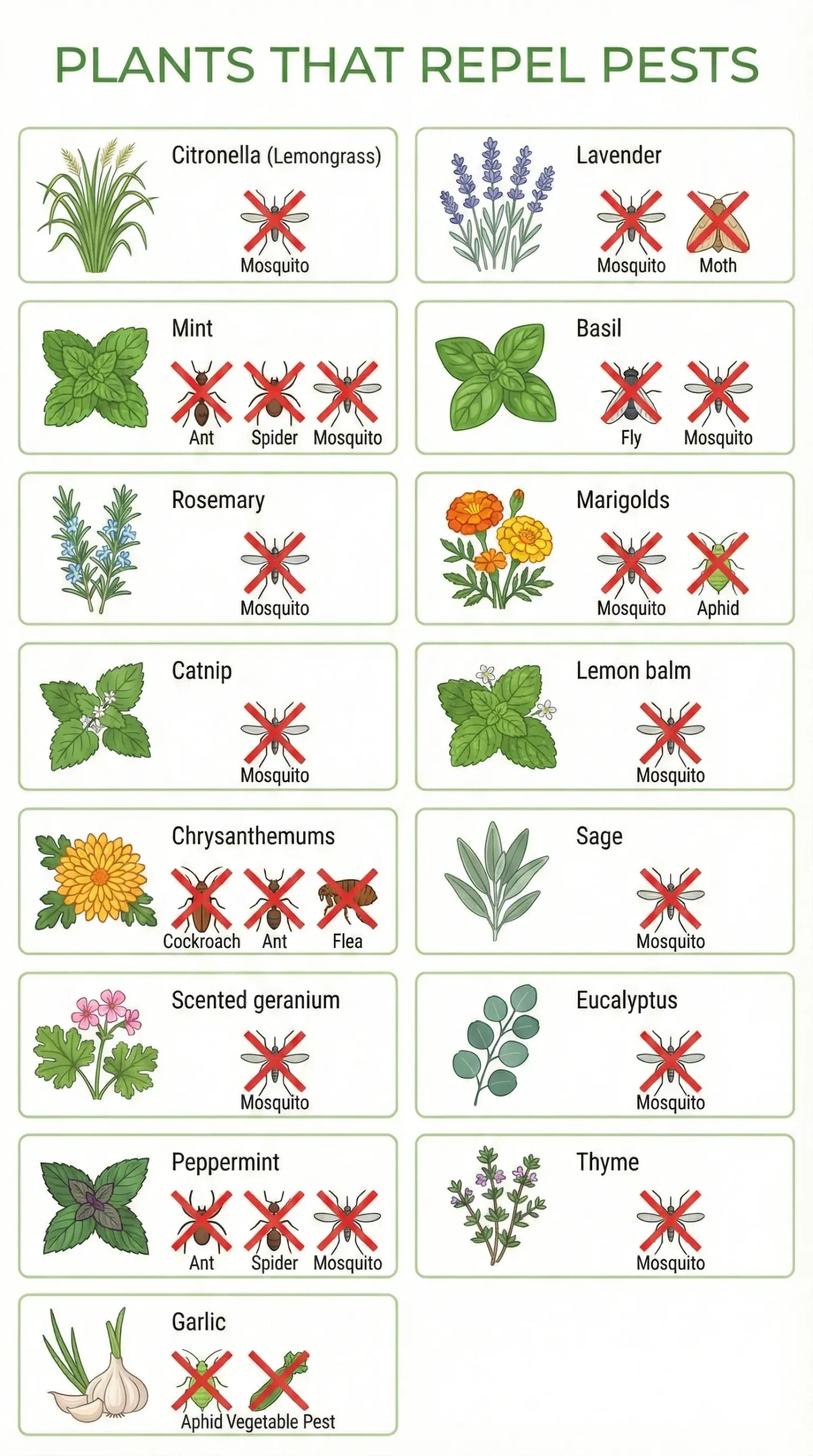
Most so called “insect repelling plants” only do something useful when their leaves are bruised or when you sit very close to them. They do not create an invisible shield around your yard. Still, some plants contain strong aromatic compounds that can reduce insect landings or make an area less attractive to pests.
Below is a practical list of 15 plants, what they repel, and how they are realistically useful.
1. Citronella Grass (True Citronella, Cymbopogon nardus / C. winterianus)
Citronella is the classic “mosquito plant.” The oil distilled from the grass is what goes into many citronella candles and sprays.
Repels.
- Mosquitoes
How it helps.
- Fresh leaves contain citronellal and citronellol, which interfere with mosquito host finding
- Potted clumps around seating areas slightly reduce mosquito activity, especially if you crush a few leaves before sitting down
Use tips.
- Grow in large pots, full sun, rich soil
- Cut and bruise leaves, then place them on the table or near your legs for stronger effect
2. Lemongrass (Cymbopogon citratus)
Related to citronella, with a strong lemon scent. Common in Asian cooking and also useful around patios.
Repels.
- Mosquitoes
- Some biting midges, to a lesser degree
How it helps.
- Contains citral and other volatile oils that confuse mosquito scent tracking
- Works best when leaves are crushed and placed close to skin or mixed into homemade sprays
Use tips.
- Plant in big containers near doors, decks, or patios
- Combine with a fan to spread the scent across a small sitting area
3. Lavender (Lavandula angustifolia and hybrids)
Lavender smells good to humans, but many insects dislike the scent.
Repels.
- Mosquitoes
- Clothes moths
- Some flies and fleas around entry areas
How it helps.
- Essential oils such as linalool and linalyl acetate have repellent properties
- Dried lavender sachets help deter moths in closets
- Potted lavender near doorways slightly reduces flies and mosquitoes
Use tips.
- Full sun, well drained soil
- Harvest flowers, dry them, and use in closets and drawers
4. Basil (Ocimum basilicum)
Basil is more than a kitchen herb. The strong scent annoys several flying insects.
Repels.
- Houseflies
- Mosquitoes
- Some gnats
How it helps.
- Volatile compounds like eugenol and linalool interfere with insect olfactory receptors
- Growing basil on a windowsill or outdoor table can cut down on flies hovering over food
Use tips.
- Keep pots on outdoor dining tables and near kitchen doors
- Rub a leaf on exposed skin for short term mosquito annoyance reduction
5. Peppermint (Mentha × piperita)
Peppermint is harsh on many small insects and even on some larger pests.
Repels.
- Ants
- Spiders
- Mosquitoes
- Certain beetles
How it helps.
- Menthol and menthone are irritating to many insects
- Strong peppermint aroma near cracks and door frames discourages ants and spiders from using those routes
Use tips.
- Grow in pots only, never directly in beds, or it will spread aggressively
- Place pots by doors, steps, and problem corners, crush a few leaves for stronger scent
6. Rosemary (Rosmarinus officinalis / Salvia rosmarinus)
Rosemary acts as a mild repellent and is also good for cooking and edging beds.
Repels.
- Mosquitoes
- Some flies
- Cabbage moths near vegetable beds
How it helps.
- Aromatic oils have moderate repellent effect against biting insects
- When burned on a grill or fire pit it produces smoke that mosquitoes dislike
Use tips.
- Plant in sunny, dry spots or in large pots
- Toss a few sprigs into the grill or small fire near your seating area
7. Sage (Salvia officinalis)
Sage in the soil does very little on its own. Sage in the fire is another story.
Repels.
- Mosquitoes, mainly when burned
- Some flies and gnats in smoke
How it helps.
- Burning sage releases a complex smoke that mosquitoes avoid
- A bundle of dried sage added to a campfire or fire pit improves local comfort
Use tips.
- Grow in a sunny herb bed, then dry stems
- Burn small handfuls in a safe fire container when you are outside
8. Catnip (Nepeta cataria)
Catnip is one of the most studied plant based mosquito repellents. It is also cat entertainment.
Repels.
- Mosquitoes
- To some degree, cockroaches and certain flies
How it helps.
- Contains nepetalactone, which has been shown in lab tests to repel mosquitoes with strength comparable to some synthetic repellents over short periods
- Works best when used as an extracted oil or heavily bruised foliage, not just sitting in a pot far away
Use tips.
- Grow in a contained part of the garden, it self seeds aggressively
- Remember, neighborhood cats may roll in it and crush it for you
9. Lemon Balm (Melissa officinalis)
A member of the mint family with a bright lemon scent.
Repels.
- Mosquitoes
How it helps.
- Contains citronellal and related compounds, which disturb mosquito host seeking
- Fresh leaves rubbed on skin give a temporary light repellent effect
Use tips.
- Another plant that should be in pots to control spreading
- Position near doors and seating, trim often to keep the scent strong
10. Marigolds (Tagetes species)
Marigolds are often used in vegetable gardens as companion plants.
Repels.
- Aphids
- Whiteflies
- Nematodes in soil around roots
- Mild effect on mosquitoes near dense plantings
How it helps.
- Pungent odor deters some sap sucking insects
- Certain species release compounds from roots that affect soil nematodes
Use tips.
- Plant as borders around tomatoes, peppers, and other vegetables
- Use near greenhouse vents or doors to make the entry slightly less attractive to pests
11. Chrysanthemums (Chrysanthemum / Tanacetum cinerariifolium)
The source of natural pyrethrum insecticides.
Repels and kills.
- Fleas
- Ticks
- Lice
- Roaches
- Ants
- Many garden pests
How it helps.
- Flowers contain pyrethrins, which act on insect nervous systems
- In the garden, living plants mainly deter some pests near the foliage. For strong effect, the flowers must be dried and processed into sprays or powders
Use tips.
- Grow in sunny beds, then harvest flowers for homemade, carefully diluted preparations if you know what you are doing
- Keep pets and children away from concentrated pyrethrum products
12. Scented Geraniums (Citronella Geranium, Pelargonium citrosum and relatives)
Often sold as “mosquito plants.” They are not magic, but they are not useless either.
Repels.
- Mosquitoes, at close range
- Some flies
How it helps.
- Leaves release citronella like scent when touched, which provides mild local mosquito annoyance
- Good near windows, on patios, or in table pots
Use tips.
- Treat like a decorative plant that also brings minor repellent benefit
- Pinch or bruise leaves before spending time near it
13. Eucalyptus (various Eucalyptus species)
Not practical as a small patio plant in most climates, but worth mentioning since its oil is widely used.
Repels.
- Mosquitoes
- Some biting flies and ticks, especially in oil form
How it helps.
- Essential oil known as oil of lemon eucalyptus is one of the few plant derived repellents approved in many regions for real mosquito protection when used on skin
- As a living tree, the effect is limited to slight scent in the immediate area
Use tips.
- Realistically, you use eucalyptus through commercial or DIY diluted oil repellents, not by planting a tree next to your chair
- Never apply undiluted oil directly to skin
14. Thyme and Lemon Thyme (Thymus vulgaris, Thymus × citriodorus)
Low growing herbs that work better as burned or crushed foliage than as static bedding plants.
Repels.
- Mosquitoes
- Some vegetable pests around beds
How it helps.
- Oils in thyme foliage have documented mosquito repellent activity
- Burning sprigs or placing large handfuls of bruised thyme near you creates a stronger protective bubble
Use tips.
- Plant as edging in sunny, dry spots, then harvest as needed
- For campsites or patios, throw thyme sprigs onto a hot grill or into a small fire bowl
15. Garlic (Allium sativum)
Garlic is mainly a garden pest repellent, not something that protects your skin.
Repels.
- Aphids
- Some beetles
- Certain leaf miners and caterpillars
- Possibly mosquitoes when used as a strong spray or in very high local concentration
How it helps.
- Strong sulfur compounds make plant sap and foliage less appealing to soft bodied insects when garlic based sprays are used
- Growing garlic near susceptible plants can reduce some pest pressure in mixed beds
Use tips.
- Plant garlic around roses, fruit trees, and some vegetables as a companion crop
- Use homemade garlic sprays cautiously, since they can also irritate plant leaves in heat
How “Repelling Plants” Really Work. And Their Limits
Before you write unrealistic promises, be clear about what these plants can and cannot do.
- They do not replace proper repellents on skin in high mosquito or tick areas
- They can make a small patio, doorway, or seating area less attractive when used densely
- They work best when leaves are crushed, bruised, or burned, which releases much more scent than passive growing
- Most effects are short range and short duration, measured in minutes to a couple of hours around the plant or foliage
For honest content, treat these plants as helpers. Combine them with screens, fans, physical barriers, and if necessary, approved repellent products.
Quick Summary Table
| Plant | Main insects repelled | Best usage mode |
|---|---|---|
| Citronella grass | Mosquitoes | Potted near seating, leaves bruised |
| Lemongrass | Mosquitoes, some midges | Pots, DIY sprays |
| Lavender | Mosquitoes, moths, some flies | Borders, dried sachets |
| Basil | Houseflies, mosquitoes | Table pots, near doors |
| Peppermint | Ants, spiders, mosquitoes | Pots by entries, crushed leaves |
| Rosemary | Mosquitoes, some flies | Pots, on grill or fire |
| Sage | Mosquitoes, gnats (in smoke) | Burned bundles |
| Catnip | Mosquitoes, some flies | Beds or pots, bruised foliage |
| Lemon balm | Mosquitoes | Pots, rubbed on skin briefly |
| Marigolds | Aphids, whiteflies, some nematodes | Vegetable borders |
| Chrysanthemums | Fleas, ticks, roaches, ants, many pests | Flowers for pyrethrum products |
| Scented geraniums | Mosquitoes, some flies | Patio pots, bruised leaves |
| Eucalyptus | Mosquitoes, some biting flies and ticks (as oil) | Processed oil repellents |
| Thyme, lemon thyme | Mosquitoes, some garden pests | Edging, burned or bruised sprigs |
| Garlic | Aphids, some beetles, various garden pests | Companion planting, garlic sprays |