
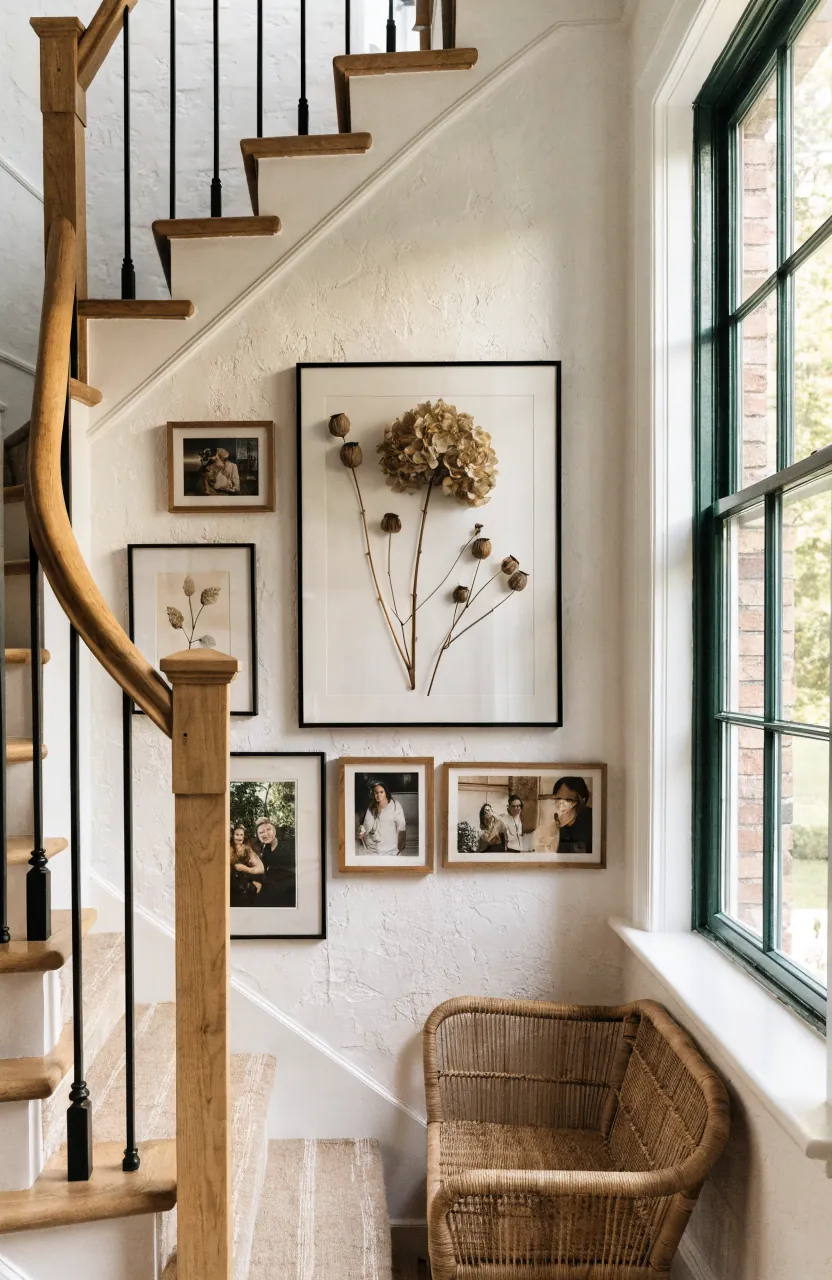
A blank stair landing has a strange way of making the rest of the house feel unfinished. It is not a room, but you see it every day. It is not usually wide enough for much furniture, but if the wall stays empty, the whole stairwell can feel like a pass-through instead of part of the home.
The best gallery wall ideas for a blank stair landing solve that awkwardness first. They do not just add more frames. They use scale, spacing, light, and sightlines so the landing feels intentional from the entry, the hallway, and the stairs.
Use these ideas as a design menu. Pick the layout that fits your wall shape, then tighten it with the hanging rules near the end.
Start With the Landing’s Job, Not the Frames
Before choosing wall art, decide what the landing should do visually. Some landings need a warm pause between two floors. Some need color because the stairwell is all white paint and railings. Some need one strong focal point because the wall is visible from the front door.
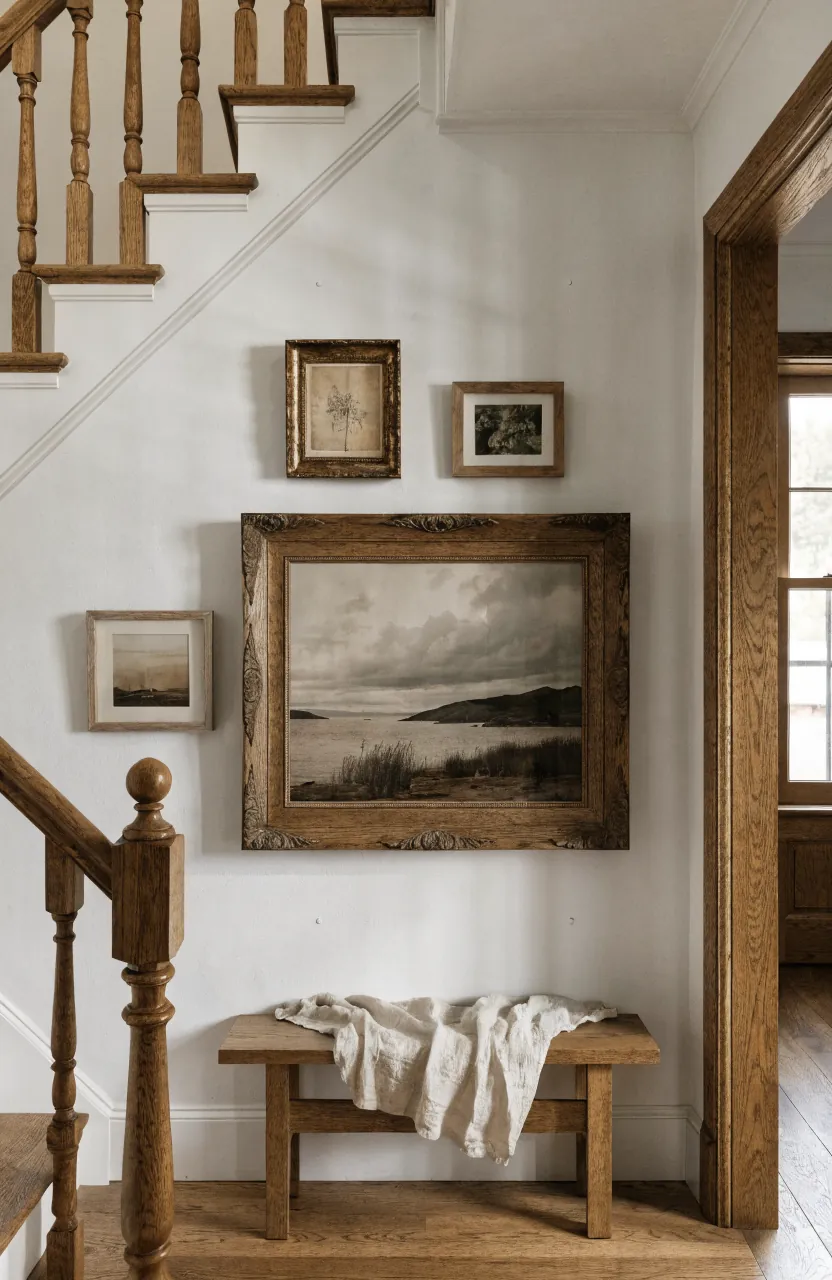
If the landing is visible from the entryway, treat the gallery wall like a first impression. Use one larger anchor piece at eye level and build around it. If the landing is only seen as you climb the stairs, a rising arrangement can feel more natural. If the landing is narrow or busy, fewer larger frames may look more expensive than a crowded frame wall.
A good starting point is one clear design sentence: “This landing will be a family photo wall,” “This landing will be a calm botanical wall,” or “This landing will add color to a white stairwell.” That sentence prevents the common mistake of mixing every leftover print in the house and hoping it becomes a plan.
Choose a Shape That Fits the Wall You Actually Have
The shape of the wall should decide the shape of the gallery. A square landing wall usually wants a grid, a tall narrow wall usually wants vertical movement, and a long stair wall usually wants a composition that follows the stair angle.
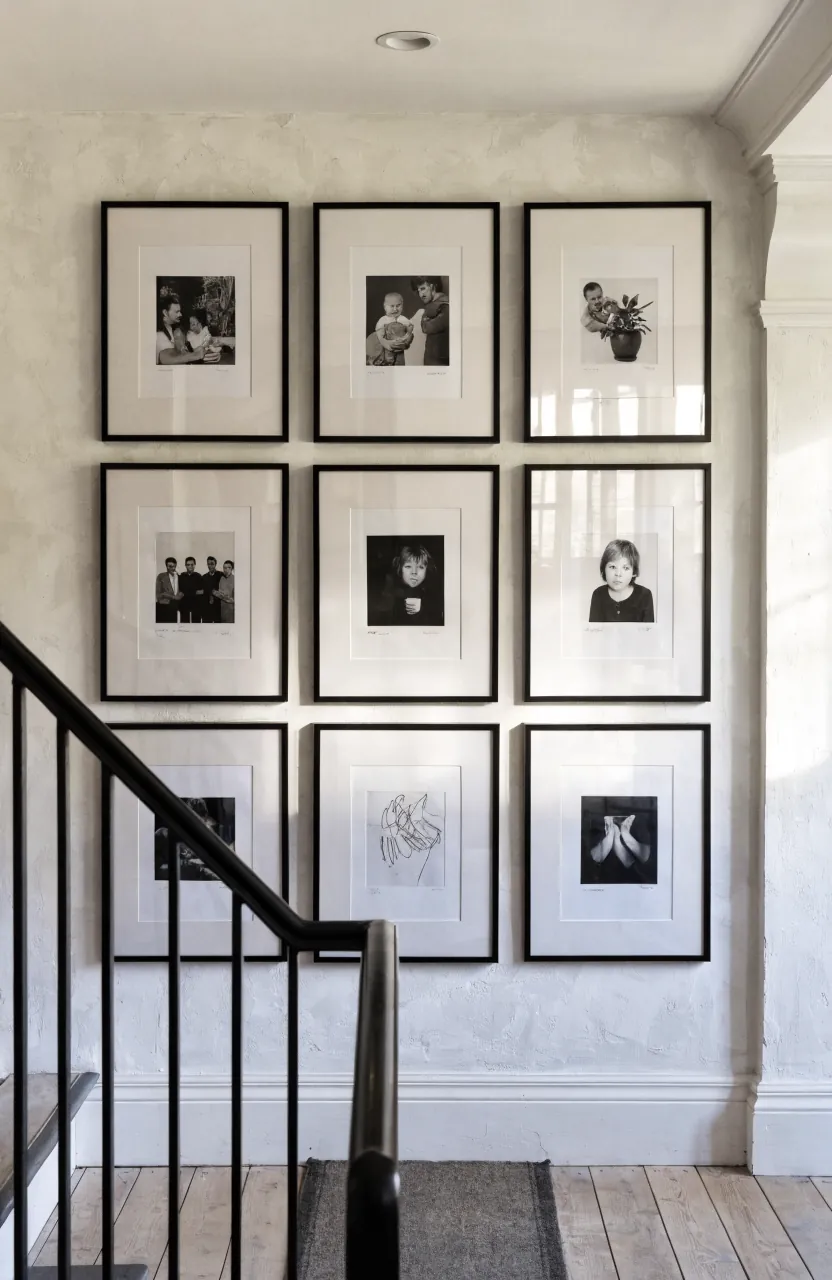
- Square or rectangular landing wall: Try a 2-by-2, 2-by-3, or 3-by-3 grid with matching frames. This is the cleanest choice when you want hallway decor that feels calm and ordered.
- Tall blank wall: Use one oversized piece, a vertical stack of three frames, or a gallery wall with a larger bottom anchor and smaller pieces above it.
- Wall that turns a corner: Let the gallery wrap lightly around the corner, but keep the frames closest to the turn simple so the space does not feel visually cramped.
- Stairway plus landing wall: Start the frame wall on the stair run, then let one larger piece land at the flat landing as the visual finish.
For a polished look, keep one thing consistent even if everything else varies. That could be all black frames, all wood frames, black-and-white photos, similar mat widths, or a repeated art theme. Consistency is what turns a collection into interior styling.
Use a Rising Centerline So the Wall Does Not Look Crooked
A stairway gallery wall looks wrong when the frames fight the angle of the stairs. The fix is to imagine a diagonal centerline that rises with the stair treads. The centers of your main frames should sit near that line, even when the frames are different sizes.
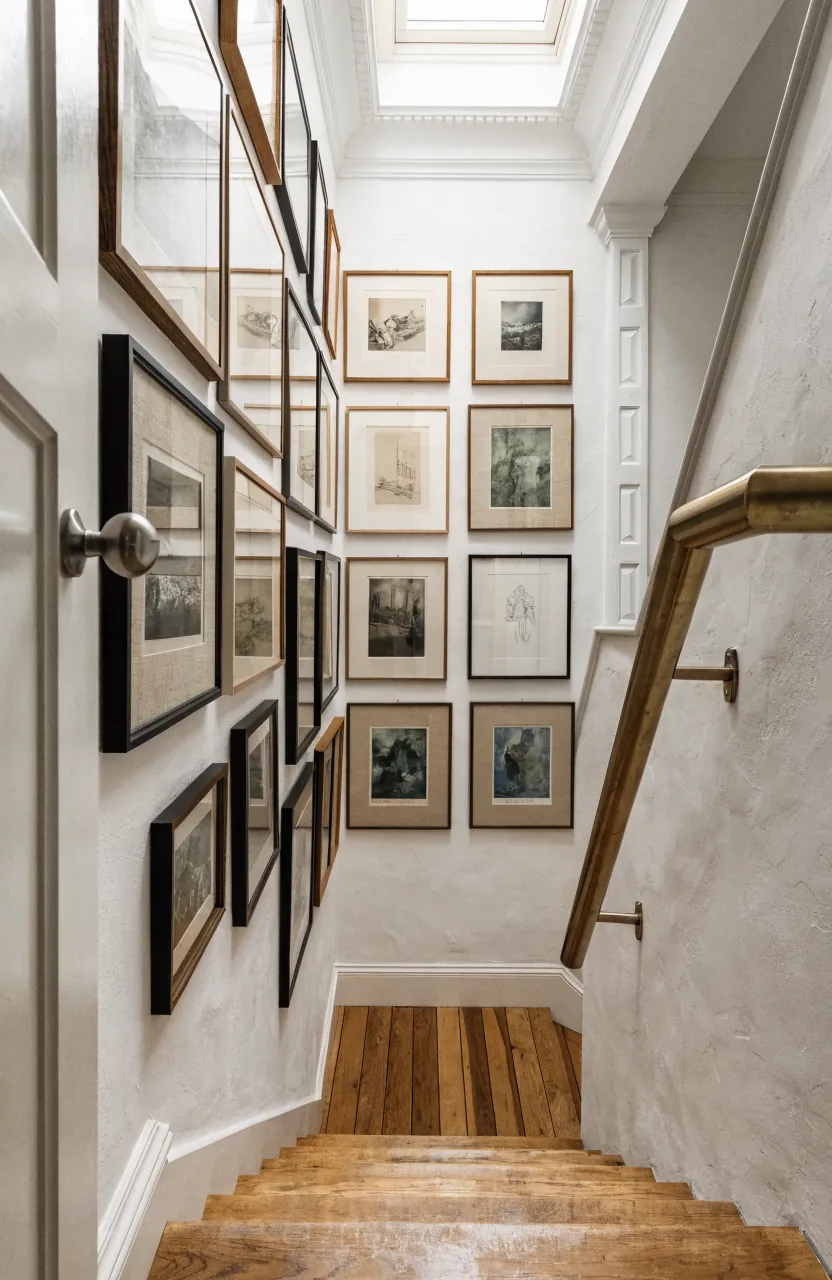
For most gallery wall layouts, 2-3 inches between frames is a practical gap. Larger frames can handle a little more breathing room, but random spacing is what makes a wall feel chaotic. On stairs, judge the visual gap between frame edges, not just the measurement from nail to nail.
Start with the largest or most important frame. Place it where the landing naturally catches your eye, then work outward. This keeps the wall from drifting too high, which is one of the fastest ways to make a stair landing decor idea feel disconnected from the people walking through it.
Make the Landing Feel Finished With More Than Frames
Reddit decorating threads about stairwells repeat the same pain points: the wall feels blank, the light fixture feels wrong, and the landing needs personality without getting in the way. That is why the strongest frame wall ideas usually include one or two supporting elements.
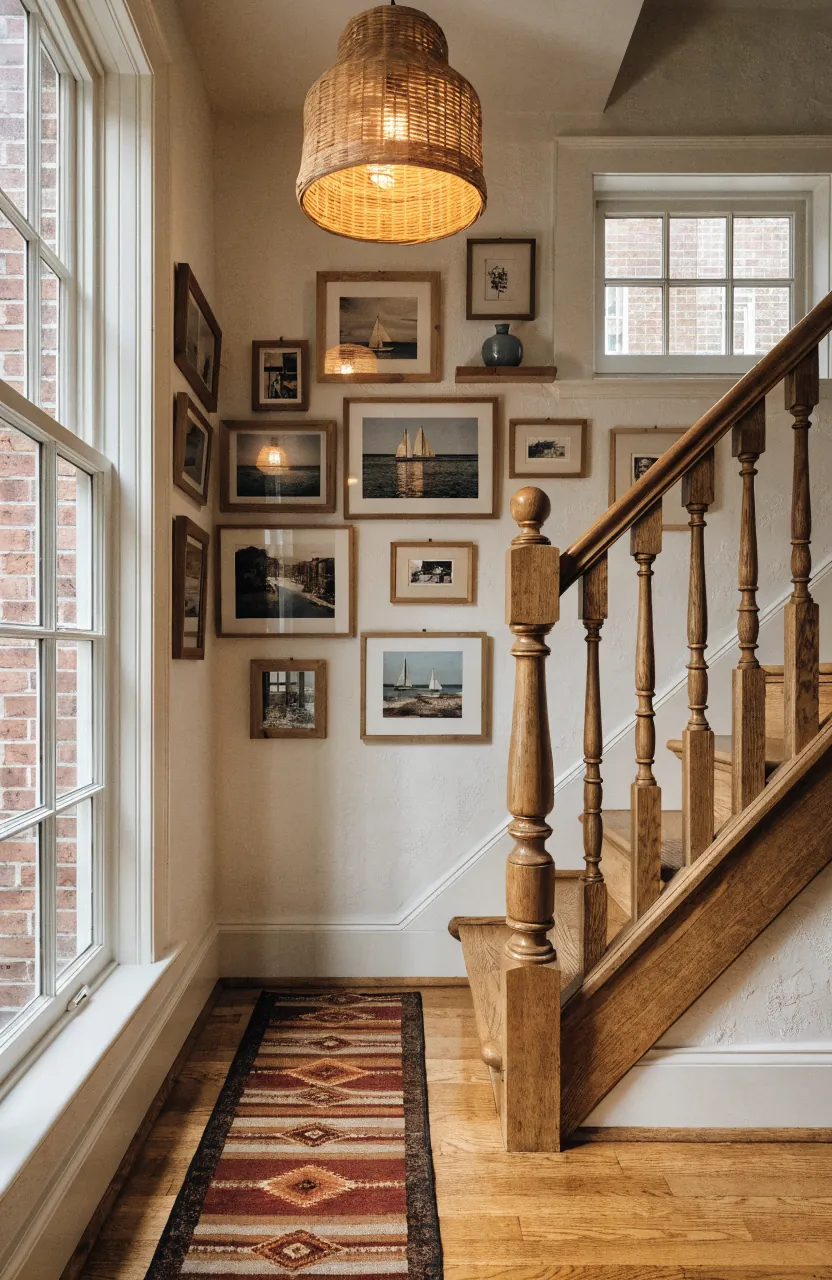
A warm pendant, a runner rug, a small bench, a slim picture light, or a woven accent can make the gallery wall feel like part of a designed hallway instead of a patch on a blank wall. Keep anything on the landing shallow and secure. Stairs are high-traffic areas, so the wall can be expressive while the walking path stays clear.
If your stairwell has cool white walls, use the gallery wall to bring in warmth: oak frames, brass picture lights, sepia family photos, muted landscapes, woven texture, or art with earthy color. If the stairwell is already dark, avoid filling the wall with too many heavy black frames. Use mats, pale frames, and lighter artwork so the landing still breathes.
Try These Gallery Wall Ideas for a Blank Stair Landing
Once the shape and mood are clear, the actual gallery wall becomes easier. These ideas work especially well on stair landings because they have a strong organizing rule.
- The quiet family wall: Print family photos in black and white, use matching mats, and vary frame sizes just enough to avoid a stiff grid.
- The botanical landing: Mix pressed-flower prints, fern studies, small landscapes, and wood frames for a natural home decor look.
- The travel memory wall: Use maps, tickets, small city photographs, and one larger destination print as the anchor.
- The mirror and art mix: Add one brass or wood mirror among framed pieces to bounce light through a dark hallway.
- The vintage collected wall: Combine oil-style prints, small portraits, landscapes, and mismatched frames, but repeat one color so it feels intentional.
- The landing grid: Use six or nine matching frames for a clean frame wall that works with modern railings and simple hallway decor.
- The oversized trio: Hang three large pieces in an ascending rhythm when the landing is too narrow for many small frames.
The trick is restraint. A gallery wall does not have to fill every inch. Negative space can make the art feel more deliberate, especially on a landing where people view the wall from several angles.
Avoid the Mistakes That Make a Stairway Gallery Wall Feel Chaotic
The most common stairway gallery wall mistake is hanging first and planning later. Stairs exaggerate small errors. A frame that is slightly too high, a gap that changes from 2 inches to 6 inches, or a layout that ignores the handrail can look off from the bottom of the stairs.
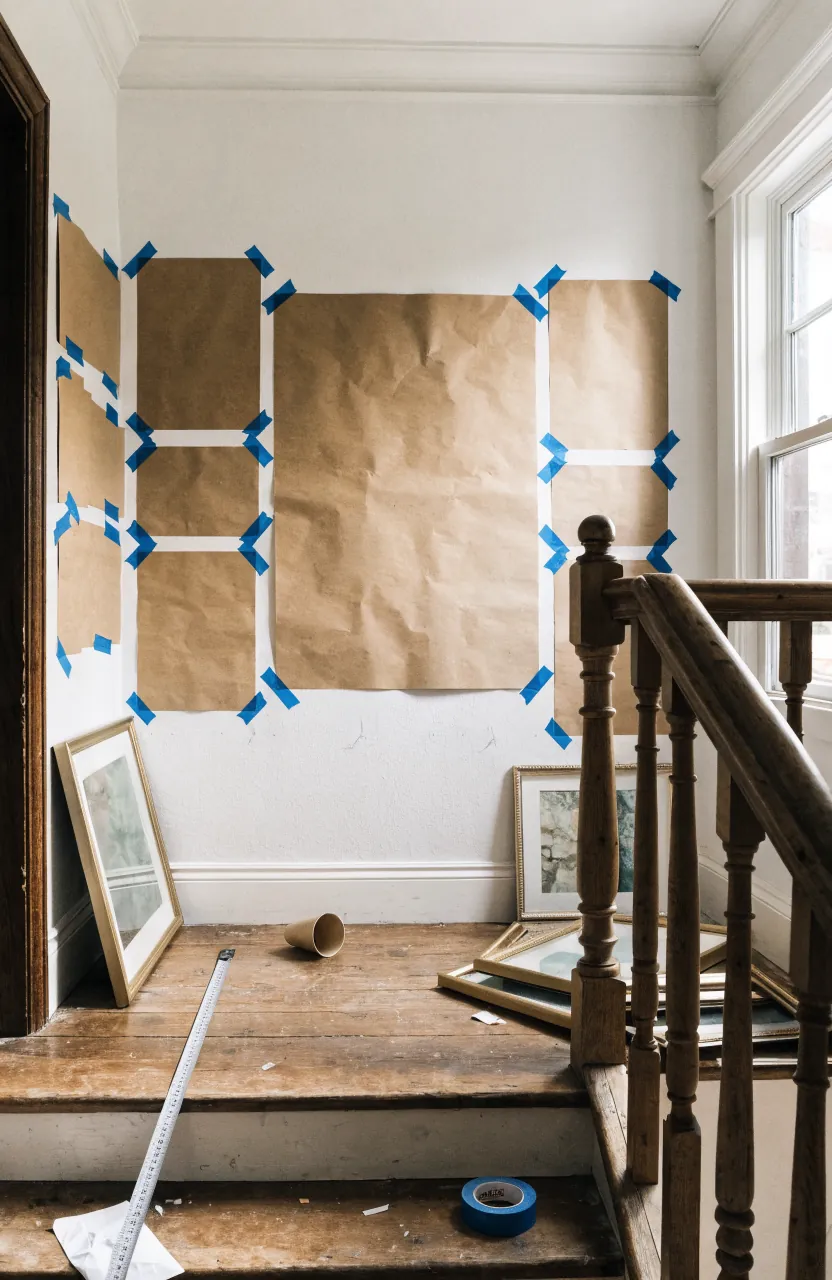
Cut paper templates for every frame and tape them to the wall before making holes. Live with the arrangement for a day if you can. Walk up the stairs, stand at the bottom, look from the hallway, and check whether the layout still feels balanced from each view.
- Do not hang small frames too far apart; they will feel scattered.
- Do not place delicate pieces where shoulders, bags, or hands will hit them.
- Do not water hanging plants above framed art unless the plants can be removed safely for watering.
- Do not force a gallery wall where one large piece would look cleaner.
- Do not ignore vents, switches, thermostats, or awkward trim. Either give them breathing room or make the layout clearly work around them.
When a Full Gallery Wall Is Too Much, Go Larger and Quieter
Not every blank wall needs a dense gallery wall. If the landing is tight, the railing is visually busy, or the wall sits in a high-traffic path, three large frames can be stronger than fifteen small ones.
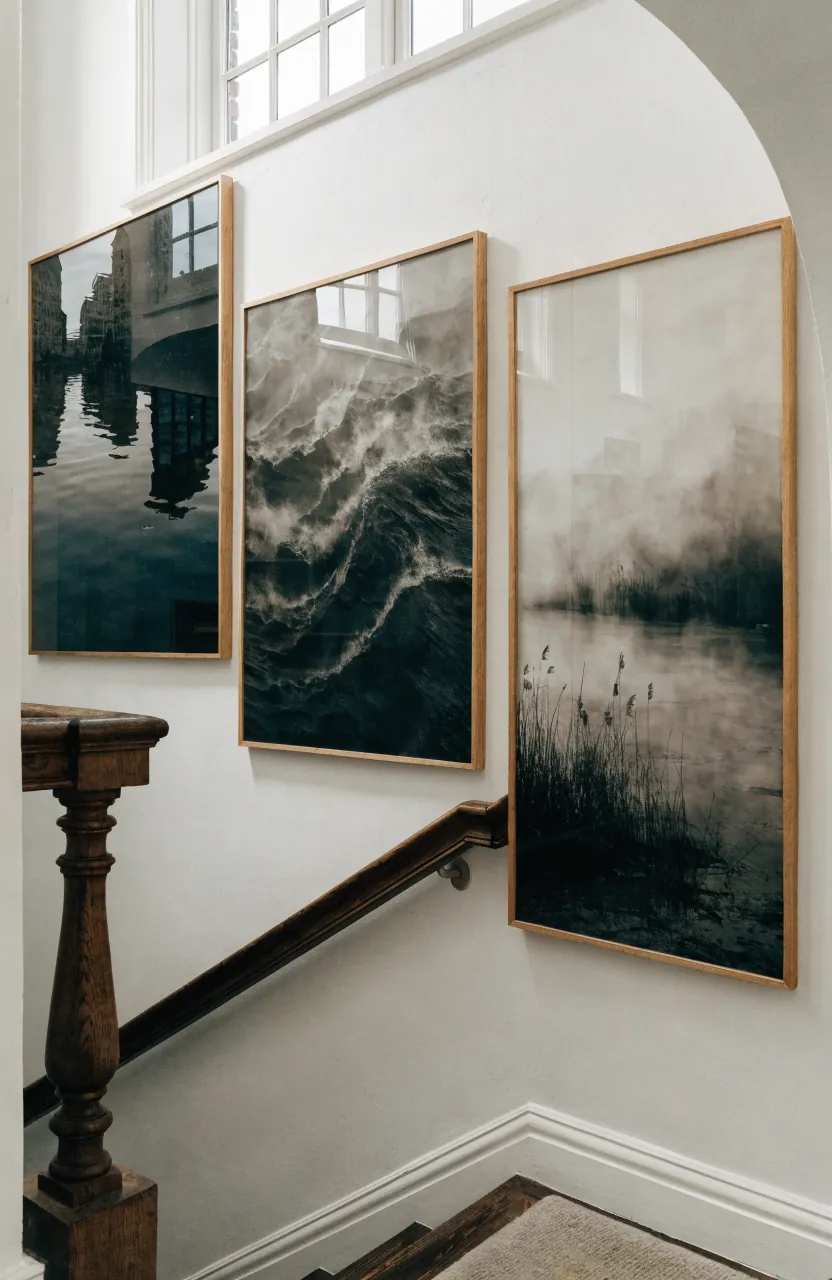
This approach works well with abstract landscapes, oversized family portraits, black-and-white photography, or a matched set of prints. Hang the middle piece first, then let the other two step up or down with the stairs. The result still gives you wall decor and personality, but the landing stays calm.
A Simple Weekend Plan
On Friday night, gather every frame, print, photo, and mirror you might use. Remove anything that does not support the mood you chose for the landing. On Saturday, choose the anchor piece, cut paper templates, and tape the full layout to the wall. On Sunday, hang from the anchor outward, checking the view from the stairs after every few frames.
The goal is not to cover a blank stair landing as quickly as possible. The goal is to make a small transitional wall feel like it belongs to the rest of the home. When the spacing is steady, the sightlines are considered, and the frame wall has one clear story, even an awkward landing can become one of the most personal parts of the house.