
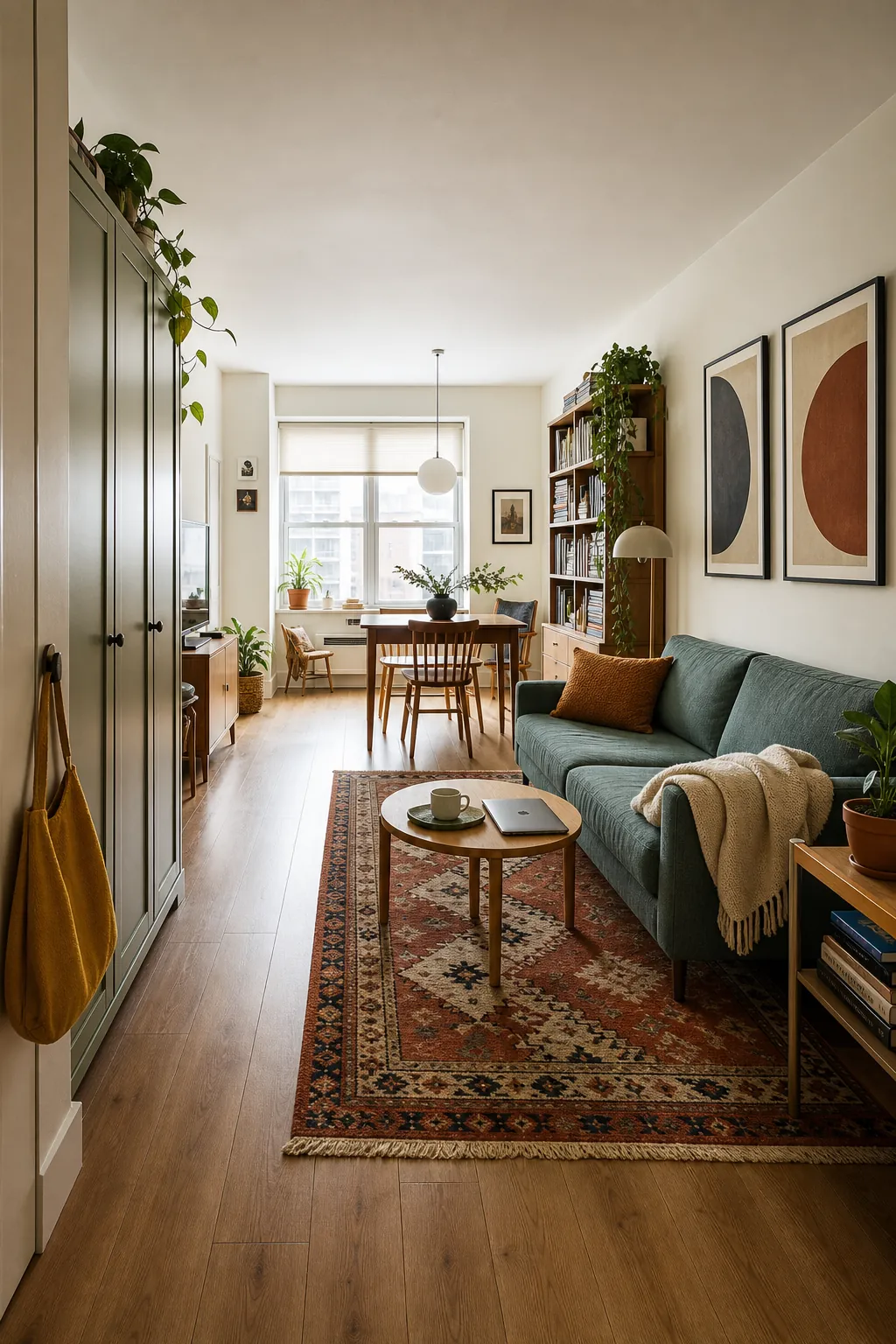
A small apartment does not feel cramped simply because it contains books, color, art, or a well-loved collection. It feels cramped when your body cannot move easily and your eyes cannot tell what matters. That distinction is useful because it means you do not have to strip the room of personality to make it feel more spacious.
The better goal is visual order rather than visual emptiness. Give everyday objects a home, protect the main sightlines, and let a few deliberate moments carry the character of the room. You can keep the patterned rug, the gallery wall, the plants, and the stack of novels—as long as they work with the apartment instead of interrupting it.
This approach is especially practical for renters. It relies on furniture placement, lighting, textiles, closed storage, and removable displays rather than renovation. Start with how the apartment functions on an ordinary Tuesday, not how it looks for a photograph.
Make the Main Walking Route Impossible to Miss
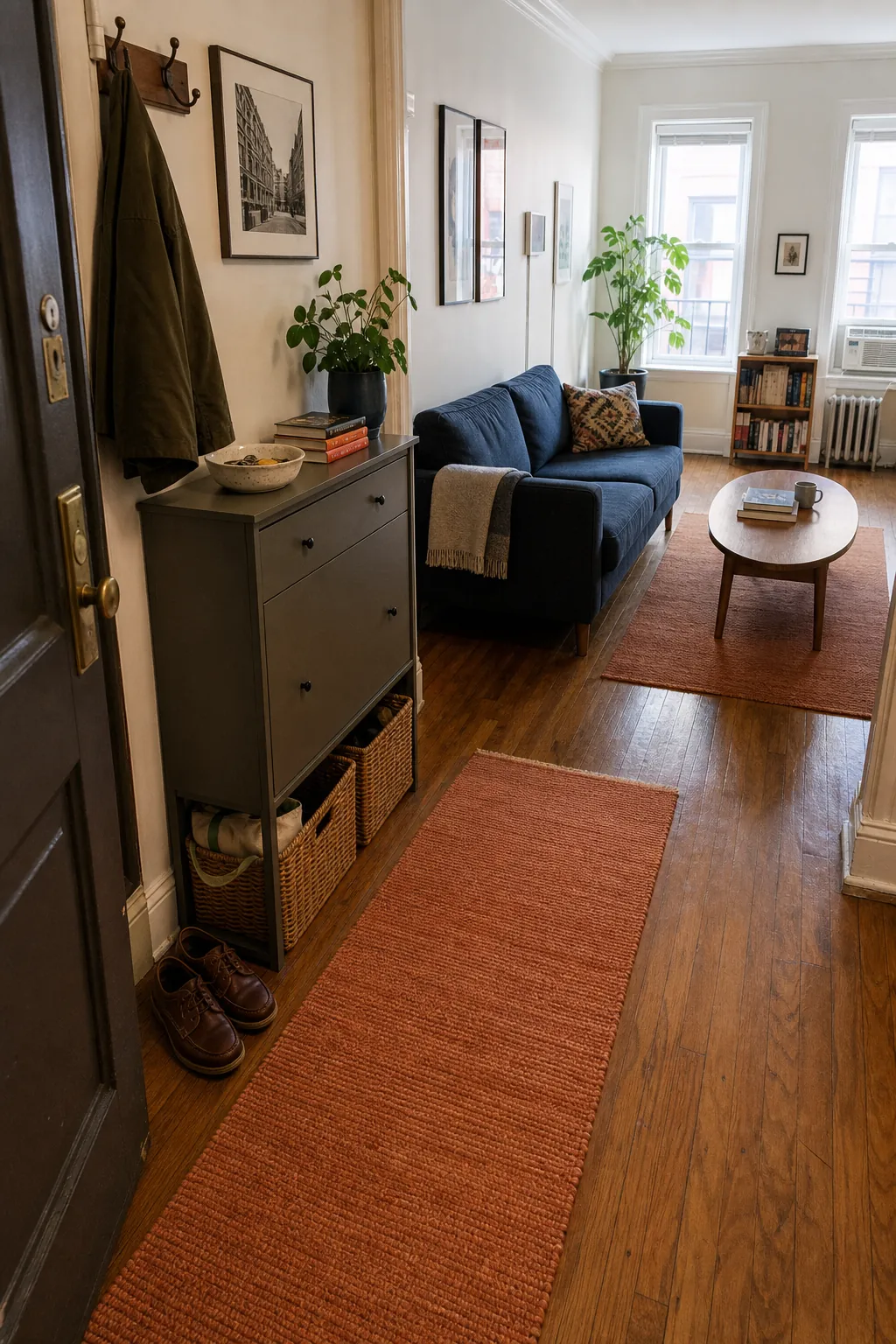
Before buying a mirror or another storage basket, trace the route you use most: front door to sofa, sofa to kitchen, bed to bathroom. If that route bends around a side table, clips the corner of a rug, or squeezes between a chair and a cabinet, the entire apartment will feel harder to navigate.
A clear path creates spaciousness you can feel, not just see. Test it while carrying a laundry basket or two grocery bags. Those ordinary movements reveal pinch points that are easy to overlook when you are standing still.
- Move occasional furniture out of the route, even if it looks balanced in a floor plan.
- Turn the narrow side of a table toward the path.
- Keep rug edges out of door swings and walking lines.
- Give bags, shoes, and delivery boxes a landing spot near the entrance.
You do not need every wall to remain visible. You need one or two strong routes that stay open every day.
Create Zones Without Building Visual Barriers
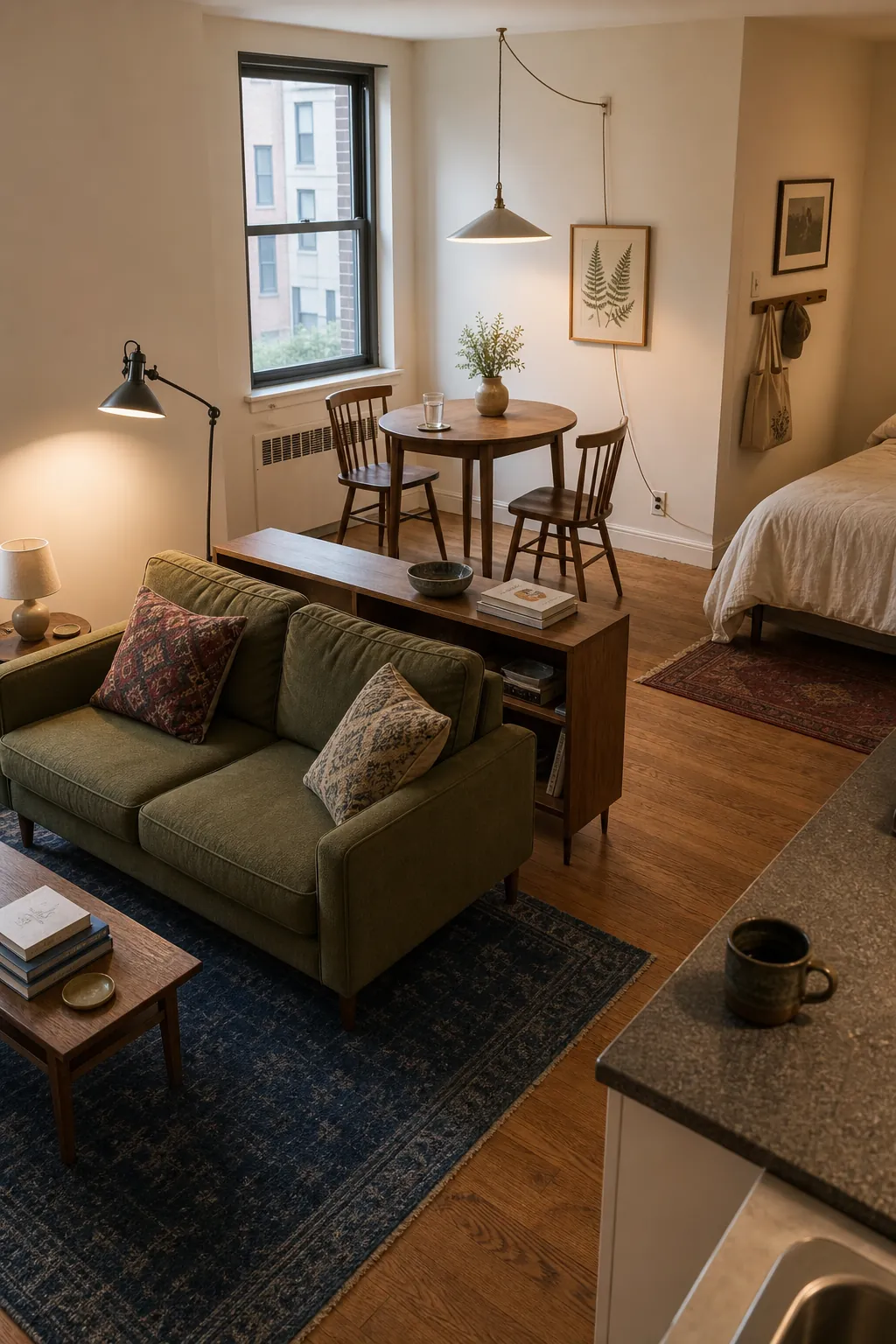
A studio often feels smaller when the bed, desk, dining table, and sofa appear to float as unrelated islands. Zoning solves that confusion, but tall dividers can replace one open room with several cramped boxes. Use low, readable boundaries instead.
Let the front legs of the sofa and chair sit on one rug to define the living area. Place a pendant-style plug-in light over the dining table or a focused lamp beside the desk. A narrow console behind the sofa can mark an edge while keeping the view above it open.
Each zone should have one job and one visual anchor. A rug can anchor conversation, a lamp can anchor reading, and a piece of art can anchor the dining corner. When a single object tries to define two or three zones, the layout starts to look accidental.
Choose Furniture by Visual Weight, Not Size Alone
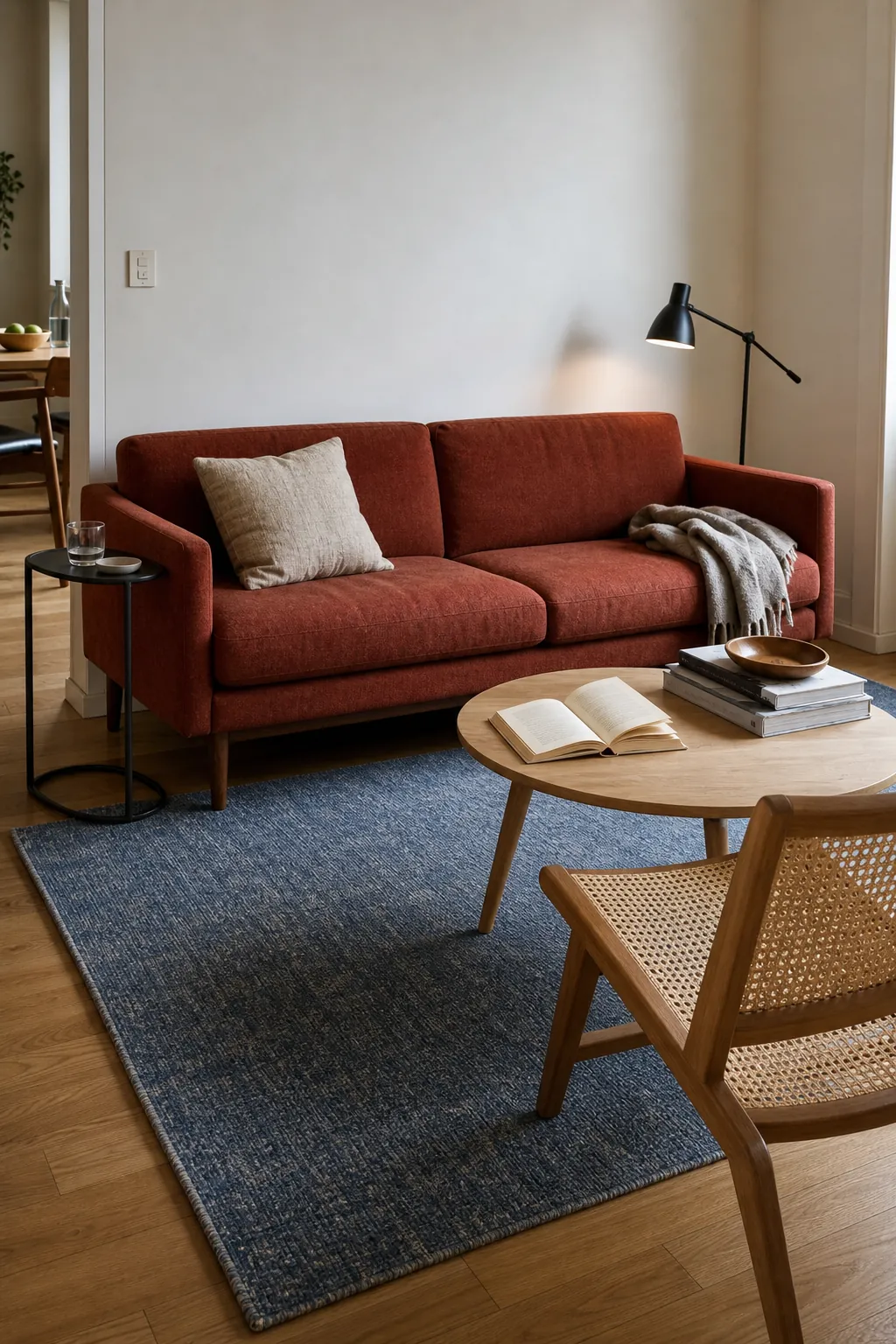
The smallest furniture is not automatically the best furniture. A tiny sofa with bulky rolled arms may consume more visual space than a longer sofa with a low back and slim arms. A solid cube side table can feel heavier than a slightly wider table with an open base.
Look at three things together: the floor area a piece occupies, the amount of wall it blocks, and how much light can travel around or beneath it. Furniture with visible legs, open sides, rounded corners, or lower profiles often lets the room breathe. Use that lightness selectively; an apartment filled entirely with spindly pieces can feel unsettled.
Before ordering, mark the footprint on the floor with painter’s tape and stack boxes to the proposed height. Walk past it, open nearby doors, and sit where you normally sit. Measurements tell you whether a piece fits; a full-size mock-up tells you whether it dominates.
Keep Everyday Storage Quiet at Eye Level
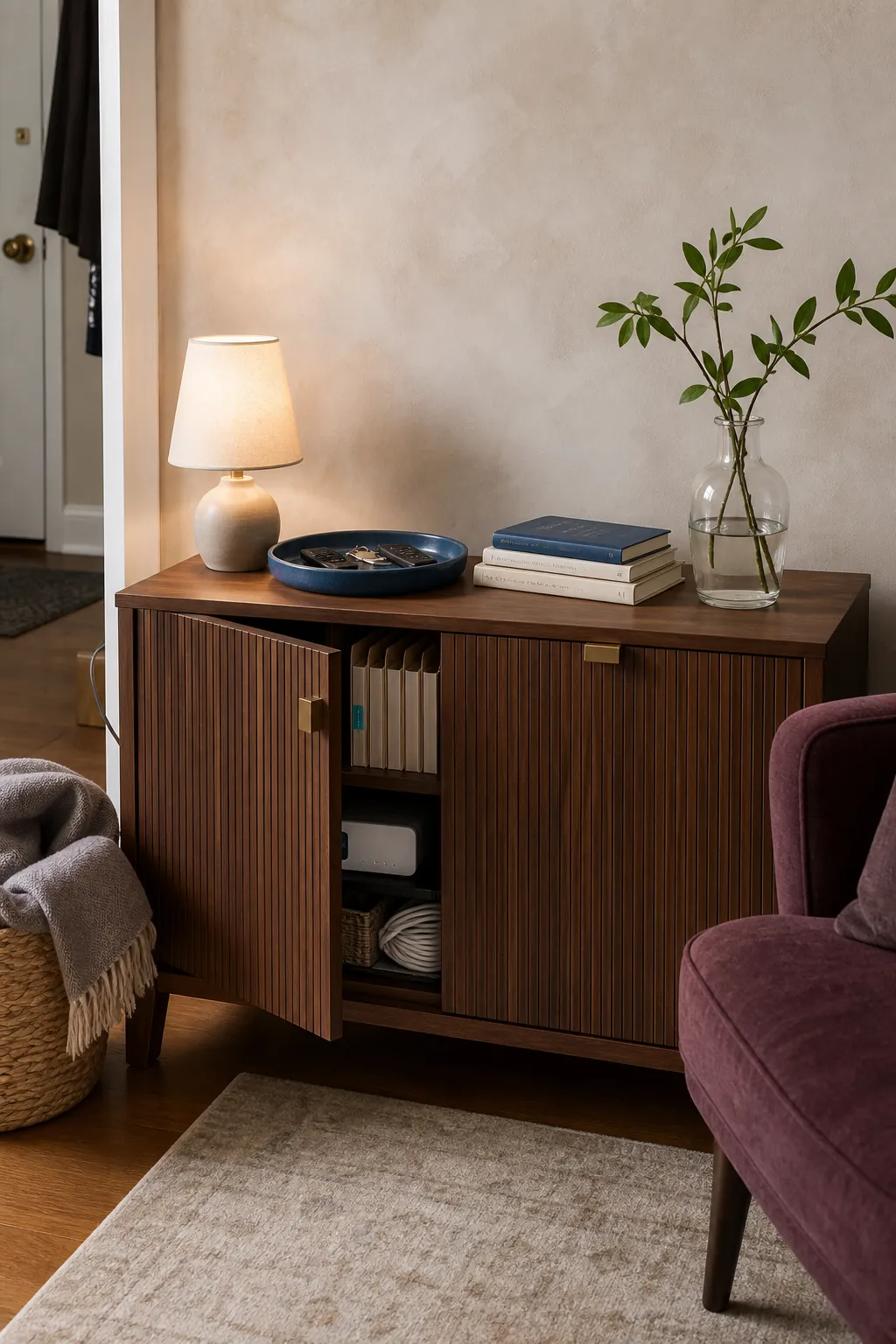
Open shelving is useful, but it asks every practical object to become part of the decor. Charging cables, spare toiletries, paperwork, game controllers, and cleaning supplies rarely cooperate. When too many daily-use items remain visible, the eye keeps stopping to process them.
Put high-frequency clutter behind doors or inside drawers, especially from waist to eye level. A low cabinet can hold technology and paperwork while its top supports one lamp, one tray, and a small group of objects you actually want to see. Matching containers can help inside a cabinet, but buying more bins is not a substitute for deciding what belongs there.
Closed storage should shorten the daily reset. If returning an item requires moving three other things or lifting a heavy lid, it will live on the nearest surface instead. The best storage position is usually where the object is used.
Use Height in One Deliberate Move
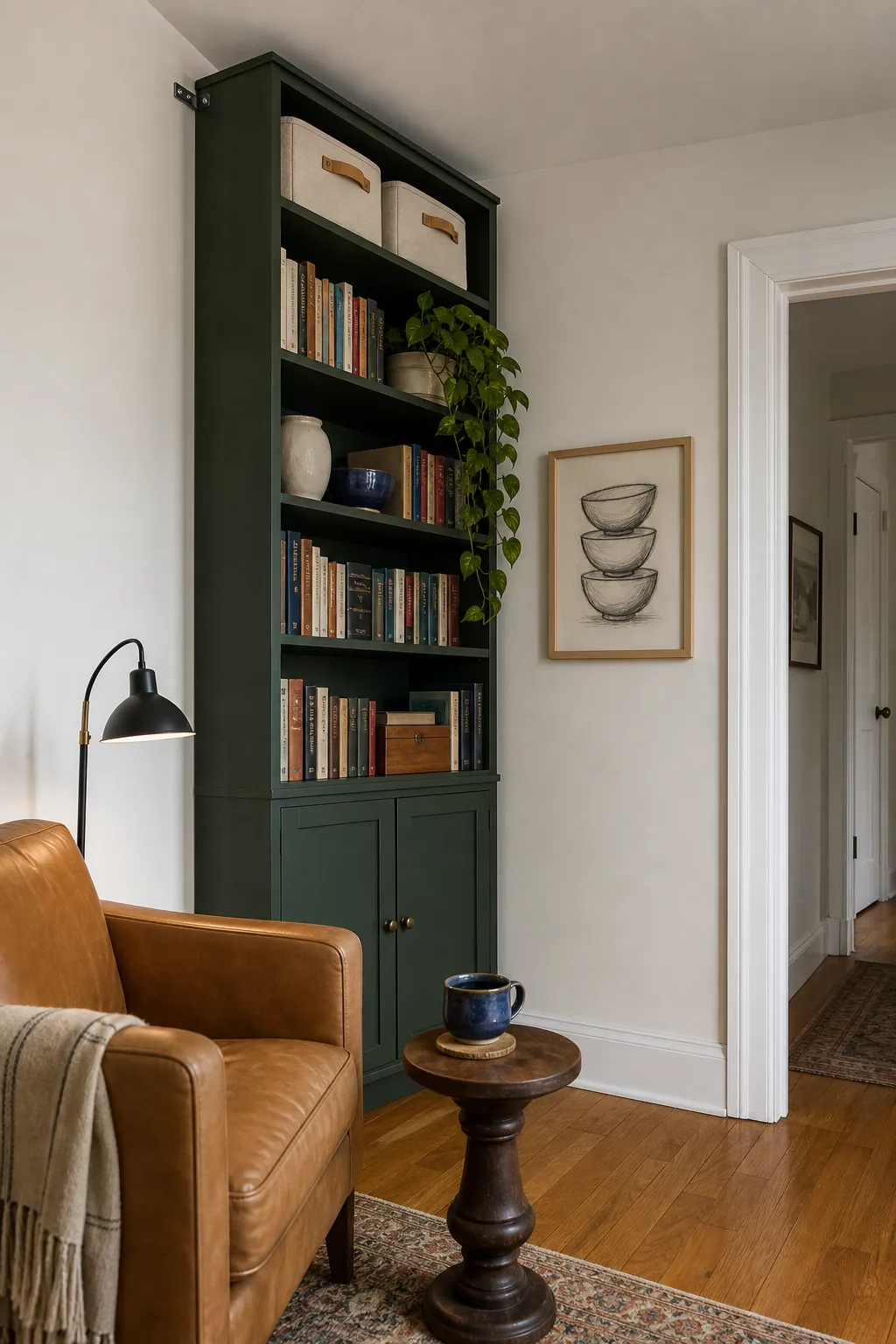
Vertical storage can free valuable floor area, but covering every wall with shelves creates a new kind of pressure. Choose one strong upward gesture: a tall bookcase, a narrow cabinet, or a shelf installed above a doorway. The eye reads that full-height line as intentional architecture rather than scattered storage.
Reserve the hardest-to-reach area for light, infrequently used items such as extra pillows, archived papers, or seasonal decor. Keep heavy objects low, secure tall furniture according to its installation instructions, and never overload a renter-safe adhesive hook. If drilling is prohibited, a tension system or freestanding shelf is safer than pretending removable strips can carry anything.
Leave part of the surrounding wall open. Height feels expansive when it has contrast; it feels crowded when every vertical inch competes.
Turn Collections Into Compositions
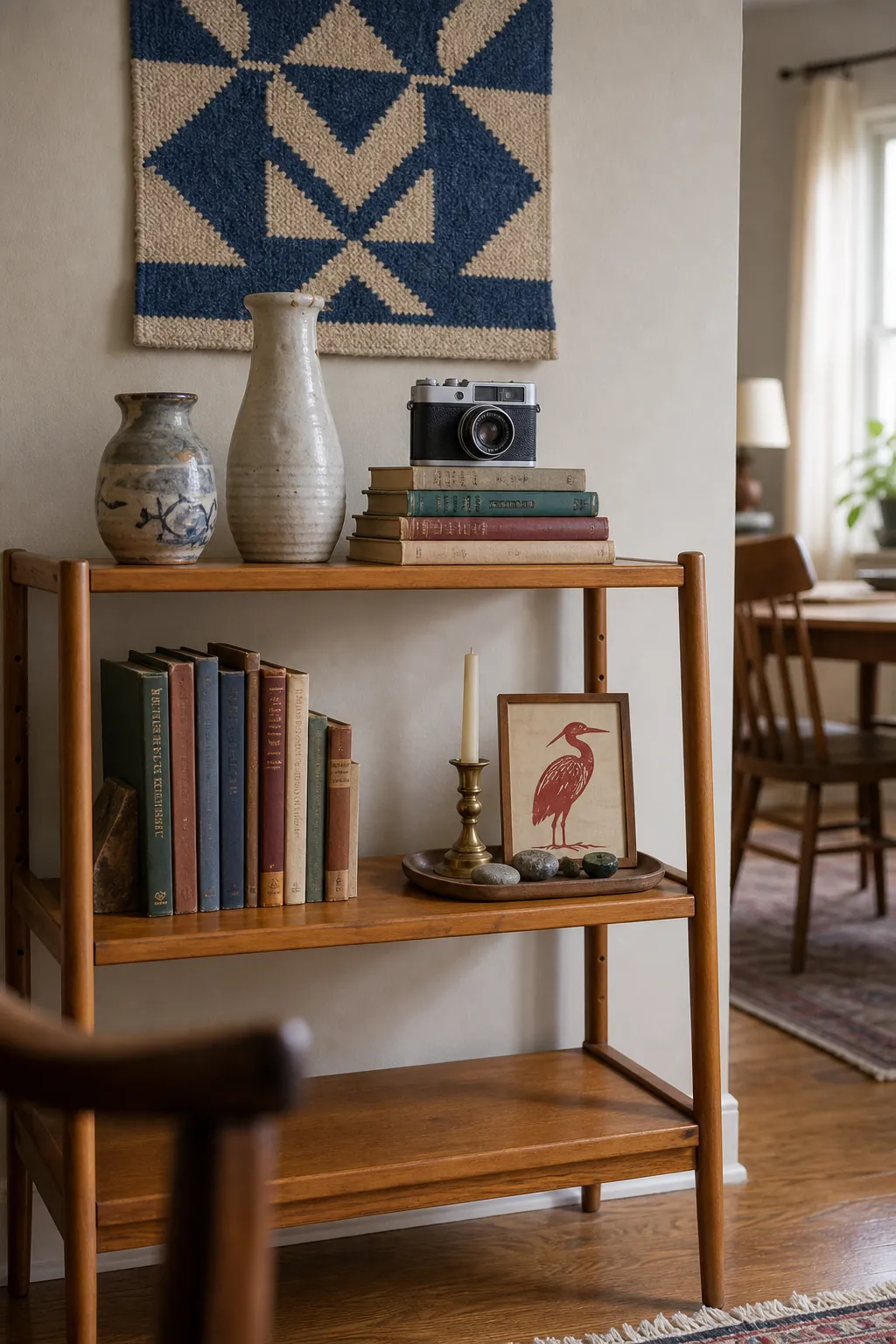
Personality is not the problem; distribution is. Ten small objects scattered across ten surfaces create ten separate interruptions. The same objects arranged in two purposeful groups become readable compositions with calm space around them.
Group items through a visible relationship: shared color, similar material, a common story, or a clear range of heights. Place the tallest object first, add a medium form, then use smaller pieces to connect them. A tray can turn perfume bottles or barware into a single unit, while a line of frames in one finish can organize very different artwork.
Do not decorate every surface. Keep part of the coffee table available for a mug and leave one section of shelving sparse. That breathing space is not minimalism; it is what allows the collection beside it to register. Rotate pieces if you love more objects than the room can display comfortably at once.
Place Mirrors Where They Repeat Something Useful
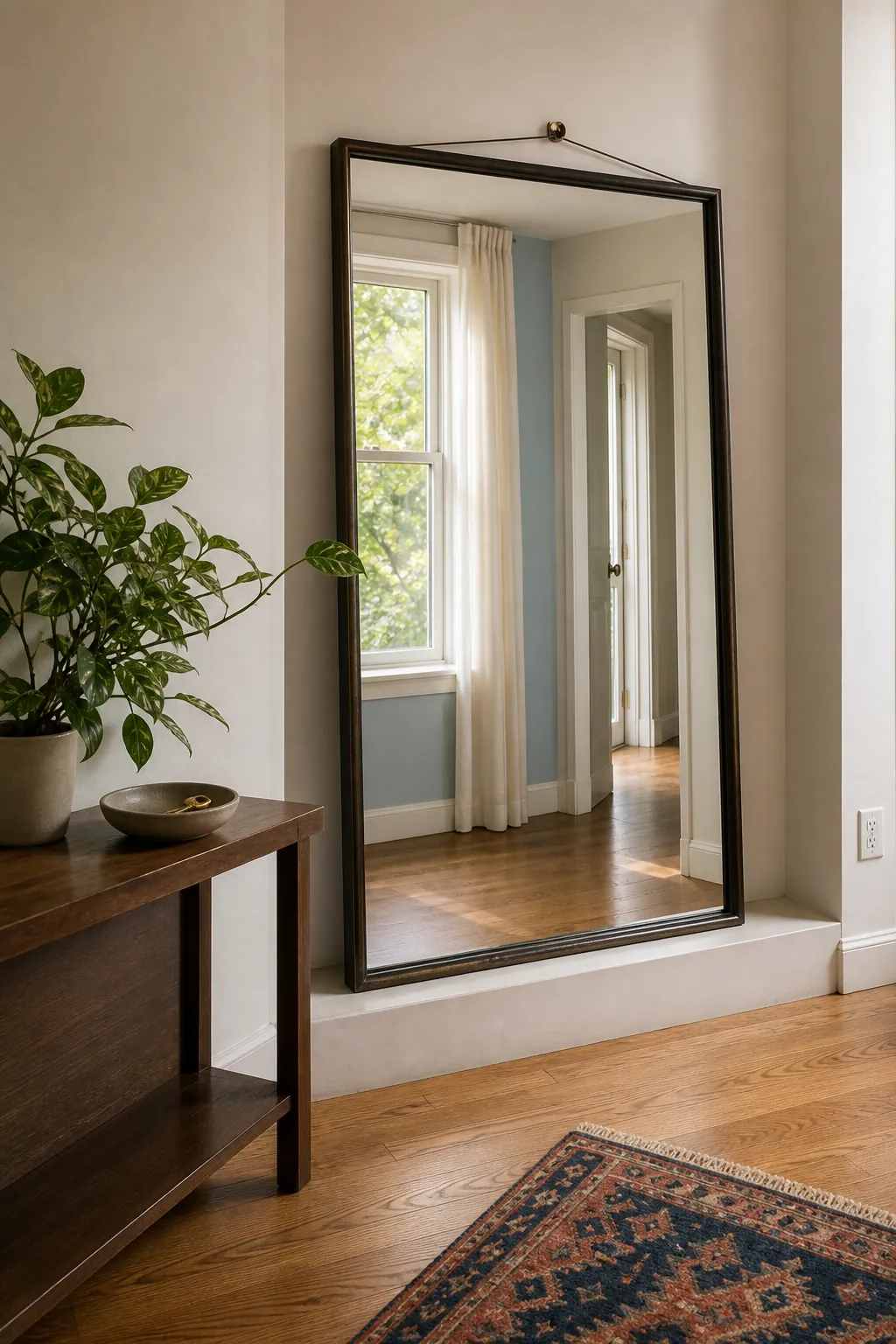
A mirror doubles whatever faces it. If it reflects a window, a lamp, or the longest view through the apartment, it can spread light and extend the sightline. If it reflects an overflowing coat rack or a crowded shelving unit, it doubles the visual noise instead.
Test the position before hanging anything. Prop the mirror safely at the proposed angle, or tape a paper rectangle to the wall and stand in the places where you will actually see it. Check the reflection from the entrance, the sofa, and the dining chair—not only from directly in front.
One well-placed mirror is more useful than several decorative mirrors with random reflections. Choose a scale that relates to the wall or furniture below it, and use the mounting method required for its weight.
Let Curtains Enlarge the Window, Not Cover It
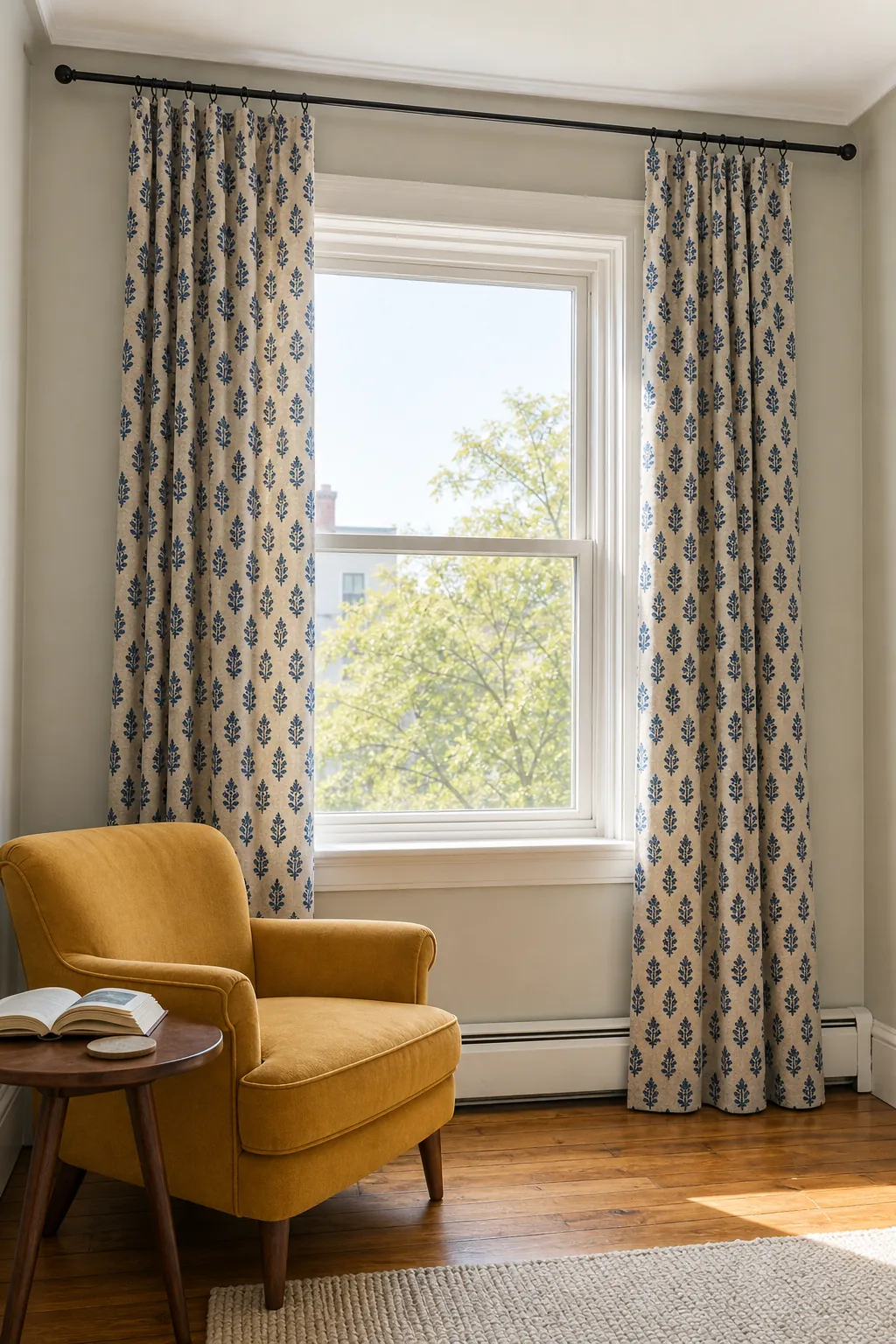
Short curtains fixed tightly inside the window frame make the opening look smaller. Where the lease and wall construction allow, place the rod close to the ceiling and extend it beyond the sides of the frame. When open, the curtain panels should stack mostly in front of the wall rather than blocking the glass.
Full-length fabric creates an uninterrupted vertical line and gives color or pattern a large, controlled place to live. If privacy matters, pair the decorative panels with a light-filtering roller shade or renter-safe tension sheer. Avoid excess fabric pooling on the floor in a tight walking route; it collects dust and makes the edge of the room look untidy.
Measure the complete wall, not only the glass. The purpose is to make the window feel generous while preserving every useful inch of daylight.
Layer Light So the Corners Do Not Disappear
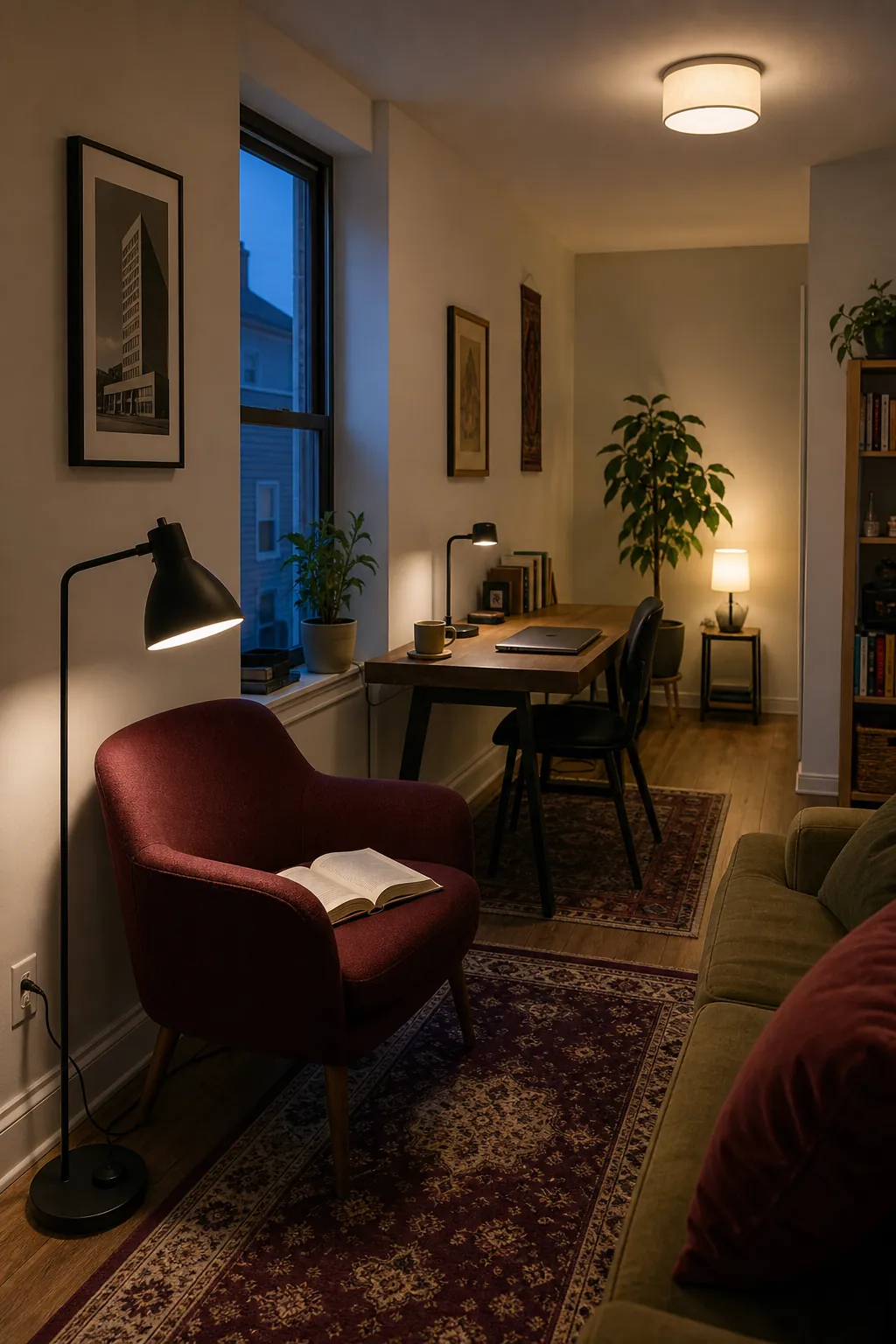
A single ceiling fixture often makes the center of a room bright while shelves, reading corners, and wall edges fall into shadow. Those dark boundaries make the usable room feel smaller at night. More light is not necessarily the answer; light placed at different heights is.
- Use the ceiling fixture for general visibility.
- Add a floor or table lamp where you read, work, or prepare food.
- Use a small accent light to reveal art, a plant, or a previously dark corner.
Keep the color temperature reasonably consistent so the apartment reads as one connected environment. Plug-in sconces, cord covers, smart bulbs, and compact rechargeable lamps can add layers without electrical work. Position shades so bulbs are not glaring at seated eye level.
Lighting should reveal the full depth of the apartment and support the task happening in each zone. That makes the room both larger-looking and easier to live in.
Repeat Color and Material to Connect the Whole Room
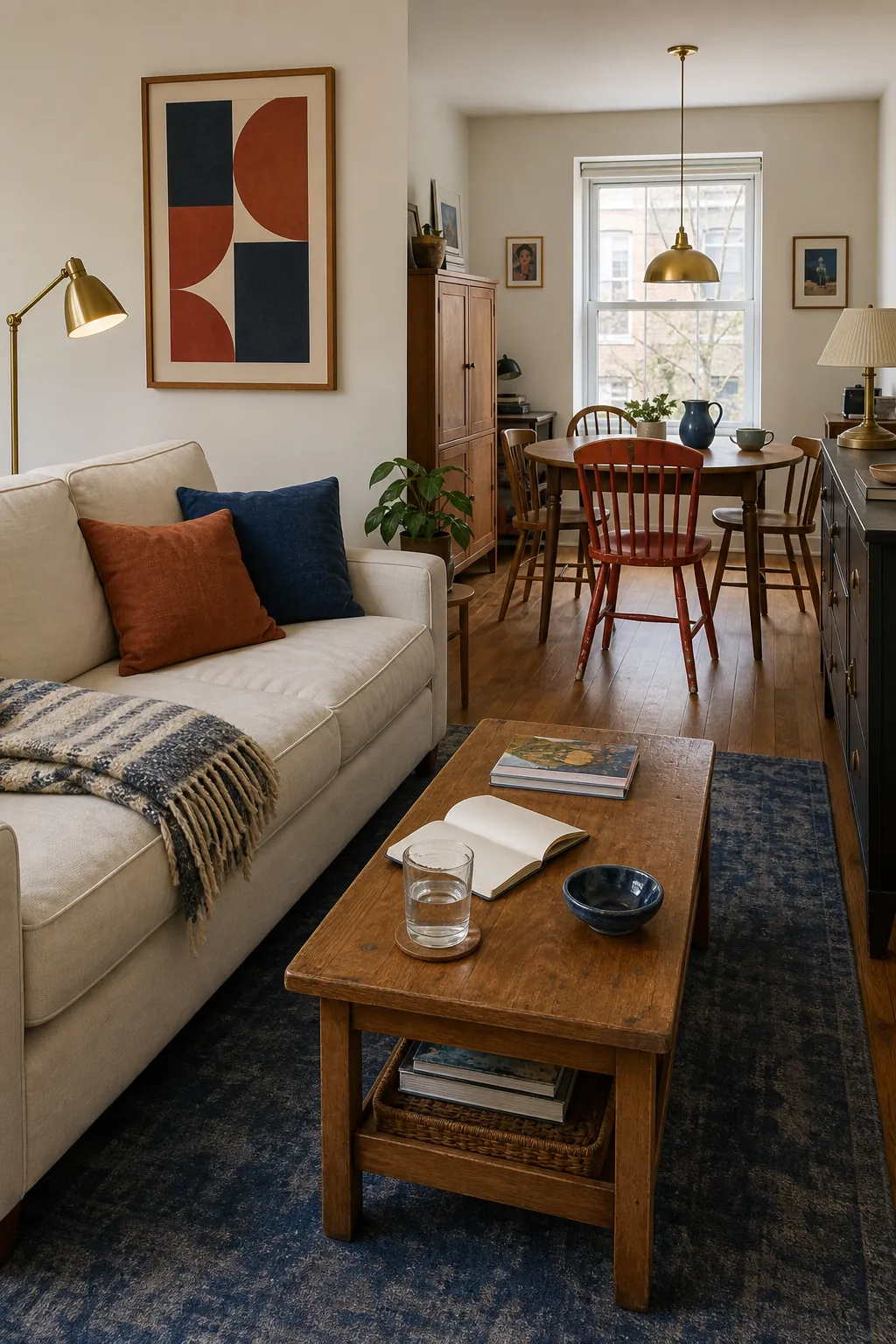
White paint is not the only route to an open-feeling apartment. Strong colors can work beautifully when they repeat with enough rhythm to connect one end of the room to the other. A blue in the rug might return in a cushion and again in a print near the dining area. Warm wood can reappear in a frame, a side table, and a storage box.
Repetition lets varied objects feel related, which is especially useful when most of your furniture is secondhand. You do not need a matching set. Choose a small material thread—perhaps black metal, oak, cane, or brushed brass—and let it appear in several zones. Keep large background surfaces reasonably connected so every corner does not announce a completely different palette.
Cohesion reduces visual friction without erasing character. The room can hold pattern, contrast, and sentimental pieces because a repeated color or finish gives the eye a route through them.
Edit Duplication, Not Identity
Making a small apartment feel bigger does require editing, but that does not mean keeping only objects that look neutral or practical. Start with duplicates that create maintenance: the extra side chair nobody uses, five half-empty baskets, old delivery boxes, too many throw pillows to sit comfortably, or decor spread thinly across every surface.
Then protect the things that give the room a point of view. A bright inherited quilt, a wall of concert posters, a shelf of ceramics, or a reading chair worth walking around may deserve more space than generic furniture bought simply to fill a gap. The test is not whether an object is minimalist; it is whether it earns the space and attention it uses.
Finally, design a short reset you can complete without rearranging the apartment: return remotes to one drawer, clear the main path, put dishes away, and restore one open patch on the table. A room that recovers easily after daily life will feel more spacious far longer than a room styled once for a photograph.
Your apartment does not need to look empty. It needs to make movement easy, storage obvious, and personality intentional. When those three things are working, a small home can feel generous precisely because it still looks like yours.