
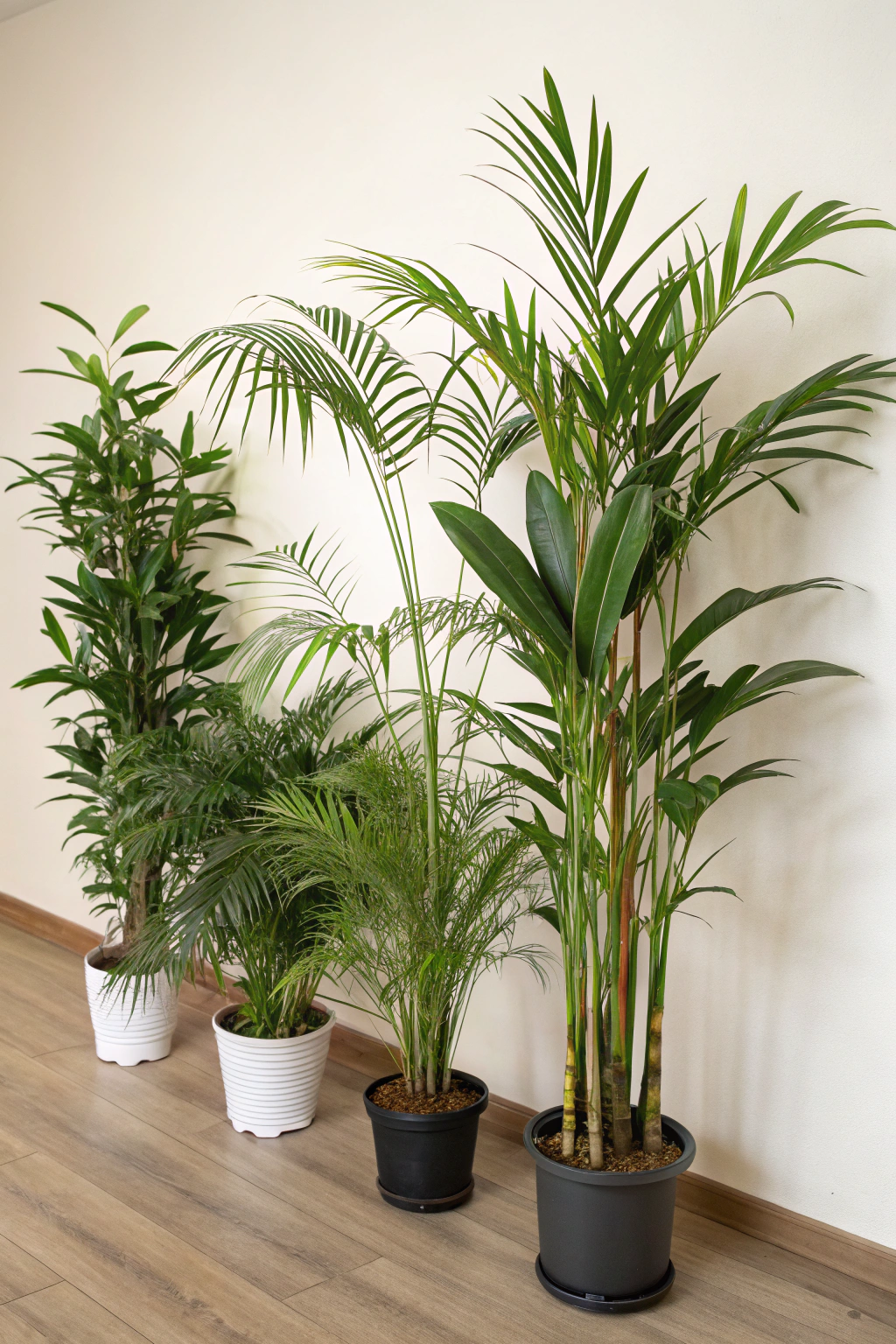
If you’ve ever looked at reeds and mistook them for bamboo, you’re not alone! With over 1200 distinct bamboo species, it’s almost impossible not to confuse plants that look like bamboo for the real thing. To prevent the same mistakes in the future, below we’ll investigate which plants are bamboo-look-alikes.
Several plants resemble bamboo, including bamboo palms, horsetails, Japanese knotweed, and cane spp. While similar in appearance, bamboo plants have diagnostic features, including a culm that grows from a rhizome, characteristic growth forms, and vegetative propagation.


Recognizing and differentiating bamboo plants from those that look similar is an important skill for gardeners cultivating these incredible grasses. This article examines the look-alikes in more detail and what sets bamboo apart.
Plants That Have A Similar Appearance To Bamboo

Bamboo is a type of grass (Poaceae) within the subfamily Bambusoideae. There are roughly 1400 distinct species, which vary in height, width, growth form, color, etc.
Bamboo plants are recognizable by their diagnostic “woody” culms (stem) composed of nodes and internodes, which sprout from a rhizome (an underground stem that grows laterally).
These structures are typical for grass and store proteins and starch, which allow the plant to resprout roots and stems after the dry season.
The diversity between species makes it easy to mistake other similar-looking plants for bamboo.
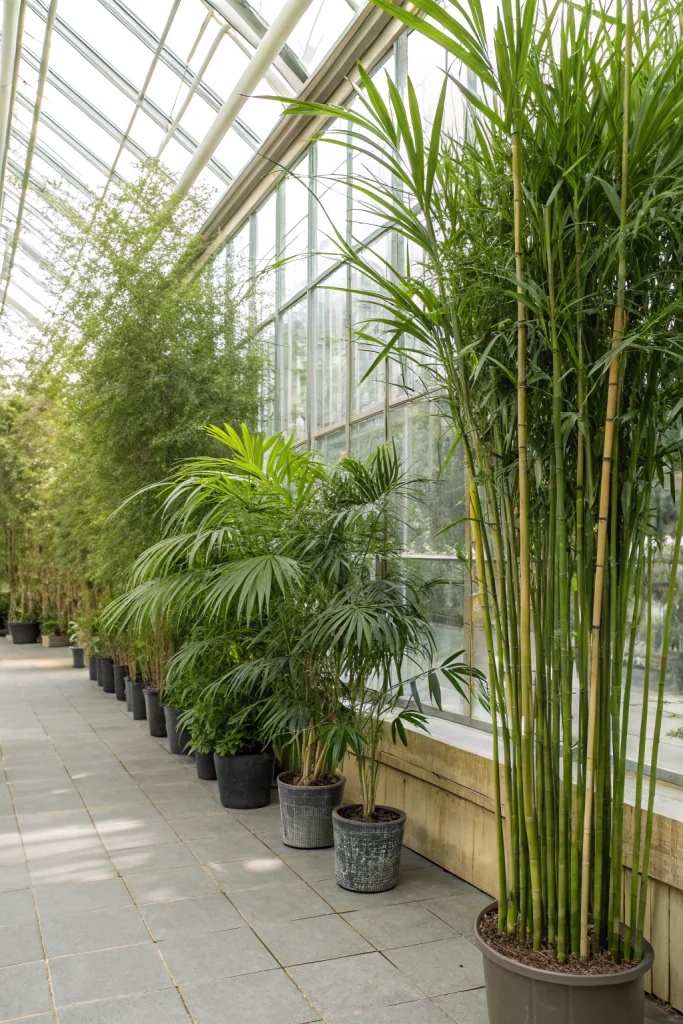
The species most frequently misidentified as bamboo include the following:
Bamboo Palm (Chamaedorea seifrizii)
These plants are a type of palm tree belonging to the Arecaceae family. They are relatively short, reaching 8’ to 12’, and grow as a multi-stemmed plant.
Distribution
- Origin: Mexico and Central America, where they form part of the rainforest understory (tropical and subtropical environments).
- Many nurseries stock them.
Uses
- These ornamental plants are frequently used to decorate landscapes or as potted plants. They are a popular, hardy plant, easy to look after.
Similarities
- The common name is derived from the leaves resembling bamboo leaves.
- The multiple stems also look like cluster-growing bamboo.
Differences
- Although their stems appear to have nodes and internodes at first glance, these palms don’t. Instead, they have a straight stem (not a culm) with “scars.”
- No rhizome. These palms have a characteristic “root ball.”
Dumb Canes (Dieffenbachia spp.)
Dumb canes belong to the Araceae family. There are roughly 50 plant species in this genus. Their common feature is large oval-shaped (or paddle-shaped) leaves, which come in various color combinations of cream, green, and white.
There are several popular species, including:
- Dieffenbachia amoena – grows to 6’. They have green and yellow/cream leaves that are roughly 20” long.
- Dieffenbachia seguine – grows up to 10’. They are the plants typically found in nurseries and have dense, large green and yellow/cream leaves.
There are several cultivators and differences between the leaves and heights.
Distribution
- Origin: Tropical and subtropical regions of Central and South America (including Brazil).
Uses
- They are mainly used for indoor/outdoor decoration as potted plants.
Similarities
- Dumb canes resemble bamboo in their straight stems with alternating leaves.
- Their stems are thin but grow in “clumps,” and have “nodes” (rings along the stem), which are where previous leaves grew from but fell off.
Differences
- The shape of their leaves is completely different from bamboo.
- They do not have hollow internodes divided by nodes.
Giant Reed (Arundo donax)
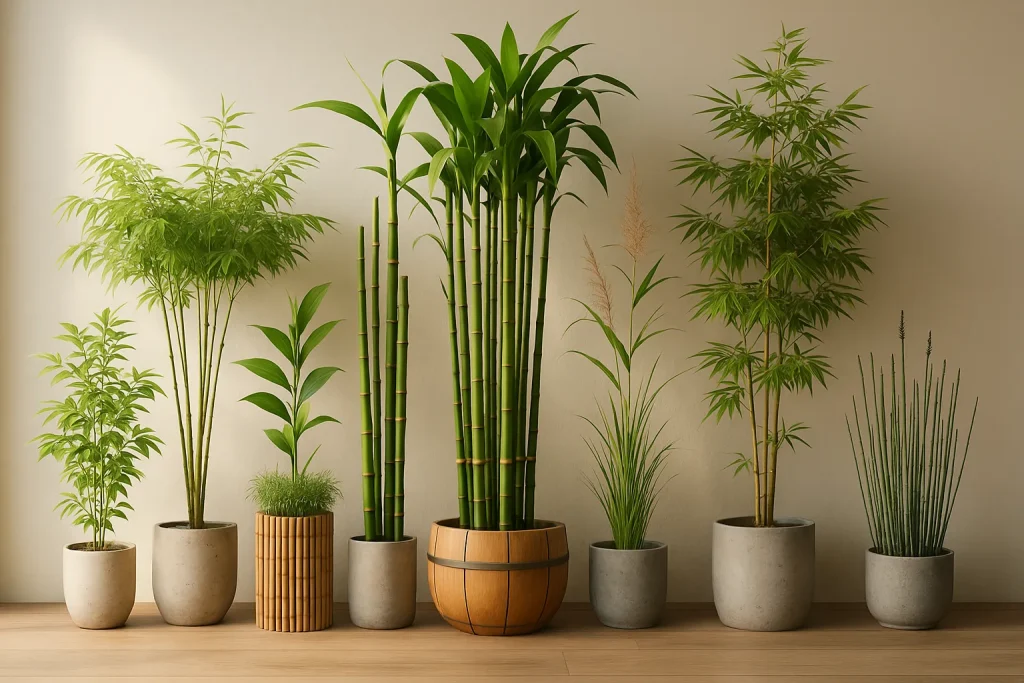
A closer relative to bamboo, the giant reed is also part of the grass family. These reeds are cane-like in appearance, they are perennial, and can reach 30’.
Distribution
- Origin: Experts believe that this plant originated from India.
- Widespread in the Mediterranean region.
- These riparian plants are invasive in the US and many other tropical and subtropical climates, particularly in wetlands and along rivers.
Uses
- Walking sticks
- Roofing material
- Riverbank stabilizers
- They are a potential source of biofuels
- They make excellent woodwind instruments.
Similarities
- Nodes and internodes – giant reeds have hollow stems divided by nodes. They also become hard with age and grow to similar heights.
- They grow from rhizomes – these plants propagate vegetatively from rhizomes, which run laterally through the soil. They frequently grow in clumps.
- Long, lancet leaves.
Differences
- Giant reeds grow close to water (in wetlands and along river banks), while bamboo is usually further away.
- They are not evergreen and turn brown during the dry season.
- These reeds are not as strong as bamboo; if you bend the culm, it easily snaps. They
are also softer.
- They flower annually.
Sugar Cane (Saccharum officinarum)
Sugar cane also belongs to Poaceae. These perennial grasses grow between 6 and 20’ and closely resemble bamboo.
Distribution
- Origin: India, Southeast Asia, and New Guinea
- These plants are widespread in tropical, subtropical, and warm temperate regions.
Uses
- Producing sugar.
- A biofuel source, as they produce ethyl alcohol.
- The parts not needed for sugar extraction are used as livestock feed and thatching material.
Similarities
Like other reeds/cane in the grass family, sugar cane shares several similar features with bamboo, including:
- Growing from a rhizome
- Nodes and internodes in the culm
- Elongated leaves
Differences
- Sugar cane culms are solid and have a high liquid content, while bamboo culms are hollow (in the internodes).
- Bamboo is stronger than sugar cane and better adapted to timber.
Heavenly Bamboo (Nandina domestica)
These plants are unrelated to bamboo or the grass family and belong to Berberidaceae. They are an evergreen perennial shrub and grow between 4’ and 8’.
Distribution
- Origin: Asia (China, India, and Japan)
- Frequently invasive in the southeastern US
Uses
- Ornamental: including gardens and hedges
Similarities
- Grows from a rhizome
- Stems are tall and narrow (cane-like), resembling bamboo growth forms.
Differences
- The stems are brown and rough looking, not smooth and green.
- The leaves are different. They are compound, with multiple leaflets on each leaf stem.
- Annual flowering (without dying)
Horsetail (Equisetum spp)
These unique plants are considered prehistoric due to their adaptations. They are hardy plants from the Equisetaceae family, and most grow between 8” and 5’. Some species may reach 26’.
Distribution
- Widespread in temperate and arctic regions in the northern hemisphere.
Uses
- Traditional medicine by ancient civilizations, including Native Americans, Chinese, and Romans.
Similarities
- Grow from rhizomes
- Hollow internodes and solid nodes resembling bamboo.
Differences
- Their rhizomes can grow in water.
- They reproduce through spores (no flowers or seeds)
- Their stems are soft and easily broken.
Japanese Knotweed (Fallopia japonica)
These bamboo look-alikes belong to the buckwheat family (Polygonaceae) and grow between 4’ and 10’.
Distribution
- Origin: Parts of Korea and Taiwan. Japan and China.
- They are considered invasive in several US states, particularly in riparian areas.
Uses
- Ornamental
- Erosion control
- Screening
Similarities
- Hollow internodes with diving nodes
- Grows from a rhizome
- Similar growth forms to running bamboo
Differences
- The leaves look spade-shaped.
- The stem is soft and easily broken.
Lucky Bamboo (Dracaena sanderiana)
These plants belong to the Asparagaceae family and grow up to 8 ft; however, as an indoor plant with limited space, they typically grow to around 3 ft.
Their common name is derived from their bamboo-like growth.
Distribution
- Origin: Central Africa in tropical areas
- A common house plant globally
Uses
- These plants make excellent potted plants; many people give them as gifts, meaning “good luck.”
Similarities
- Leaves are similar in shape to bamboo’s
Differences
- These plants survive better in water than bamboo (they’re often sold with their roots in water).
- The leaves grow from different sections of the stem.
- The stems are not hard like bamboo.
- The internodes are not hollow; they are less dense than at the node. When cut, these stems may appear hollow, but that is a trick of the eye.
Bamboos Delineating Characteristics
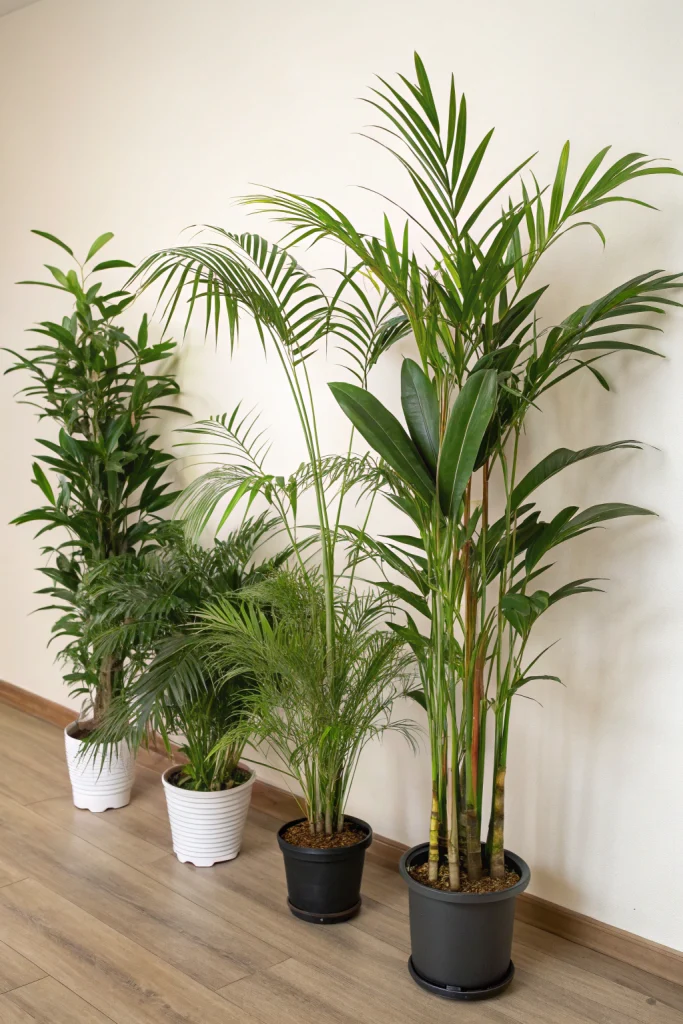
It is essential to know what bamboo’s defining characteristics are to tell bamboo apart from its look-alikes.
Bamboo Plants Grow From Rhizomes
Rhizomes store nutrients for “overwintering;” however, a bamboo’s rhizomes are the plant’s primary means of spreading.
Most bamboo species only flower every 3 to 150 years (some genera flower annually, but it is a rare trait). Instead, they rely on vegetative propagation (asexual).
Rhizomes are not limited to bamboo, but all bamboo species have them.
Bamboo Is Fast Growing
Bamboo plants are renowned for their speedy growth (some species may reach 1 foot a day!). Look-alike species generally lack this growing potential.
While not something you’ll see immediately, if you monitor the plants, you’ll determine how quickly they grow.
Bamboo Does Not Grow In Water
These grasses grow near water sources but won’t be submerged or in saturated soil.
If the plant is submerged/in water-logged soil, it is likely not a true bamboo.
Bamboo Has Plant Parts Typical Of Grass
It’s easy to forget that bamboo is part of the grass family with its tall, hard culm, so it’s easy to assume the different plant parts look different.
For example, bamboo has typical grass plant flowers. They are tiny and grow on a compound inflorescence.
Additionally, bamboo is monocarpic. It only flowers once, and then the plant dies.
Bamboo leaves are usually long with a lancet shape (tapering to a point), and they are usually medium to large. Bamboo’s culms make excellent timber.
Conclusion
Several plants resemble bamboo, and many are in the same grass family. However, bamboo culms with nodes and internodes sprout from rhizomes. To differentiate, you must examine their physical features and their growing traits.