
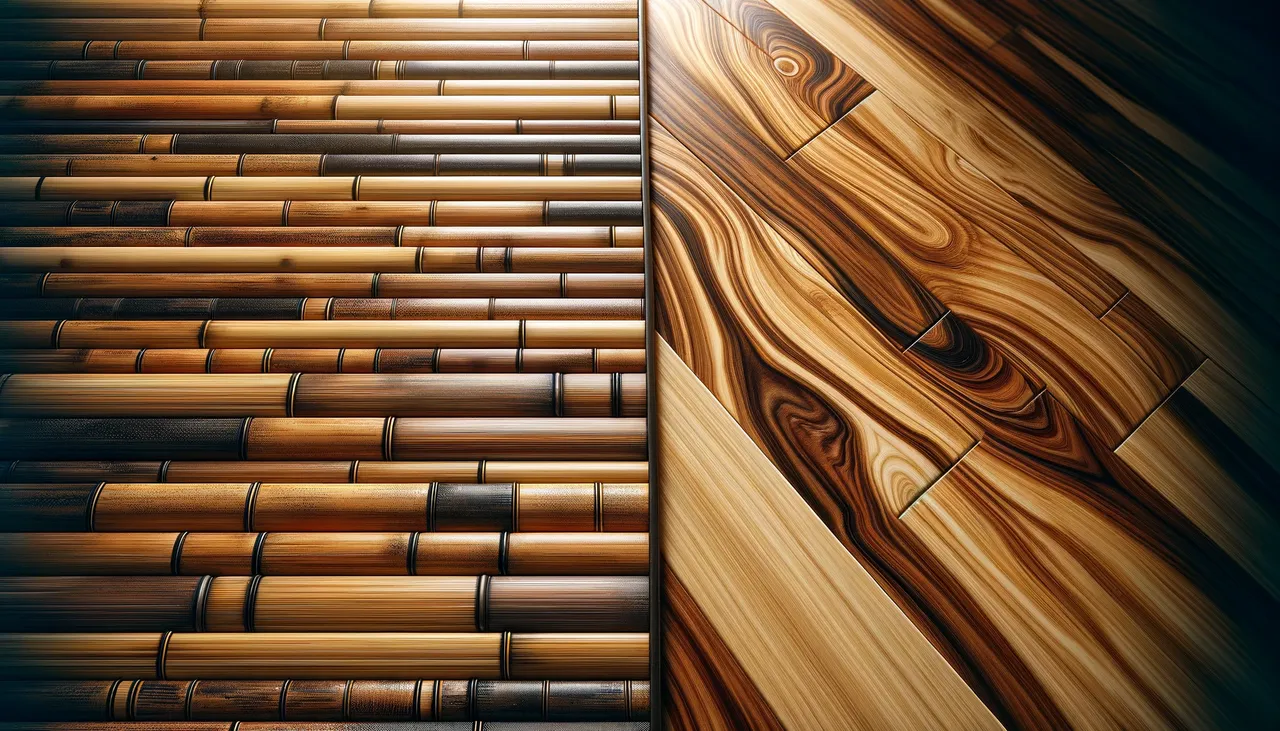
If you enjoy woodwork, you’ve probably debated “bamboo vs. hardwood” many times. Whether installing new floors or countertops, constructing a frame for a building, or making furniture, the chances are significant that you’ve elected to use wood as part of the project, but which wood would you choose?
“Bamboo” is a collective term for any of the roughly 1400 species of grass plants in the subfamily Bambusoideae. “Hardwood” refers to a category of trees that are usually deciduous angiosperms, valued for their lumber. Bamboo and hardwood fulfill different purposes and have many overlapping traits.
Humans have a long-standing relationship with wood and use different types to meet our various needs. Below, we’ll compare bamboo and hardwood’s origins, characteristics, strengths, weaknesses, and popular uses.
Bamboo Vs. Hardwood: An Overview
Wood is a wonderful resource, and those with an affinity toward it quickly learn the most desirable characteristics.
Usable trees are usually divided into hardwood or softwood, depending on the characteristics of the lumber. Both are necessary but often fulfill different roles in the various industries that use them.
By examining their pertinent characteristics and traits, we better understand the similarities and differences between bamboo and hardwood.
Bamboo Vs. Hardwood: Origins And Characteristics Of Living Plants
The quality of a tree’s wood, characteristics, and end purpose are determined by the type of tree (species) and where it grows (environmental conditions).
Characteristics Of Bamboo Plants
While most trees are either hard- or softwood, bamboo does not belong to either as it is grass. However, the roughly 1400 bamboo species (subfamily Bambusoideae) have different heights, growth forms, thicknesses, and other features.
Some shared characteristics of bamboo plants include:
- They grow from a rhizome – an underground stem that stores starch and other nutrients for overwintering.
- Their (often) tall culms (stems) comprise nodes and internodes. As the plant ages, the culm becomes hollow. They range from 4″ to 130′, depending on the species.
- Strong yet flexible. Bamboo can survive strong winds thanks to its ability to sway and bend. However, the culms are immensely strong to support their height and weight.
- Bamboo grows in tropical, subtropical, and mild temperate climates. Most bamboo plants are in East and Southeast Asia and surrounding areas, but several species are found in Africa and the Americas.
- Bamboo plants have one of the fastest growth rates (some species reach up to 1 foot a day).
- They are perennials, and most are evergreen.
- They are monocarpic, flowering once and then dying. Some species flower annually, while others may take up to 120 years. Bamboo spreads primarily through vegetative propagation.
Characteristics Of Hardwood Trees
Most hardwood trees are deciduous angiosperms (trees that produce flowers and cycle through shedding their leaves in the dry season).
The list of these trees is extensive, but common species include:
- Alders (including the red alder)
- Beech
- Birch
- Black Walnut
- Brazilian Cherry
- Hickory
- Maples
- Oaks
- Rosewood
- Teak
Some common characteristics of these trees include:
- Many of these trees have broad leaves, which they lose in the fall and grow back in spring.
- They range in height (from 10 feet), but most are tall trees (up to 100 feet and more).
- They propagate through flowering and seeding.
- These trees’ slower growth rate causes the wood to become harder than faster-growing gymnosperms like pine and spruce.
- They grow in tropical, subtropical, and temperate regions globally.
- They are strong trees consisting of a solid trunk (made up of 5 different layers).
- They have strong roots, either tap roots, heart roots, or flat roots.
Bamboo Vs. Hardwood: Lumber Traits, Harvesting, And Processing
Aside from their natural beauty, we love trees for their lumber (harvested and processed wood) and what we can do with it.
The lumber’s properties/characteristics are directly related to what tree species it comes from (in this case, hardwood/softwood/bamboo).
The table below summarizes some of the characteristics of bamboo and hardwoods.
|
Characteristic |
Bamboo |
Hardwood |
|
Rot/insect/disease resistant |
Not rot/insect/disease resistant when untreated. |
Some species are resistant, while others are less |
|
Strength and durability |
Incredibly strong and durable as a building material |
Incredibly strong and durable as a building material |
|
Flexibility |
Highly flexible |
Not flexible |
|
Cost |
Inexpensive (location dependent) |
More costly |
|
Life span |
Untreated bamboo = 5 to 7 years Treated floors = up to 25 years |
Treated floors may last 100 years. |
|
Versatility of use |
Versatile |
Versatile |
|
Ease of use |
It may damage saw blades but holds resin and glue well. |
A very hard wood that may require special tools to cut. It may also damage saws and other tools. |
|
Sustainability |
A fantastic renewable resource thanks to its fast growth rates and widespread availability. |
It’s not as renewable. Intentional reforestation/planting is essential. These are slow-growing trees that are often limited in distribution. |
Additional Characteristics Of Bamboo And Hardwood “Lumber”
- Bamboo “wood” is not theoretically wood, as bamboo is a grass plant. It lacks “heartwood”; instead, it comprises dense fibers.
The fibers contain lignin and silica, making them hard and durable. They have high compressive and tensile (1400 psi) strengths. This wood is also flexible, allowing it to bend without snapping (as a tree and as lumber).
- Bamboo is naturally light-colored, and the wood grain shows up well.
- Once cut, bamboo and hardwood lumber shrinks (as it loses water) and requires a period of drying before use.
- Hardwoods have incredible durability, and their products last for decades or longer.
- Hardwood lumber is typically dark in color.
Harvesting And Processing Bamboo
Bamboo is harvested through various methods, depending on the end goal.
I.e., bamboo shoots for cooking are harvested by removing the entire shoot from the ground (off the rhizome). Mature bamboo plants are cut above the 1st or 2nd node (for wood).
Once harvested, bamboo (for lumber) is dried and then transported to mills where it is processed. For flooring, bamboo is sliced into thin strips, which are then ‘glued together” (either horizontally or vertically) with resin and under immense pressure. The resulting product is a solid section of flooring.
Bamboo is also used in its “whole” state for construction.
Harvesting And Processing Hardwood
Hardwood trees follow a typical forestry method of harvesting, where mechanized saws (like chainsaws and fellers) are used. Axes and handsaws are outdated. Unlike bamboo, these trees must be “cleaned” of branches (also with a chainsaw).
After felling, the timber moves to sawmills, where it is cut into various boards. These boards are sold “as is” or further processed into engineered wood.
Bamboo Vs. Hardwood Lumber Benefits And Drawbacks
To appreciate the differences and similarities of bamboo vs. hardwoods, you must explore the benefits provided by these products and the unavoidable drawbacks.
Bamboo Benefits
- Bamboo mixes well with resin to produce durable biocomposite products.
- Bamboo is frequently engineered for flooring and other uses.
- Bamboo is lightweight, making it ideal for an array of products.
- Good thermal conductivity (R=0.072 m²K/W).
- Bamboo is slightly more water resistant than hardwoods.
Bamboo Drawbacks
- A significant drawback of bamboo is that many manufacturers use Formaldehyde to treat it.
While most quality products are below the legal thresholds, there is often little regulation on bamboo products (flooring especially), which allows some manufacturers to use more of these dangerous chemicals.
- Its durability makes working with bamboo difficult (without the correct tools).
Hardwood Benefits
- Thanks to their strength and durability, these woods are easy to repair (scratches and dents) and maintain.
- This lumber is fantastic for building support structures.
Hardwood Drawbacks
- These woods are more expensive than bamboo and soft woods due to the time it takes to grow and the manufacturing costs.
- The lumber is heavy, which requires additional support when working with it.
- This wood is hard and requires quality tools.
Bamboo Vs. Harwood: Uses
Bamboo and hardwood are wonderfully versatile and are extensively used in many industries. Bamboo has more end uses and is popular in Asia (and the surrounding areas), while hardwood is more widely used in Western countries.
Some common uses for bamboo include:
- Food – many Asian cultures use bamboo in traditional recipes, targeting young shoots. Bamboo powder is another form of edible bamboo, where culms are ground into “flour” and added to food as a fortifier.
- Fodder – aside from human consumption, bamboo is frequently used to feed livestock.
- Flooring – bamboo floors are increasingly popular and are either horizontal, vertical, or strand woven (made from fibers glued together under heat and pressure).
- Textiles – bamboo fabric is produced by stripping fibers from the culm (mechanically, chemically, other through a combination) to produce strands that are spun into yarn.
- Biocomposites – bamboo is a potential replacement for mild steel as reinforcement. Bamboo is mixed with resin or cement to form stronger building materials/flooring.
- Building materials – walls, frames, panels, flooring, roofing, etc.
- Decoration – as living plants, bamboo has ornamental value, and the dried wood is used to make outdoor decorative structures, carvings, etc.
- Furniture, utensils, and other items – cutting boards, fishing, rods, spoons, chopsticks, musical instruments, chairs, cupboards, and many other items are frequently constructed from bamboo.
Popular hardwood products and uses include:
- Building materials – walls, frames, floors, roofing, fencing, etc.
- Railway structures – railways sleepers/ties.
- Boat construction – most wooden ships were made of hardwoods.
- Furniture, utensils, and other items – musical instruments, chairs, tables, counters, wardrobes, etc.
- Decorations – carvings, paneling, etc.
Conclusion
Bamboo and hardwood are essential to many people. Although bamboo is a grass, it is durable, strong, and flexible. Hardwoods are equally useful, and their strength is ideal for many industries. Bamboo is widely used in Asia, while hardwood is more frequently used in Western countries. Bamboo serves a wider range of uses, including food and forage, but both are equally important.