
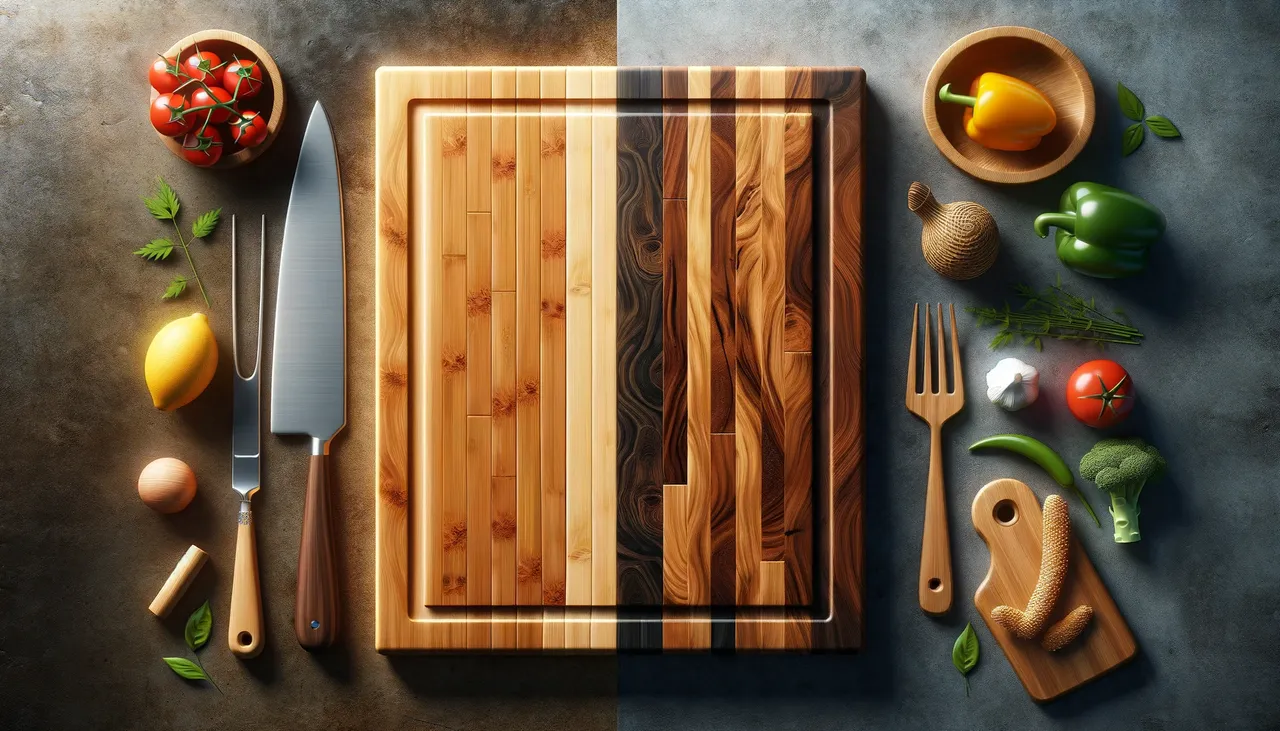
If you were asked if you preferred quality cutting boards, you’d be quick to answer “yes.” However, if asked whether a bamboo or wood cutting board was better, you will likely struggle to answer. If you’re in the market for a new “chop block” and are weighing up the virtues of each, we’re here to help as we explore bamboo vs. wood cutting boards.
Bamboo and hardwood are popular options for cutting boards as both provide hard, durable surfaces. However, some suggest that bamboo is a poor material for cutting boards as it damages knives due to its hardiness and composition. There are benefits and drawbacks to both materials.
We all have personal preferences regarding cooking utensils, and cutting boards are no different, but is a bamboo board all that bad? What are the pros and cons of either? How should you care for them? And what makes them the way they are?
Bamboo Vs. Wood Cutting Boards: Origins And Defining Characteristics
Wood is an essential and versatile product harvested from various tree species.
While most wood is soft or hardwood (depending on its characteristics and the tree species), bamboo is not technically wood. Instead, it is a type of grass (Poaceae).
There are roughly 1400 bamboo species under the subfamily Bambuacea. These plants vary in height, thickness, growth forms, and what their end use is. Cutting boards are one of the uses.
Aside from bamboo, there are several regular kinds of wood used in cutting board manufacturing, including:
- Maple (the most popular)
- Acacia
- Beech
- Cherry
The most suitable wood for cutting boards is fine-grained, with small pores.
Significant debate is on whether bamboo or “regular” wood is better as a cutting board.
Unfortunately, there are few substantiated facts to argue that bamboo is too hard and damages knives. If they do cause knives to blunt quicker, how much quicker?
These questions might be answered in the future, but for now, they remain non-specific, leaving it up to personal preference and budget as the driving forces behind which material you choose.
How Are Bamboo Cutting Boards Made?
If you’ve looked at bamboo, you’ll notice that the culms (stems) are generally thin and hollow, which makes constructing a cutting board for a single piece of bamboo wood impossible.
Instead, bamboo culms are sliced into long, thin pieces to flatten them. These pieces are cut to length and laid horizontally or vertically. Once positioned, they are glued with a strong adhesive (under heat and pressure).
Once the bamboo sets, the board is trimmed and sanded. Many are treated with food-grade mineral oil.
How Are Wooden Cutting Boards Made?
Wooden cutting boards may be cut from a single wood piece or glued together like a bamboo board (particularly if patterns are incorporated).
Wooden cutting boards come in three varieties:
- Edge grain – where the wood is cut along its length (vertically). The wood is either a single piece or several joined together.
- End grain – the wood is cut horizontally through the tree (a cross-section showing the growth rings in their circles). These are popular for butcher’s blocks. They are usually cut into blocks that are glued together.
These cuts absorb the cutting impact, improving your board’s longevity. They also absorb and drain moisture faster than the other grain styles.
- Face grain – similar to an edge grain, except the cut is “uneven” where the face side is wider. Edge and face grain cuts are slightly more stain and moisture-resistant.
Taking Care Of A Bamboo Vs. Wooden Cutting Board
Maintaining your cutting board is essential to its longevity and your continued health. Bamboo and other wooden cutting boards have similar cleaning and maintenance requirements; however, bamboo requires (slightly) less frequent oiling/seasoning.
Wooden boards (normal and bamboo) should not soak in water or go in the dishwasher. The prolonged exposure to water and heat has adverse effects on your board. Rather, wash the board by hand in hot water with a mild detergent.
Wood and bamboo boards require periodic oiling to prevent the wood from absorbing water. If the boards absorb water, they can (potentially) split, splinter, crack, or create a breeding ground for bacteria.
While some manufacturers use mineral oils, it is recommended to use fractionated coconut oil or beeswax as the healthier option.
Bamboo Vs. Wood Cutting Boards: Advantages And Disadvantages
When comparing wood and bamboo cutting boards, it’s best to examine the pros and cons they bring to the table.
The Advantages Of Bamboo Cutting Boards
- Bamboo is a renewable resource – when sustainably harvested, bamboo is an ideal resource. Its immense growth rates replace the harvested wood in a quarter of the time required to grow a large tree.
- They are tough – bamboo has incredibly high durability thanks to the lignin and silica within its fibers. Its durability is comparable to mild steel. Thanks to their strength, they resist scratches from knives.
- Better water resistance than other wood – bamboo grows in humid environments, making it better at handling moisture than some other woods.
- Easy maintenance- bamboo is easily cleaned with hot water and a mild dishwashing detergent but should not be put into a dishwater (as it may remove the adhesive).
- Aesthetically pleasing – bamboo cutting boards look great thanks to the colors, patterns/grains, and overall appearance.
- Lightweight – one of the most significant drawcards of bamboo is how lightweight it is, particularly for the strength you’re getting out of it.
The Disadvantages Of Bamboo Cutting Boards
- The most significant drawback of these boards is that they are “glued” together with an adhesive. Adhesives lose their stickiness over time (speeded up through frequent washing), which limits the lifespan of your board as they begin falling apart/separating.
- Adhesives may be harmful chemicals – some glues that hold bamboo “planks” together are dangerous (particularly those containing Formaldehyde). It can cause several irritations/rashes, and it is a carcinogen.
High temperatures and acidic foods may cause these chemicals to leach out.
- Some manufacturers use mineral oils to coat the cutting board, which are potentially harmful.
- Bamboo is a naturally porous material – there is an increased risk of bacterial growth and rot establishing on the cutting board as it absorbs moderate water.
- Bamboo is a hard substance that might damage your knife blades, thanks to the silica and dense fibers forming bamboo wood.
The Advantages Of Wooden Cutting Boards
- Wooden cutting boards are (theoretically) less likely to cause your knife to go blunt (as quickly as bamboo).
- Wooden cutting boards might be a single piece of wood, which removes the need for (potentially) harmful adhesives to join the different pieces.
- Some wood species are naturally immune to disease/rot/bacteria, etc.
- Hardwood species with fine, tightly packed grains are ideal as they are durable enough to resist scarring yet are not so hard that they’ll damage your blades.
- Maintaining these boards is relatively easy, with frequent oiling.
The Disadvantages Of Wood Cutting Boards
- Wooden boards require more frequent seasoning (oiling) than bamboo.
- Wooden boards (particularly hardwood) are more expensive than bamboo counterparts.
- Although wood is renewable, it grows slower than bamboo and is more likely to become depleted/there is significant competition to use the wood for other industries.
Which Is Best: Wood Vs. Bamboo Cutting Boards?
There is considerable debate as to whether bamboo cutting boards are, in fact, bad for your knife blades. While the theory checks out (silica and the overall hardness of bamboo), many people have used bamboo cutting boards for years without issues.
Your cutting methods, the frequency of use (i.e., how often you spend cutting), and the quality of your knives are essential factors when choosing between bamboo and wooden boards.
The other essential consideration is your budget. Bamboo cutting boards are significantly cheaper, a huge selling point for most people. Bamboo is the board for you if your budget doesn’t allow for a more expensive hardwood cutting board.
Finally, your preference is the determining factor. If you try a bamboo board and like it, you should stick with it. If you prefer other wood, then that’s the best answer.
Conclusion
While bamboo’s suitability as a cutting board is heavily debated, it has some significant advantages, including durability, ease of use, sustainability, and affordability. While wooden boards are slightly more expensive, many people prefer them, believing they are “softer” on knives. Your budget and preference are essential when selecting a cutting board.