
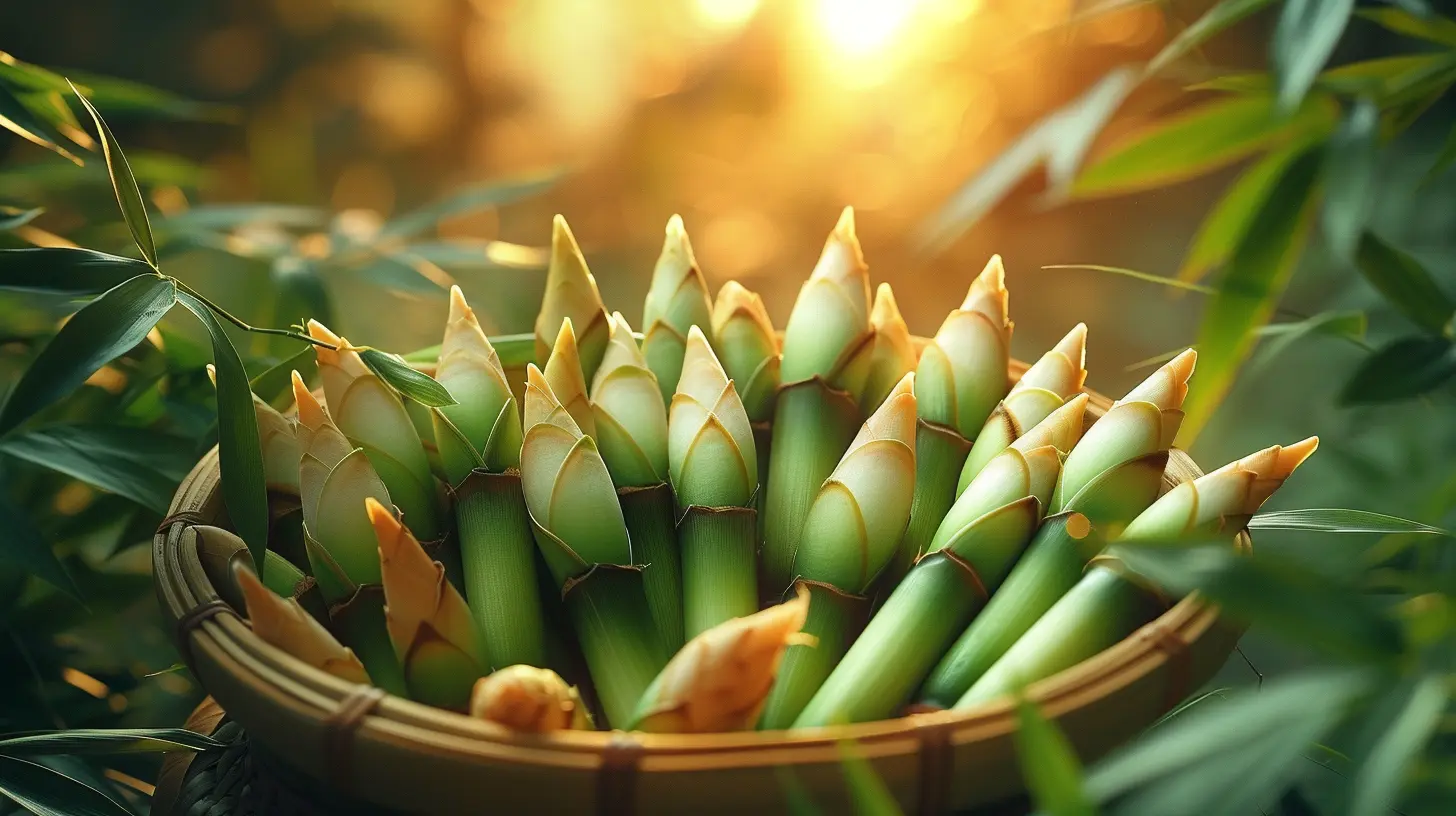
Out of all the plants that have lent their strengths to human use, bamboo stands tall – and not just in a literal sense! This versatile giant steps beyond its roles in shelter, fiber, and fuel to grace our plates. But, amidst its vast family, a curious gastronome might wonder: which bamboo can we actually eat?
While the concept of dining on bamboo may seem offbeat in Western culinary scenes, it’s a familiar and cherished practice in many Asian cultures. Here, we delve into the bamboo’s culinary chapter, exploring how this green giant transitions from forest to fork, and what makes some species a chef’s delight while others are better left as part of the scenery.
Key Takeaways
- Edible Species: Approximately 200 bamboo species are on the edible list.
- Top Edible Genres: The Bambusa, Dendrocalamus, and Phyllostachys genera are where most edible bamboos are found.
- Cooking Is Crucial: Cooking is key to transforming bamboo from tough to tender and safe.
- Toxic Compounds: Some bamboo varieties harbor arsenic and cyanogenic glycosides, requiring cautious preparation.
- Nutritional Powerhouse: Bamboos are rich in fiber, minerals, and protein, but low in fats and sugars.
- Cultural Delicacy: While a novel ingredient in Western kitchens, bamboo is a staple in many Asian cuisines.
What You Need To Know About Eating Bamboo
Bamboo refers to a group of related plants belonging to the subfamily Bambusoideae (of the grass family Poaceae). If eating these grass plants seems foreign to you, it’s because you’re on the “wrong” continent.
While a novelty in the West, these plants form part of many Asian traditional cuisines, which is unsurprising as the largest species diversity and the greatest biomass (physical plants) are in East and Southeast Asia and the surrounding areas.
While the majority of plant parts consumed are the shoots (young plants), there are other edible parts of certain species, including:
- The seeds are eaten as a type of grain.
- Crushed into a powder form and used as a food fortification.
The plant parts are often cooked before eating (usually by boiling). Aside from adding flavor to the meal, cooking is essential for removing the toxic compounds in these plants. However, these plants are low in sugars and fats and are a spectacular fiber, minerals, and protein.
Which Bamboo Species Are Edible?
Hats off to the early humans who figured out which species are fit for consumption (your imagination can fill in the blanks).
Through trial and error, humans determined that some species were good for eating while others were less pleasant. Edible plants have less chemical “defensive” mechanisms for discouraging herbivores from eating them.
While 200 edible species of the Bambusoideae may seem like many plants, it’s important to remember that there are more than 1400 of these grasses, making the edible varieties a small percentage of the overall diversity.
The other factor for consideration is that edibility and palatability are different (palatability refers to taste), and many people have different opinions on how good or bad bamboo tastes.
Some of the most commonly eaten species include the following:
Giant Thorny Bamboo (Bambusa bambos)
These tropical and subtropical plants are widespread in Southeast Asia (Bangladesh, Burma, China, India, Kampuchea, Laos, Pakistan, Sri Lanka, Thailand, and Vietnam), where they grow in clumps.
They grow between 65 and 98 feet and have dark green shoots. This species gets its name from the sharp thorns that grow on its branches.
While not the “tastiest” of plants, thanks to their expansive distribution and fast growth, these plants are a popular food species, and people eat their shoots and seeds (and use their leaves as fodder and medicine).
They are rated 3 out of 5 for edibility.
Nodding Bamboo/Mai bong (Bambusa nutans)
These are tropical and subtropical species with a range that includes Bangladesh, India, Myanmar, and Thailand.
These grasses are medium to tall and grow between 20 and 50 feet and in clumps. Their foliage gives them a “weeping appearance.”
They are rated 2 out of 5 for edibility.
Square Bamboo (Chimonobambusa quadrangularis)
These plants have a running-type growth form and occur predominantly in temperate regions of China (East Asia), where they grow between 10 and 25 feet.
The common name comes from their flattened culms and rounded edges, giving these plants a square shape.
Many consider this species delicious, giving it an edibility rating of 5 out of 5.
Giant Bamboo (Dendrocalamus giganteus)
As the name suggests, this grass species grows between 80 and 100 feet (one of the tallest). They are a clump-forming species distributed in Bhutan, Burma, China, and Thailand (Southeast Asia).
The edible shoots are covered in a white waxy “crust” and grow up to 1 foot daily.
These gigantic plants are not the most delicious but are a close second, and many rate them as 4 out of 5 for edibility.
Hamilton’s Bamboo (Dendrocalamus hamiltonii)
These are medium to large plants which grow between 39 and 82 feet.
They are tropical plants, and their natural distribution includes the Indian subcontinent, southern China, Laos, Myanmar, Thailand, and Vietnam; however, they are cultivated for food in China and India.
This versatile species is relatively average in the taste department, giving it a 3 out of 5 for edibility. While most parts eaten are shoots, the stems are pickled as a delicacy in India (called “hiyup”).
Waya Bamboo/White Bamboo (Dendrocalamus membranaceus)
Widely distributed in Southeast Asia, these plants inhabit tropical and subtropical regions of Bangladesh, Cambodia, China, Laos, Myanmar, Thailand, and Vietnam.
They grow between 32 and 60 feet, making them a medium-height species, and have a clumping growth form.
The shoots of these plants are average in taste, affording them a 3 out of 5 on the edibility rating.
Calcutta Bamboo (Dendrocalamus strictus)
These medium to large-sized plants reach roughly 65 feet and are naturally distributed in tropical and subtropical regions of Bangladesh, India, Myanmar, Nepal, and Thailand.
However, they are cultivated in China, Indonesia, Malaysia, Philippines, Sri Lanka, and Vietnam.
They have a clumping growth form and edible shoots. The leaves are frequently used as fodder, and several plant parts are used as part of traditional medicines.
These plants have an “acquired” taste and are rated 3 out of 5 for edibility.
Sweetshoot Bamboo (Phyllostachys dulcis)
This species is one of the best-tasting and is cultivated in several areas (including China) for its edible shoots. It scores a 5 out of 5 edibility.
They naturally occur in cooler regions of East Asia (China) and have a running growth form between 35 and 40 feet tall.
Moso Bamboo (Phyllostachys edulis)
These plants are some of the most economically important and are used in a plethora of industries. They are fast-growing and reach heights of 25 to 60 feet.
These popular plants are cultivated in China and Japan for their edible shoots (among other products).
While they are common, they are not top-rated in edibility, scoring only 4 out of 5; however, their other uses and benefits make them essential.
Chinese Timber Bamboo (Phyllostachys vivax)
As the name suggests, these plants are native to China and reach 40 to 70 feet.
Although they are not as versatile and strong as Moso Bamboo, these plants taste better and score 5 out of 5 on edibility.
Why Are Some Bamboo Plants Not Edible?
Many bamboo species contain various dangerous chemicals, so cooking the plants is essential.
Some of these hazardous chemicals and compounds include:
- Arsenic
- Cyanogenic glycosides (including taxiphyllin)
These compounds are poisonous (sub-acute cyanide poisoning) and pose a danger to humans consuming them. Plants use them to prevent herbivory (being eaten), and some species contain higher amounts of the chemicals (up to 0.035 oz/lb of hydrogen cyanide) depending on their environmental pressures.
Ingesting these compounds produces several symptoms, including:
- Abdominal cramps
- Anxiety
- Diarrhea
- Dizziness
- Headache
- Nausea
- Vomiting
- Weakness and confusion
In situations of acute poisoning, there is a chance of death.
Does Cooking/Preparation Improve Edibility?
Cooking is an essential part of consuming bamboo. While some species may not contain high levels of toxic compounds, many do and can cause significant harm to those eating them.
Fortunately, cooking is a relatively certain method for reducing and removing these harmful compounds.
When the shoots are disturbed, they release the hazardous compounds, so slicing them into thin strips releases hydrogen cyanide, which is removed by boiling.
Bamboo Powder As Part Of Food Fortification Products
There is an overwhelming migration toward using natural products for food fortification (adding nutrients to a meal without using synthetic sources) to combat micronutrient deficiencies.
Bamboo is becoming a popular food fortification product in no small part due to its high concentration of dietary fiber, minerals, phytosterols, phenols, and vitamins (among others).
These beneficial nutrients are “added” to food in various forms, including as powder, paste, or extracted bioactive compounds obtained from processed shoots.
Many edible species are processed into food fortification products, including Bambusa nutans and Dendrocalamus hamiltonii.
Conclusion
While there are over 1400 bamboo species, only roughly 200 are edible. Most plant parts consumed are the young shoots (as they contain less lignin and fewer harmful chemicals) and the seeds (cooked as a grain). Unfortunately, even edible plants must be cooked to remove the toxic compounds found within.