
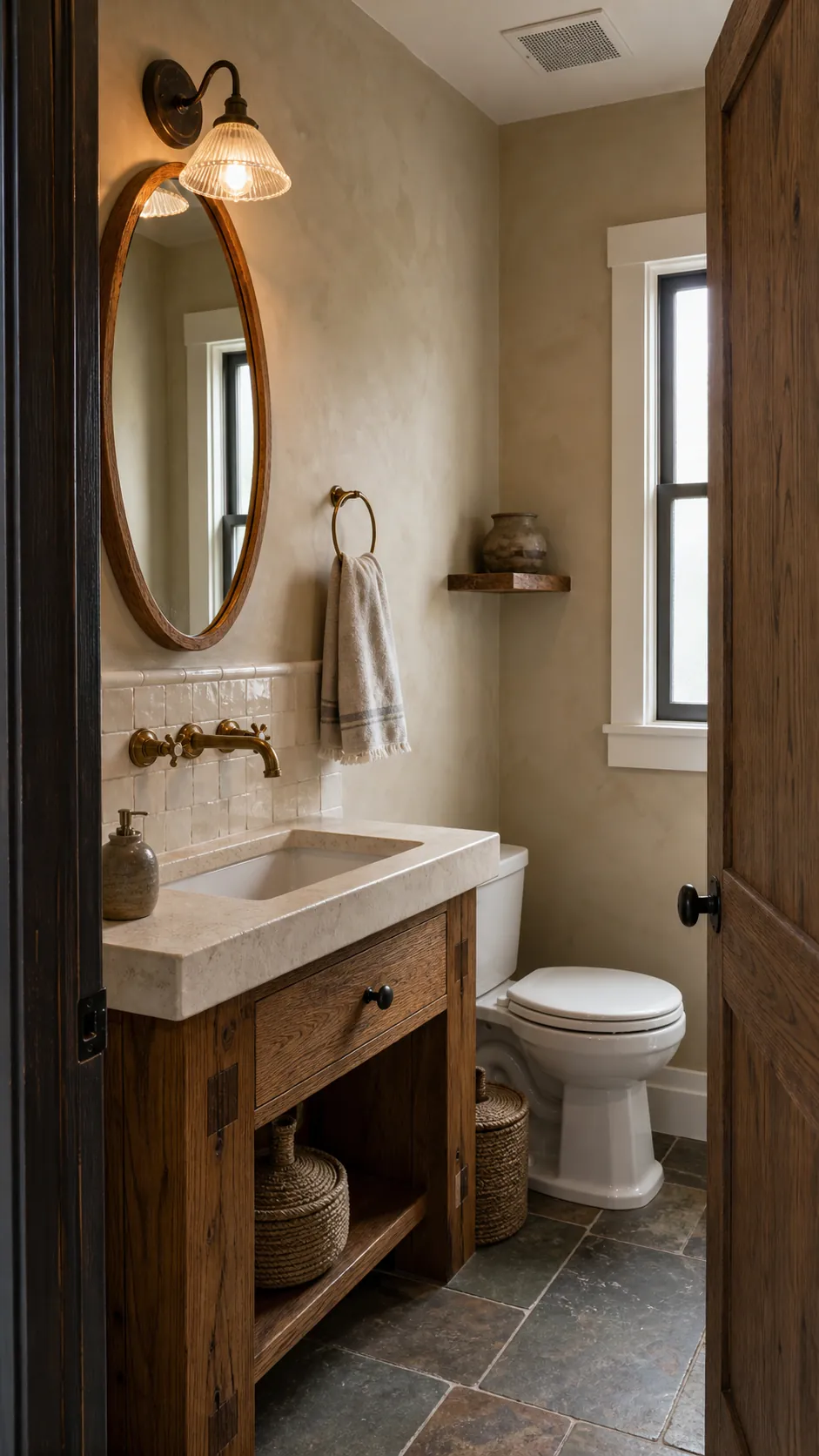
A rustic half bathroom works best when it feels collected, useful, and honest—not like a room assembled from a bundle of farmhouse signs. Because a powder room has so little square footage, one expressive natural material can do more than a dozen small accessories. Start with the sink wall, protect anything vulnerable to splashes, and give the door and toilet the clearances they need before choosing the decorative layer.
These rustic half bathroom ideas range from reclaimed wood and fieldstone to softer country details such as limewash, aged brass, and vintage furniture. Each one can stand alone, so you can borrow the idea that suits your room rather than forcing every rustic cue into the same tiny space.
1. Turn an Old Pine Washstand Into the Vanity
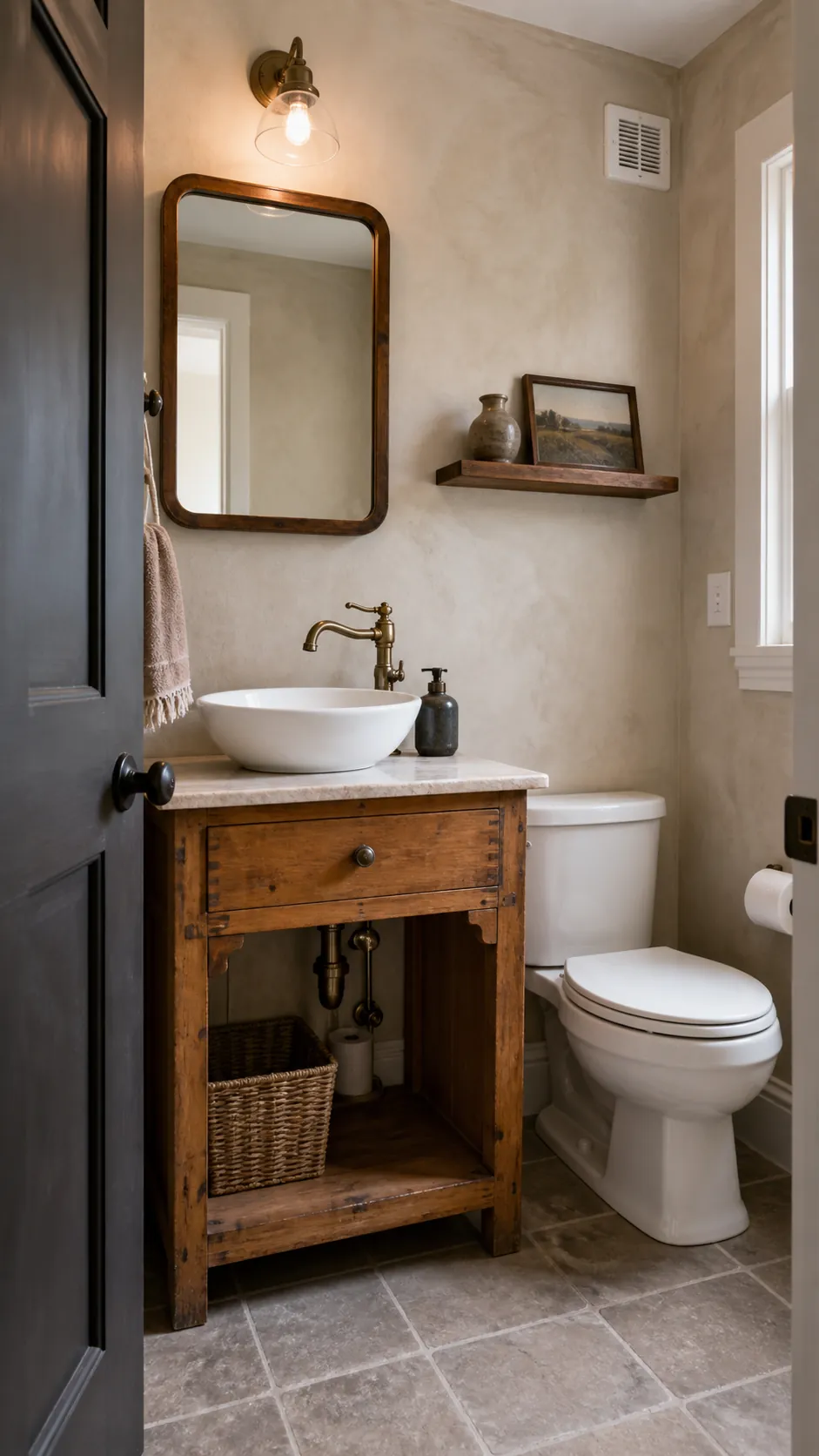
A timeworn pine washstand gives a tiny powder room instant history and useful concealed storage. Look for a piece that is deep enough to support a basin but narrow enough to preserve the path between the door and toilet. A furniture maker or careful carpenter can reinforce the top, create discreet plumbing openings, and seal the wood with a matte, bathroom-suitable finish.
Let the knots, old repairs, and uneven color remain visible; they are the point. A simple white sink keeps the room from becoming too brown, while a short stone backsplash protects the wall without hiding the furniture. Measure drawer movement around the waste pipe before committing to the conversion, and use the surviving drawer space for spare hand towels and toilet paper.
2. Frame the Mirror With Weathered Oak
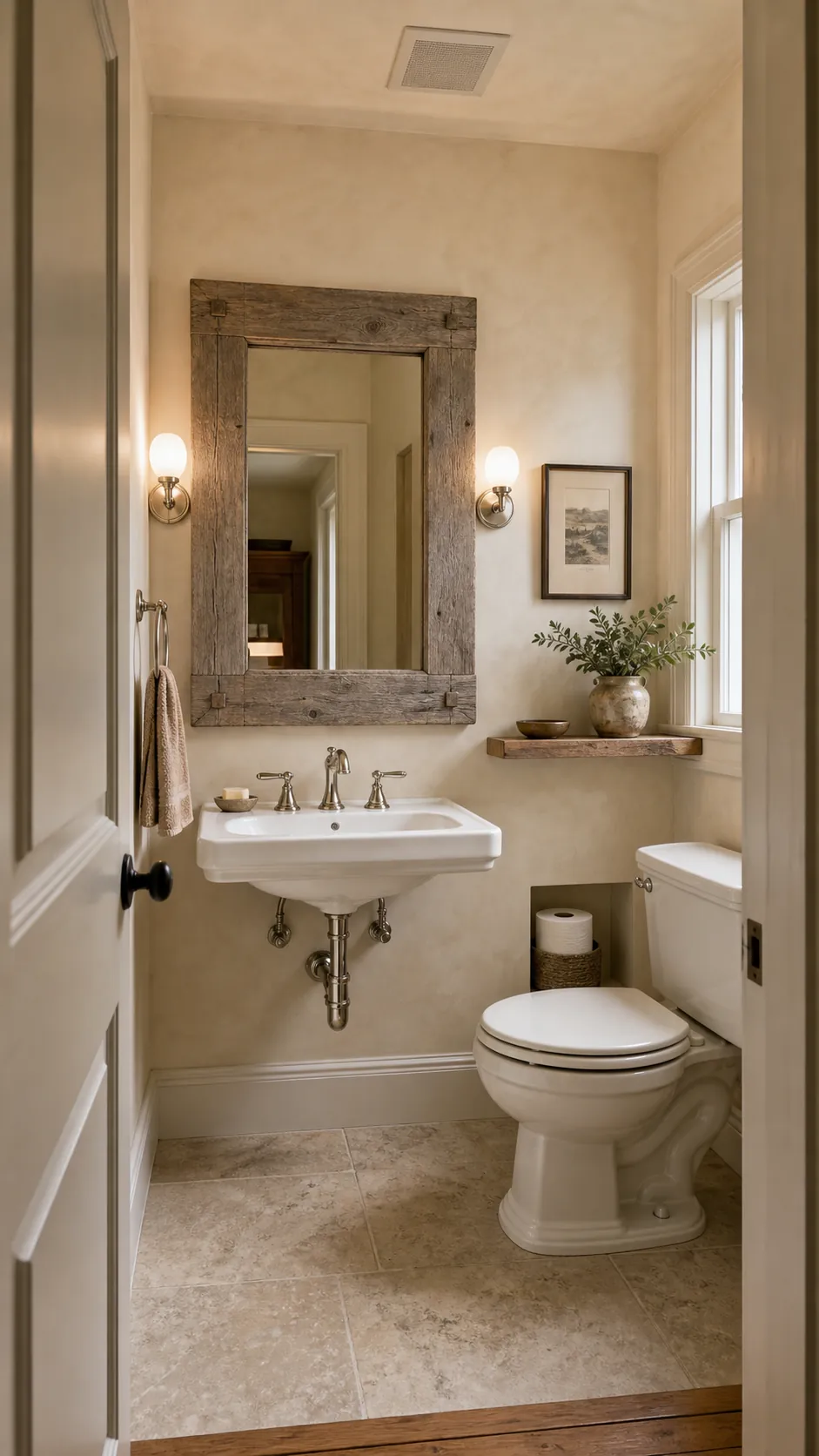
If a wood vanity would overwhelm the floor plan, put the rustic texture at eye level instead. A substantial oak mirror frame becomes the room’s focal point while leaving the basin and floor visually light. Choose boards with genuine grain and restrained distressing rather than gray paint made to imitate age.
Keep the frame clear of faucet splashes and leave enough space for sconces or a ceiling light to illuminate faces evenly. Against warm plaster or quiet cream paint, weathered oak reads as architectural rather than themed. Repeating the timber only once—perhaps in a slim shelf—creates cohesion without turning every surface into wood.
3. Build a Fieldstone Sink Wall
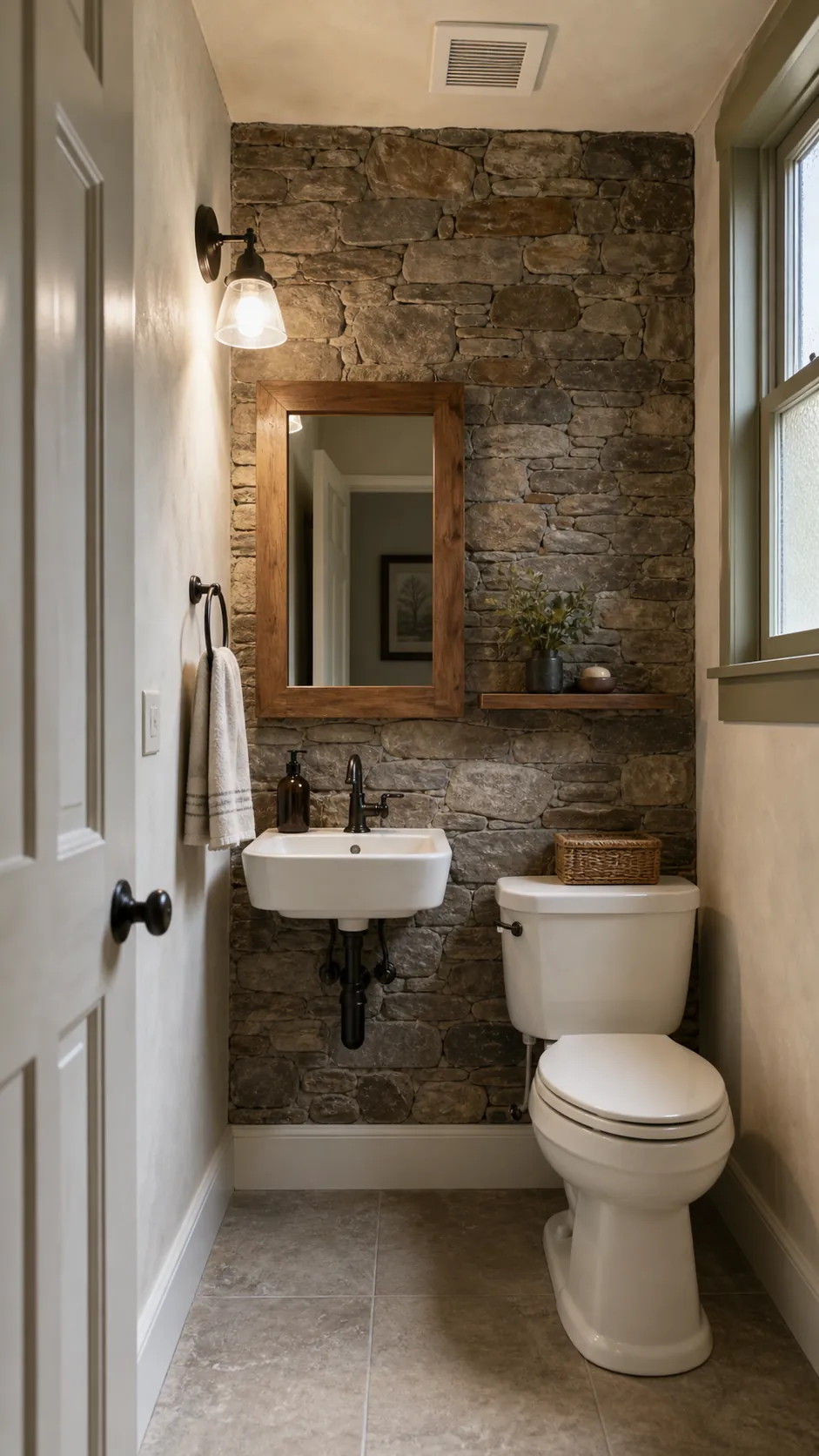
A single fieldstone wall can make a half bath feel connected to an old cottage or mountain house. Restrict the masonry to the sink wall so its irregular texture remains special and does not steal precious inches from every side. Thin stone veneer provides the character of full-depth stone with a more practical projection.
Plan electrical boxes, mirror mounts, and faucet locations before the mason begins. The uneven face needs thoughtful brackets and neat penetrations. Pair the stone with a compact wall-hung basin and a plain floor so the room still feels navigable. Soft grazing light reveals the relief beautifully, but avoid harsh uplighting that exaggerates every shadow.
4. Use Limewash for Soft, Uneven Depth
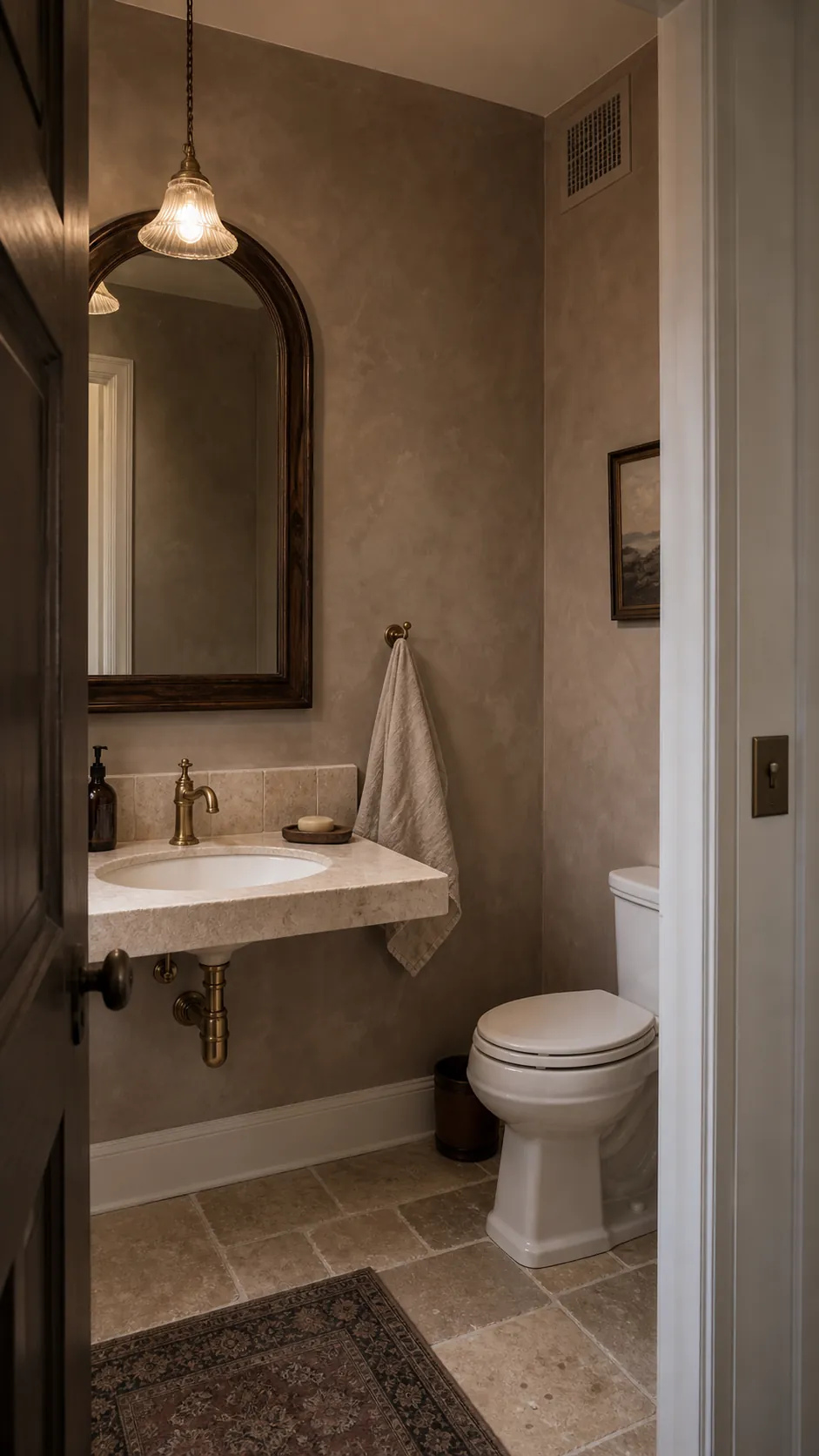
Limewash brings cloudy movement to the walls without adding a busy pattern. Warm mushroom, clay, or putty tones flatter wood and aged metal while making a windowless powder room feel enveloping. The mineral finish is especially convincing in an older home because it responds to uneven plaster rather than trying to erase it.
Check the product’s suitability for your wall substrate and protect the immediate splash area behind the basin. A small stone backsplash or sealed plaster zone can handle routine handwashing. Keep trim simple and slightly lighter than the walls, then use warm-neutral bulbs so the subtle color variation remains visible instead of turning muddy.
5. Pair a Hammered Copper Basin With Quiet Walls
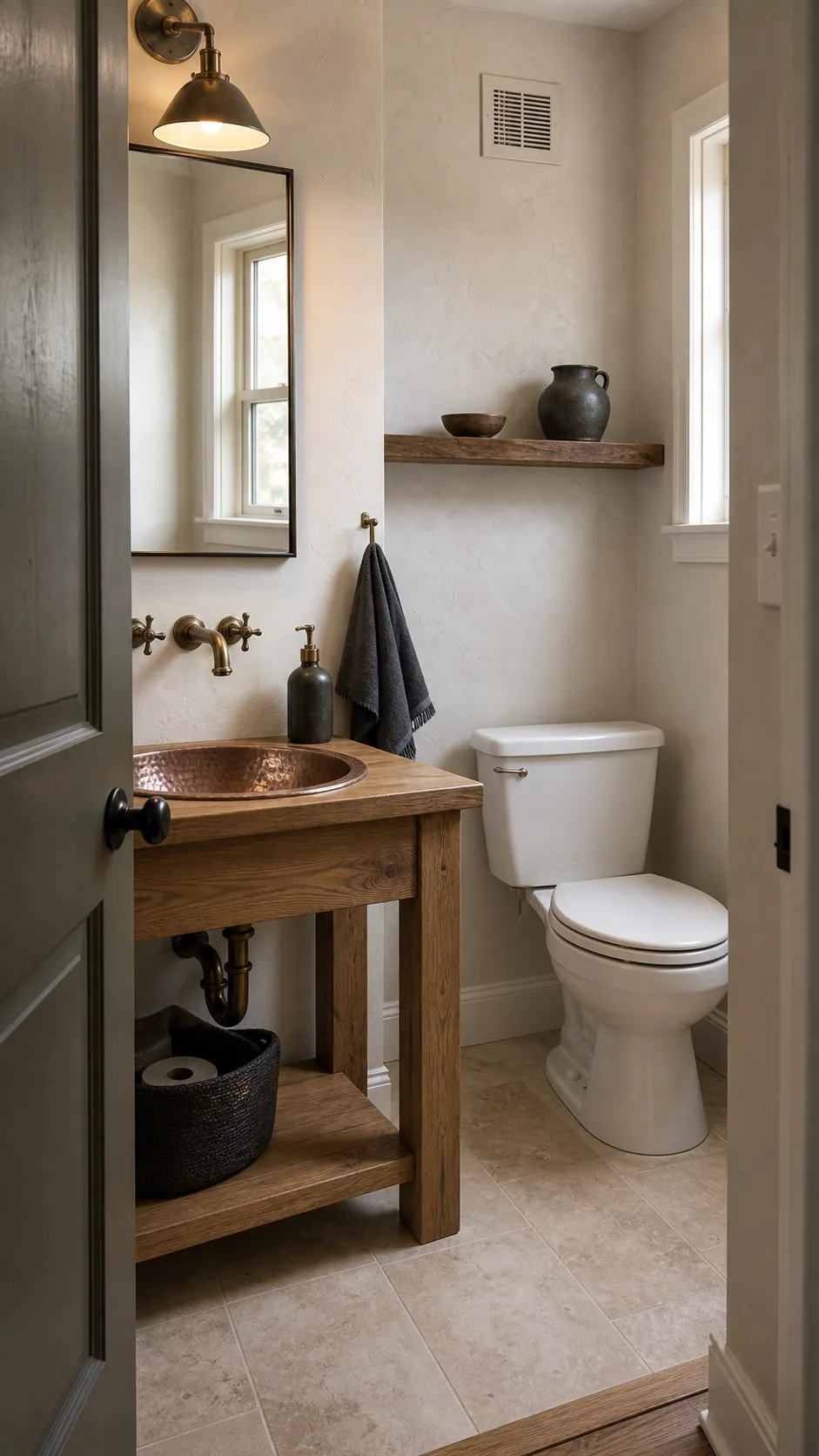
A hammered copper basin supplies warmth, reflection, and craft in one compact feature. It is strongest when the rest of the room steps back: matte plaster, a modest timber counter, and an unfussy mirror allow the metal to lead. Too many matching copper accessories can flatten the effect and make the space feel like a set.
Before buying, learn how the basin’s living finish will change and which cleaners the manufacturer recommends. Patina is part of the appeal, but harsh products may produce blotchy damage rather than graceful aging. A wall-mounted faucet can free counter space, provided its reach and height are tested against the bowl to prevent splashing.
6. Install Beadboard in a Deep Woodland Green
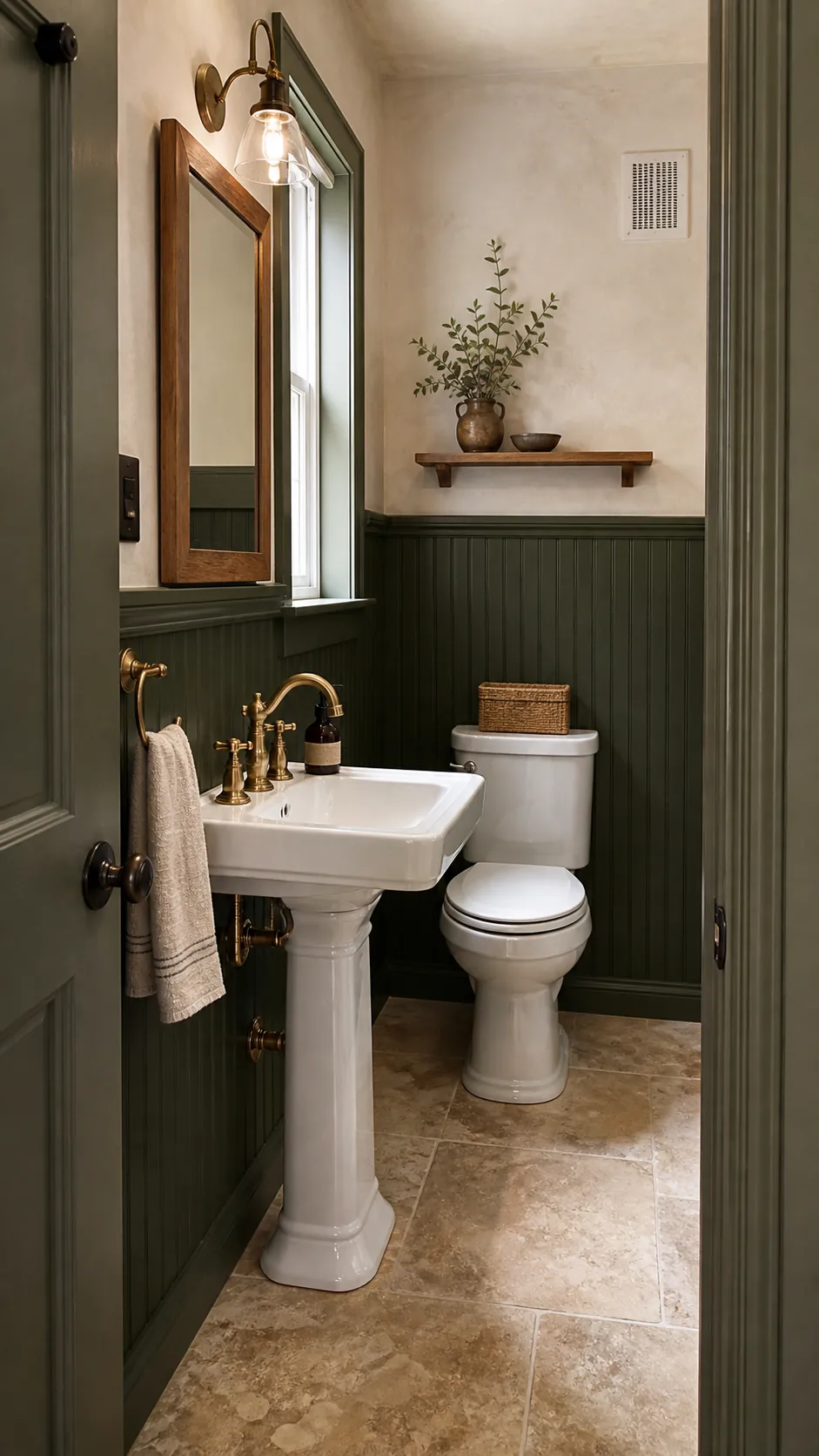
Painted beadboard gives a rustic powder room rhythm and protection without relying on bare timber. A deep woodland green feels grounded beside white ceramic and antique brass, and it hides the small scuffs that collect in a narrow, frequently used space. Take the boards high enough to relate to the mirror rather than stopping at an arbitrary line.
Use a paint system suited to humid interiors and seal vulnerable edges around the sink. Above the paneling, choose a soft neutral plaster color to keep the room from becoming heavy. A simple cap rail offers a crisp transition, but resist filling it with tiny objects; the strong vertical lines are already doing the decorative work.
7. Add One Reclaimed Beam as a Floating Shelf
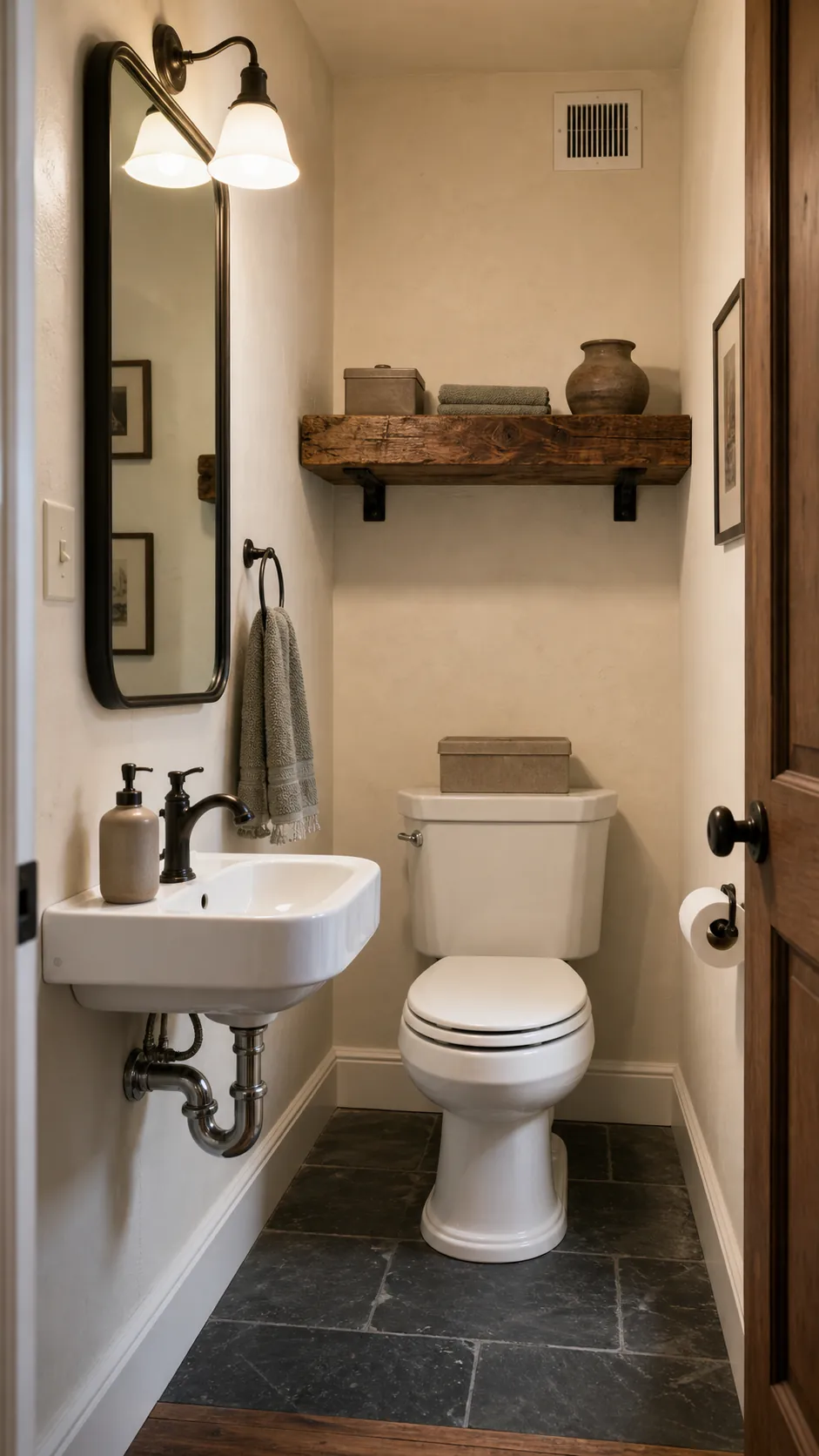
A single reclaimed beam shelf introduces weight and age without crowding the whole room. The wall above the toilet is often the safest place because it uses otherwise empty space and keeps the sink counter clear. Size the shelf so a seated guest has comfortable head clearance, and anchor it into studs or blocking rather than trusting decorative brackets alone.
After cleaning the timber, seal loose fibers and check carefully for old nails, pests, or flaking finishes. Style it sparingly with a lidded box, one small vessel, and perhaps a folded hand towel. Leaving open space around those items makes the beam’s grain and worn edges easier to appreciate.
8. Ground the Room With Slate-Look Floor Tile
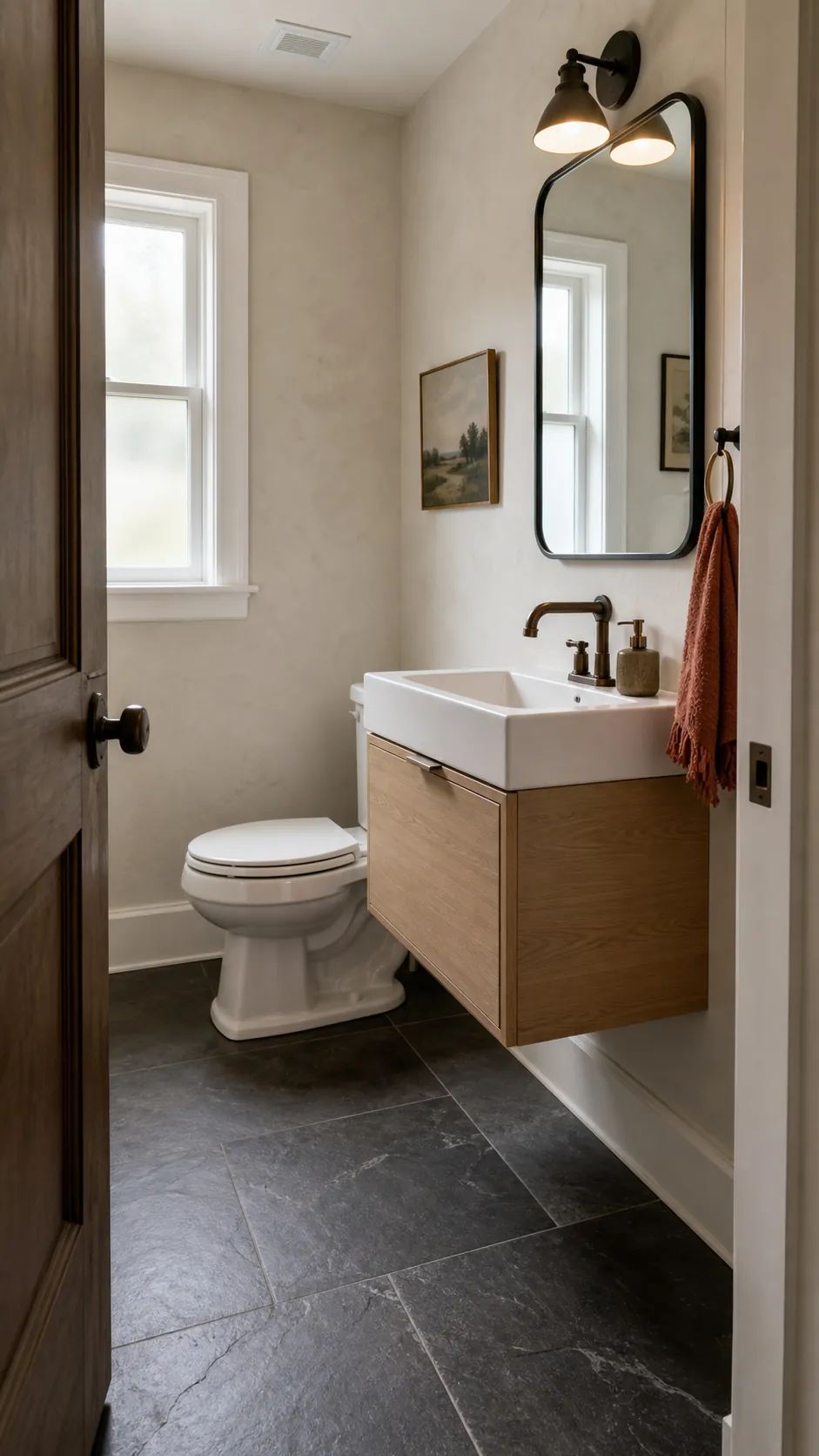
Dark slate underfoot can anchor a light rustic half bathroom and conceal the everyday marks near a busy doorway. Porcelain slate-look tile is a practical alternative when you want consistent thickness, easier care, and less sealing. Select a version with restrained variation; exaggerated printed clefts and repeated patterns quickly reveal the imitation.
Large tiles can make a small floor feel calm, but confirm that the installer can achieve a flat surface and neat cuts around the toilet. Charcoal grout reduces visual interruption. Balance the floor with pale walls, a warm oak accent, and adequate lighting so the room feels grounded rather than cave-like.
9. Hang an Aged-Brass Lantern Pendant
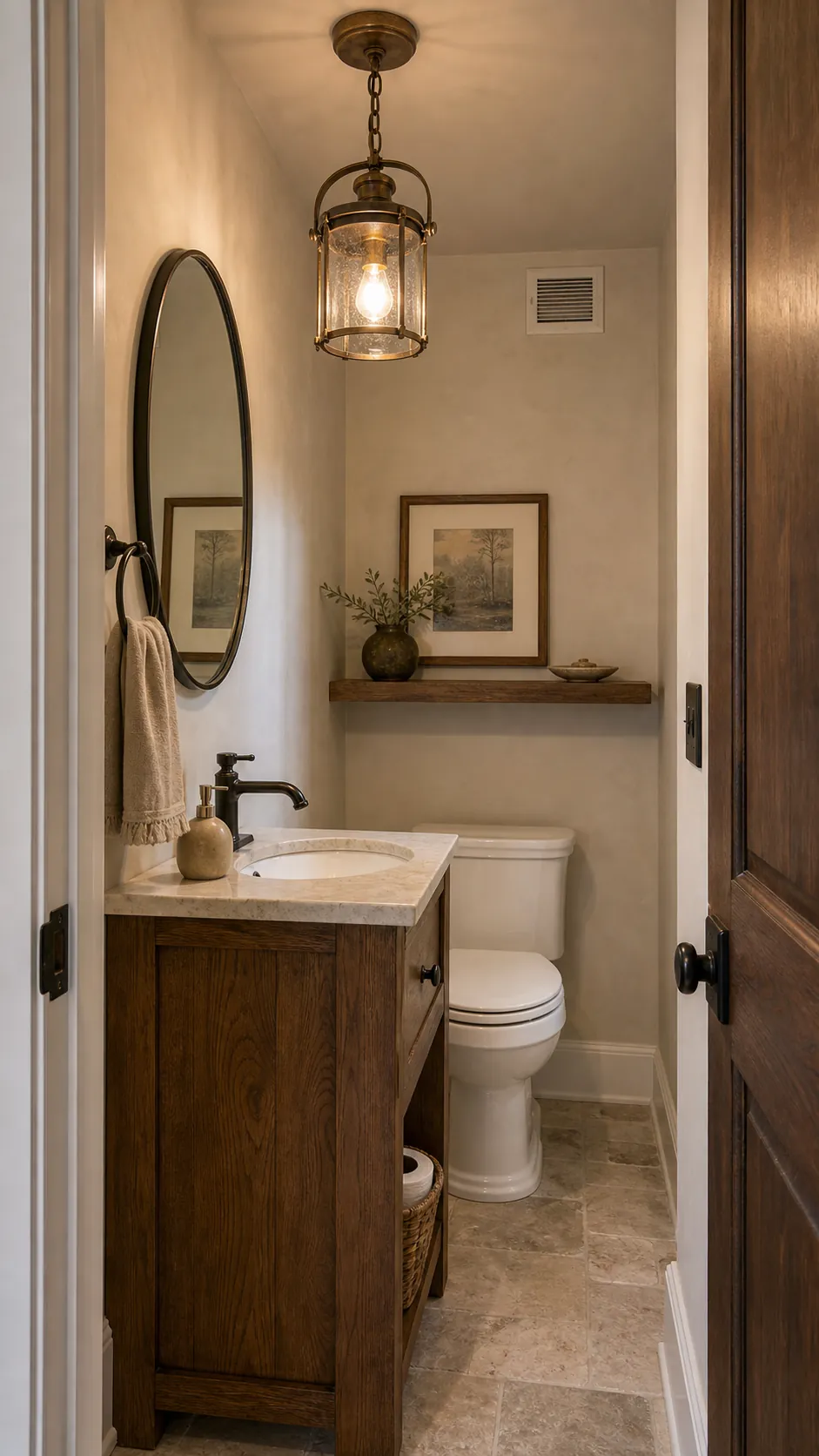
A petite lantern pendant draws attention upward and adds an old-house note without taking any wall space. It suits a powder room with enough ceiling height and can be particularly effective when a wide mirror leaves no room for sconces. Choose a compact, damp-location-rated fixture whose bottom edge clears the door and the tallest users comfortably.
Clear or lightly seeded glass keeps the fixture visually open. Put it on a dimmer so guests get flattering light while cleaning remains easy, and supplement it if the mirror area develops shadows. Aged brass does not need an entire suite of identical metal; mixed, softly worn finishes feel more naturally collected.
10. Repurpose a Stone Trough as the Sink
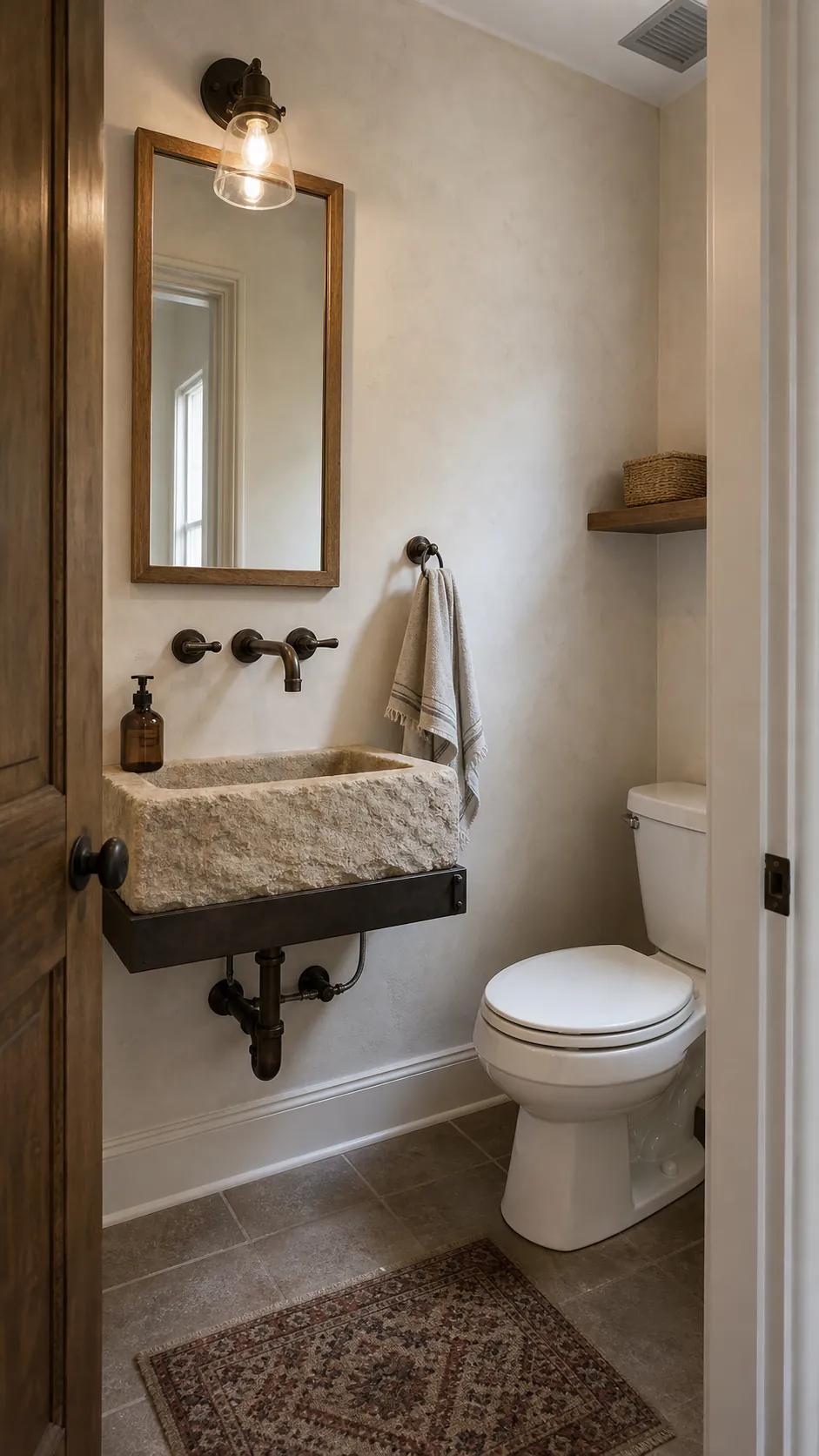
A carved stone trough makes an unforgettable sink, but it needs more planning than a decorative bowl. Confirm the weight with the fabricator, provide a properly engineered support, and make sure the drain geometry works before the wall is closed. A compact new basin with an aged surface is often safer than adapting an unknown antique.
Let the trough be the one rugged gesture. Smooth limewashed walls, a simple faucet, and a clean-lined mirror prevent the room from feeling like a themed cabin. Because many stone surfaces are porous, discuss sealing, soap residue, and maintenance honestly. The best rustic room still needs to work for every guest.
11. Mix Handmade Zellige With Rough Timber
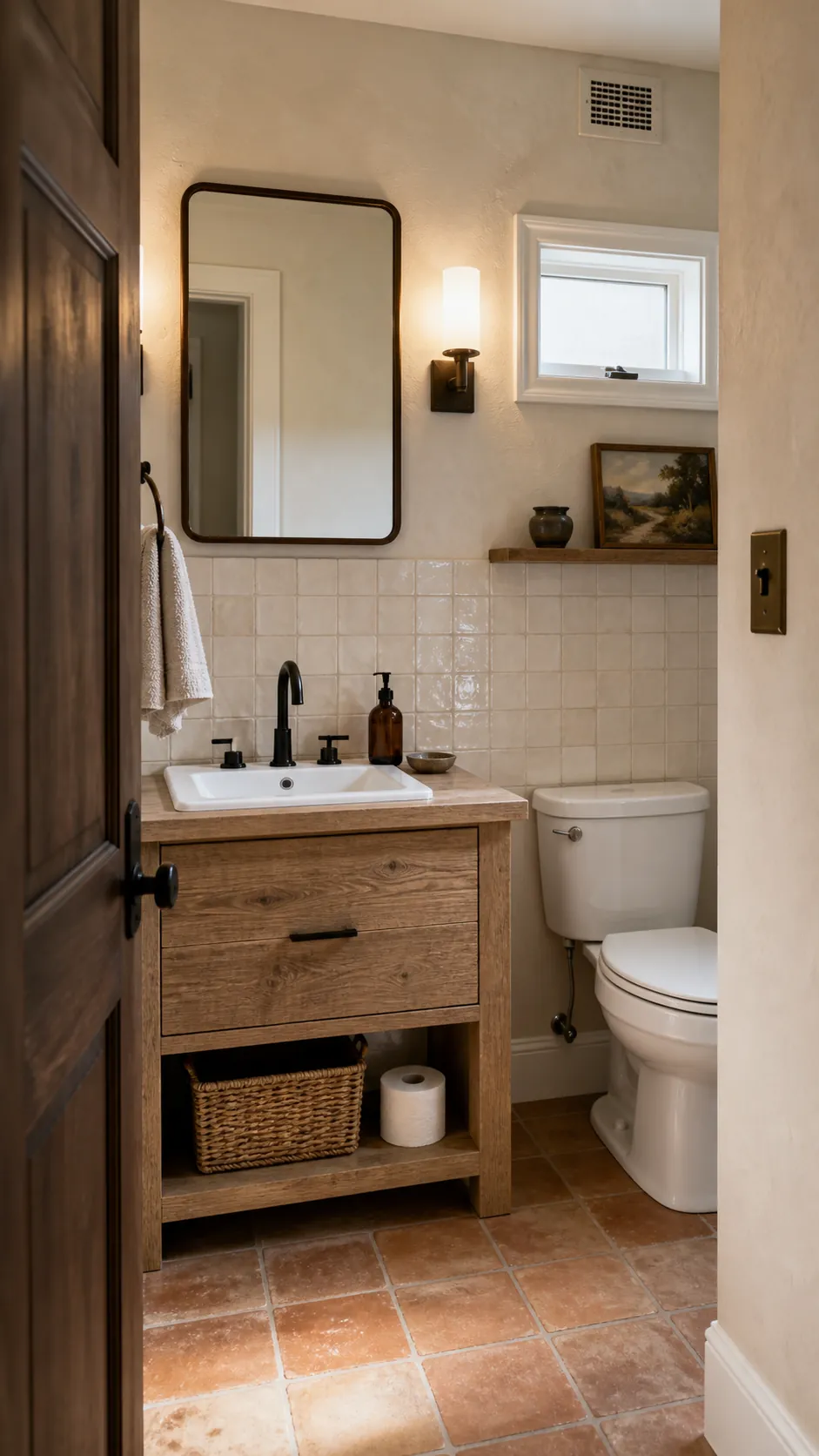
Handmade cream tile offers gentle variation that sits comfortably beside rugged wood. Use it as a practical backsplash rather than tiling every wall, allowing its irregular edges and glossy surface to contrast with a rough-sawn vanity. The two textures feel richer together because neither tries to mimic the other.
Ask the installer to dry-lay the tile and distribute color variation deliberately. Unevenness is characteristic, but outlets, corners, and the sink line should still look resolved. Choose a grout close to the tile color for a continuous surface, then repeat the cream in the wall paint so the tiny room remains bright.
12. Choose a Vintage Landscape in an Oil-Painting Style
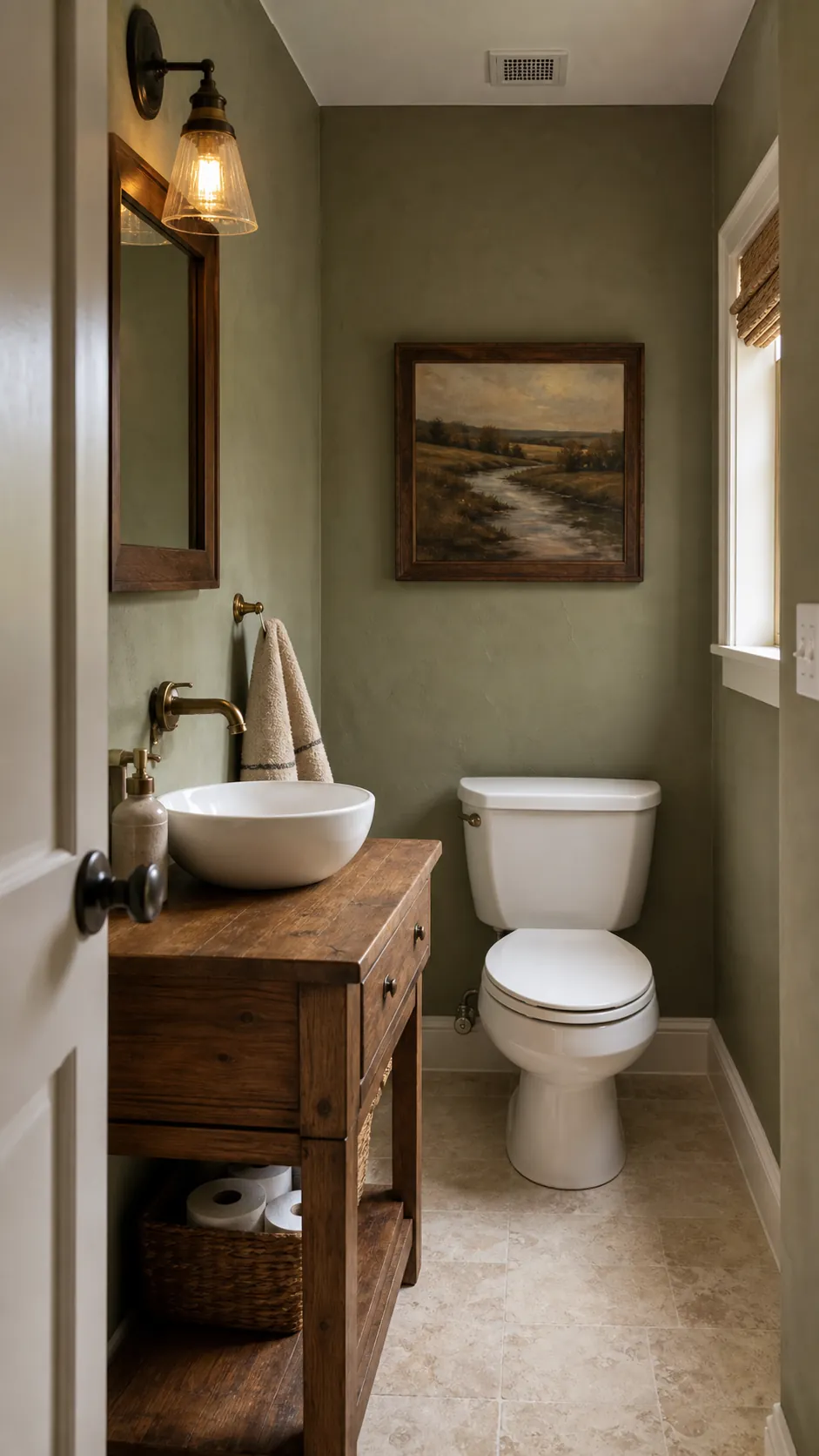
One atmospheric landscape can make a rustic half bath feel personal without adding architectural expense. Look for muted woodland, meadow, or river colors in a simple aged frame. A single larger piece usually reads more confidently than a cluster of tiny novelty prints, and it is easier to keep visually orderly in a narrow room.
Hang the art away from direct splash and use secure hardware suitable for the wall. If the piece is valuable, display a reproduction instead of risking humidity or cleaning products. Pull one quiet green or brown from the image into the towel or paint, but avoid matching every accessory to the artwork.
13. Warm Exposed Plumbing With an Antique Finish
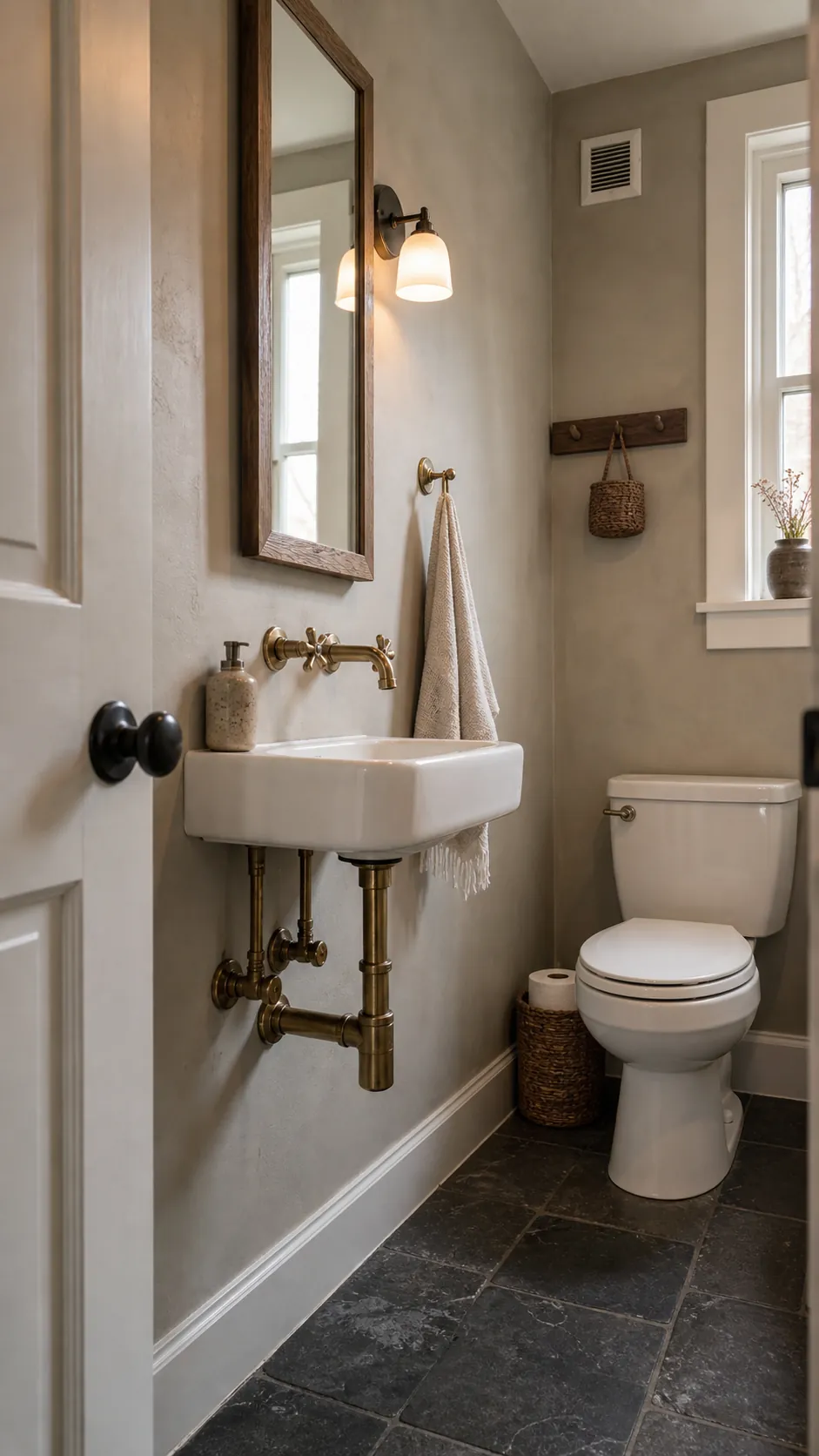
When a pedestal or wall-hung basin exposes the trap and supply lines, treat those components as part of the room. A coordinated antique-brass finish feels warmer than standard chrome and complements timber, stone, and earthy paint. Use real plumbing components designed for the job rather than coating functional parts with an unsuitable decorative paint.
The installation must remain accessible and precise: straight supply lines, tidy escutcheons, and a trap aligned with the drain matter more than ornament. Keep the wall behind it quiet so the hardware reads clearly. This detail is especially useful when there is no room for a bulky rustic vanity.
14. Bring in a Woven Basket and Linen Towel
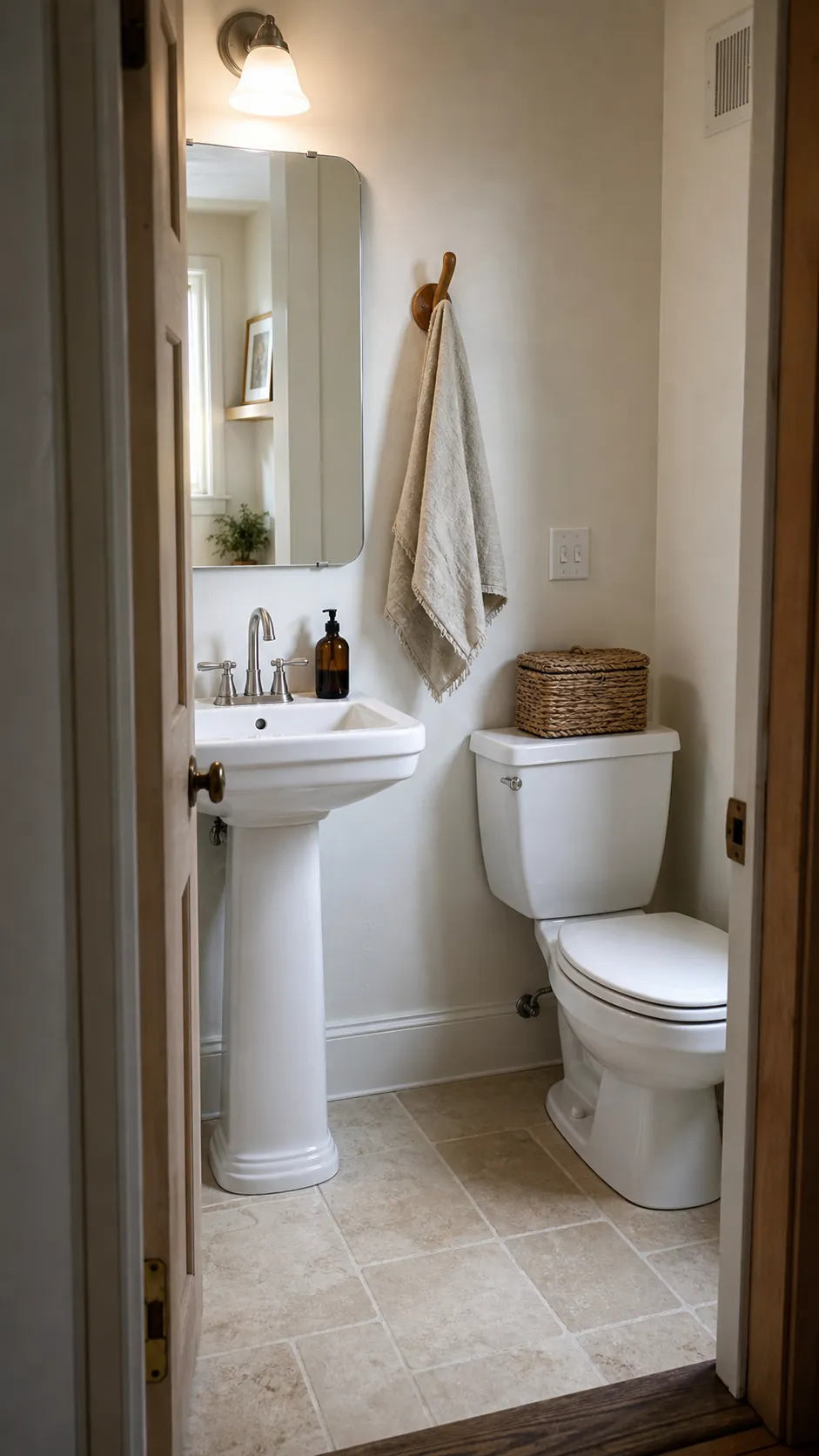
Texture can make a plain half bath feel rustic without a renovation. A lidded woven basket conceals spare rolls, while a softly rumpled linen towel adds a natural, absorbent layer near the basin. Choose pieces sized for the actual gaps in the room so they do not interfere with cleaning or the swing of the door.
Natural fiber does best away from standing water, and a liner keeps the basket easier to maintain. Use just one or two woven pieces; an abundance of baskets, rope, and distressed signs feels more staged than collected. Against warm white walls and simple fixtures, the honest texture is enough.
15. Finish With a Tonal Modern-Rustic Palette
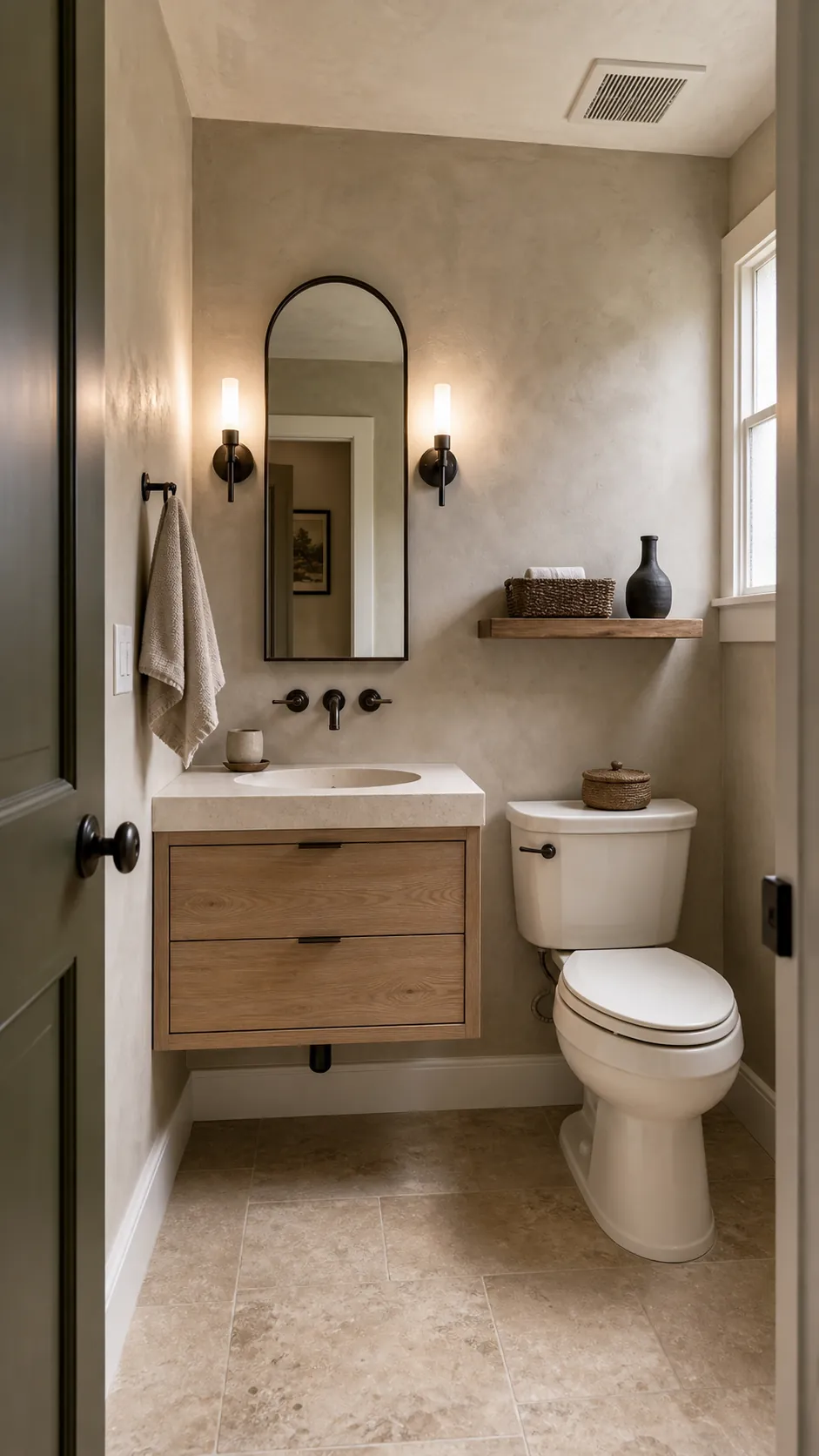
Rustic does not have to mean visually busy. A restrained palette of clay plaster, pale oak, creamy ceramic, and dark bronze lets natural texture carry the design. Clean-lined fixtures keep the room current, while subtle grain and hand-finished surfaces prevent it from feeling sterile.
Choose one dominant warm neutral, one timber tone, and one dark accent, then repeat each with discipline. Good lighting is essential because similar colors can collapse into a flat brown haze. With tonal contrast at the sink, mirror, and floor, the result feels calm, warm, and enduring.
Creating a Rustic Half Bath That Lasts
The most convincing rustic powder rooms use authentic texture with restraint. Decide which material will tell the story, then support it with durable surfaces, good light, and enough open space for the room to function. A reclaimed vanity, stone wall, or deep painted paneling can each lead; they do not all need to compete.
Before installation, verify clearances, wall anchors, moisture requirements, and cleaning needs. Those practical decisions are what allow weathered wood, aged metal, and handmade finishes to look beautiful rather than troublesome. The finished room should feel warm and storied while remaining easy for guests to use.