
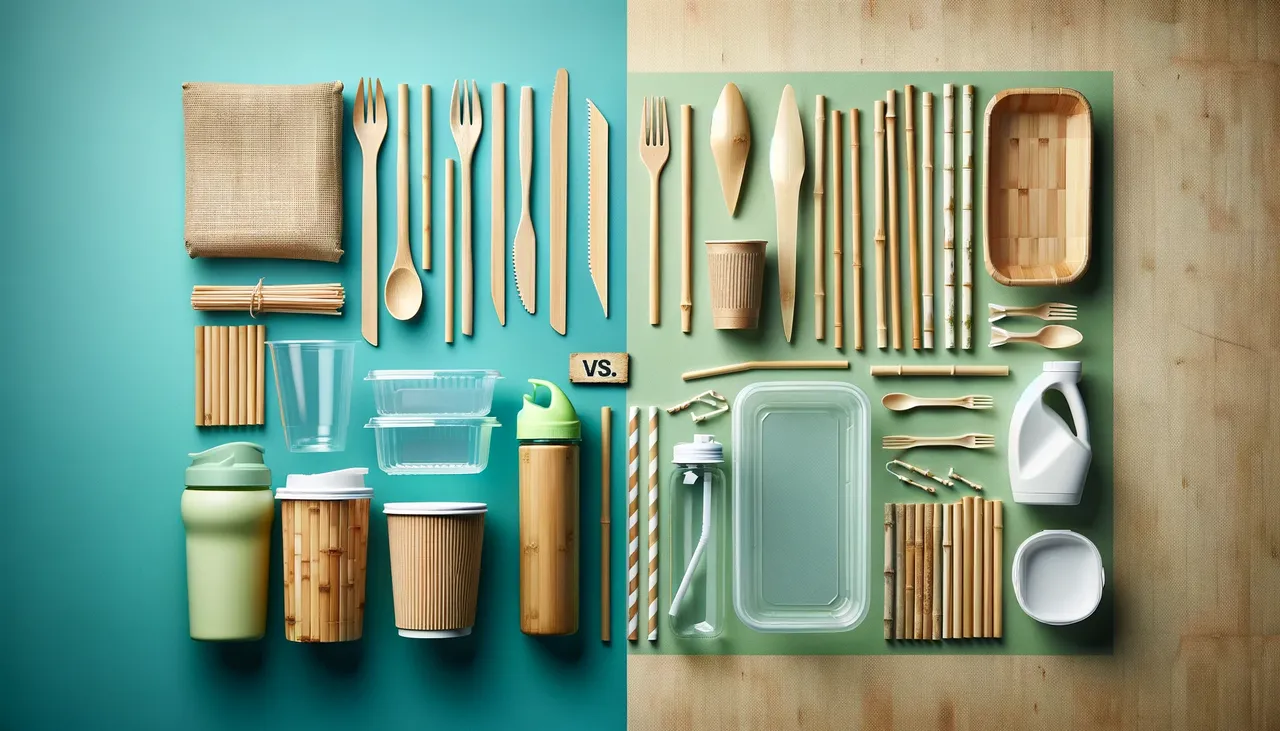
Unfortunately, you can’t move a step without tripping over a plastic item (or the subsequent backlash against it). Plastic is an integral part of life; from our clothes and cars to the device you’re reading this on, there is a trend away from it, and bamboo is one of the products frequently used as a replacement, but how does it fare in bamboo vs. plastic?
Bamboo and plastic are versatile materials with global popularity and usage. Bamboo is grass that many people harvest and use to create various products, from timber to food. Plastic is a synthetic or semi-synthetic material with an almost endless list of uses. Both are practical.
Bamboo is a fantastic product, full of versatility, but how does it compare to our overwhelming dependence on plastic? This article pits bamboo against plastic, comparing their characteristics, origins, uses, strengths, and weaknesses, among other important points, to help the savvy consumer decide between synthetic vs. natural products.
Bamboo Vs. Plastic: Origins, Uses, And Characteristics
Plastic is the most widely used product of our (and the previous) century. However, many people know the negative repercussions we and our descendants will face using plastic. There is a global trend to move away from using plastic in preference for natural alternatives.
Of these natural products, bamboo shows incredible promise in a plethora of industries as a suitable substitute. Below, we’ll further examine and compare these products for interest and to help consumers make informed decisions.
Bamboo Vs. Plastic: Origins
The best place to start is where each material comes from.
Bamboo Origins
Bamboo products are derived from the bamboo plant. The (roughly) 1400 distinct bamboo species belong to the subfamily Bambusoideae of Poaceae (the grass family).
While bamboo is commonly found globally in tropical, subtropical, and mild temperate regions, most bamboo plants (and presumed origins) are in Asia (particularly the east, southeast, and surrounding areas).
Bamboo has a long-standing history of use with the ancient civilizations living nearby, who revered bamboo, elevating its importance to symbolic and spiritual meaning (these plants are featured in Chinese and Japanese poetry and folklore and were used in Buddist traditions).
Bamboo was first used roughly 5000 years ago and is still relevant today, although it has experienced peaks and dips in popularity.
Plastic Origins
While plastic is nowhere near the age of bamboo’s use, it has been around longer than most people realize.
Plastic is a synthetic (human-made) or semi-synthetic product formed by mixing polymers. Polymers are many groups of molecules (macromolecules – a collection of monomers) joined together to create a new product. This joining is through heat and pressure.
The original discovery of plastic dates back to 1862, when Alexander Parkes discovered “Parkesine” in London, England. He synthesized this material from organic cellulose (the material in plant cell walls), making it a semi-synthetic product.
There were several major developments over the years, like the 1868 discovery of celluloid (a combination of cellulose with camphor) by John Wesley Hyatt.
Later, in 1907, Leo Hendrik Baekeland synthesized (and patented) the first truly synthetic plastic. He produced a new type of polymer resin by mixing formaldehyde with phenol. The resulting product was called “Bakelite.”
Since these developments, manufacturers have produced several different plastic varieties, including:
- Polyamide
- Polyethylene terephthalate
- Polymethyl methacrylate
- Polystyrene
- Polyvinyl chloride
Bamboo Vs. Plastic: Uses And Production
Bamboo and plastic are incredibly versatile materials with a tremendous range of uses. While bamboo is useful in various forms, plastic is generally “tailor-made” to suit a particular need.
Bamboo Uses And Production
Bamboo is popular in its various forms, including:
|
Bamboo form |
Uses |
|
Living plants |
Landscaping/decoration |
|
Shade/screening | |
|
Timber |
Building materials for houses, boats, roofs, flooring, etc. |
|
Utensils (incl. Cutting boards, chopsticks, and spoons) | |
|
Furniture | |
|
Buckets | |
|
Irrigation pipes | |
|
Fishing rods | |
|
Fibers |
Biocomposites |
|
Fabric/textiles | |
|
Paper | |
|
Food fortification | |
|
Saplings and seeds |
Human consumption |
|
Medicine | |
|
Leaves |
Fodder for livestock |
Bamboo undergoes various processing techniques to achieve the desired end product.
As a building material, bamboo is usually harvested and dried. It’s cut to the desired length and shape and attached with ropes, nails, screws, etc. Bamboo is frequently “glued” with a strong adhesive to create utensils, building equipment, or other items.
As a biocomposite, bamboo fibers are shredded and added to a resin. The mixture is subjected to intense heat and pressure to create a usable substance.
When used in fabric, bamboo fibers are extracted through mechanical (boiling the culms and scraping the loose fibers with special tools), chemical (caustic chemicals “burn” the fibers free, which are mixed with other chemicals), or combination methods to produce yarn for spinning.
Plastic Uses And Production
Plastic is the most widely used substance. The type of plastic plays a fundamental role in what the end product is and what processing is required.
Plastic is used in many industries to produce many essential products, including:
- Building materials
- Consumer products and appliances
- Toys
- Electronics (including cables, switches, and plugs)
- Linen
- Clothing
- Sports equipment
- Medical equipment (syringes, machines, etc.)
- Packaging (including containers for other products like food and liquid products)
- Transport/vehicles (including cars, boats, bikes, bicycles, and airplanes)
- Energy production (solar systems, wind turbines, etc.)
- Military equipment (as part of the personal protective equipment and many others)
Although the end products vary, plastic usually follows a similar production process. Ethane and propane are refined from natural gas, oil, or plants. These components are put through “cracking,” which produces ethylene and propylene.
They are in the form of monomers, which are combined with other monomers to produce macromolecules. Hundreds of these macromolecules are joined (with heat and pressure) to produce polymers (like polyethylene and polyurethane).
The process is known as polymerization, requiring a catalyst (like benzoyl peroxide). The resulting plastic is usually shaped into pellets. These pellets are heated into a liquid state and injected into a mold to produce the desired end-product.
Bamboo Vs. Plastic: Characteristics And Traits
Bamboo and plastic are highly prized for their characteristics and traits as a material.
While bamboo receives its characteristics from the parent plant and the manufacturing process (i.e., what form is the bamboo used in and how it got to that point), plastic is synthetic. Its properties are “custom-made” by adding specific materials.
Bamboo Characteristics And Traits
Bamboo’s properties vary depending on the plant species and the form that it’s in. While the list is extensive, the characteristics below are some noteworthy properties.
Bamboo as a living plant:
- Different growth forms (as a runner or clump)
- Incredibly fast growing (some species may grow up to 1’ a day)
- Various heights, from 4” to 130’, depending on the species
- Shade-producing
- The hollow culms (lignified) are incredibly hard in mature plants
- The culm is made of nodes (which contain silica) and internodes and grows from a rhizome
- They are disease and rot-resistant. Bamboo contains natural antibacterial and antifungal properties.
Bamboo as a timber:
- Lightweight
- Strong
- Durable
- Rot-resistant, with antibacterial and antifungal properties
- Relatively water resistant
Bamboo as a biocomposite:
- Incredibly strong (comparable to mild steel)
Bamboo as textile:
- Soft
- Absorptive
- Breathable
Bamboo as food:
- Rich in amino acids, carbohydrates, minerals, and protein.
- Low in fat
- A source of fiber
Plastic Characteristics And Traits
There are several different types of plastic, depending on the polymers used during its production. However, plastic generally shares certain characteristics, which include:
- Lightweight
- Strong and durable
- Malleable, pliable, and easy to inject into a mold when melted down
- Flexible and elastic, or rigid (as needed)
- Poor conductor of electricity
- Poor conductor of heat/good insulator
- Resistant to corrosion
- Recyclable (some types)
Bamboo Vs. Plastic Strengths And Weaknesses
The table below compares some significant strengths and weaknesses of bamboo vs. plastic.
|
Bamboo |
Plastic | |
|
Strengths |
Organic, biodegradable, and environmentally friendly |
Recyclable (some types) |
|
Fast-growing and widespread/sustainable resource |
More resilient | |
|
Resilient |
Cheap to produce | |
|
Cheap to cut (for timber products and food) |
Versatile | |
|
Versatile |
Waterproof | |
|
Ornamental and usable in its natural form |
Customizable properties | |
|
Weaknesses |
More expensive |
They are synthetic products and not environmentally friendly (microplastics) |
|
Not as waterproof |
Production requires toxic chemicals and releases dangerous gases. | |
|
Harmful chemicals (like formaldehyde) are used to produce fibers and as adhesives. |
Some plastic is not recyclable and takes hundreds of years to decompose. | |
|
Eventually, rot sets in |
They pose a risk of causing cancer. | |
|
Some plants are not sustainably harvested. |
Plastic is too widely used and results in significant wastage. |
Bamboo Vs. Plastic: Which Is Better?
Although plastic is involved in a much wider variety of industries and products, bamboo has one significant advantage. It is a naturally occurring, environmentally friendly product (when grown, harvested, and processed correctly).
Plastic’s significant advantages are its malleable, ductile, and manufacturers can alter its properties according to their specifications (by adding different macromolecules to the polymer mix).
While plastic is more versatile than bamboo, the health and environmental risks it poses are not worth the tradeoff.
However, thanks to their practical applications, plastics are here to stay for many more decades before an alternative is discovered/implemented.
Conclusion
While bamboo and plastic are highly versatile products, plastic has many more uses. Bamboo is a fantastic alternative for many industries, but it is more expensive, takes more manufacturing effort, and lacks the longevity of plastic. Switching to using bamboo is a good idea; however, we won’t get away from plastics for many years.