

A boring hallway usually is not failing because it needs more stuff. It is failing because the eye has nowhere to land. The floor feels like a strip of leftover space, the walls look longer than they really are, and every door, shoe pile, or blank patch starts to feel louder than it should.
A runner rug fixes that faster than most Hallway Decor because it gives the space a visual path. It adds color, texture, sound softness, and a sense of direction without asking you to hang ten things on the wall or buy bulky furniture. The trick is choosing the right runner for the hallway you actually have, not the one in a perfectly staged photo.
Use this as a practical, room-by-room guide to make a Hallway Runner look intentional, safe, and easy to live with.
Start With the Problem the Hallway Needs to Solve
Before looking at Runner Rugs, decide what the hallway is missing. Most dull hallways have one main problem: they feel too long, too cold, too narrow, too cluttered, or too disconnected from the rooms around them. A runner can help with all five, but the best choice changes depending on the problem.
- If the hallway feels long and empty, choose a runner with a repeated pattern that breaks up the walk.
- If the hallway feels dark, use a warm light base, a woven texture, or a muted pattern with cream, tan, sage, rust, or blue.
- If the hallway feels messy, choose a forgiving low-contrast pattern that hides dust between cleanings.
- If the hallway feels disconnected, pull one color from the entryway, living room, or nearby wall art.
Do not start with the prettiest rug. Start with the hallway’s job. That one decision keeps the rug from becoming another random thing in a narrow space.
Measure for Breathing Room, Not Wall-to-Wall Coverage
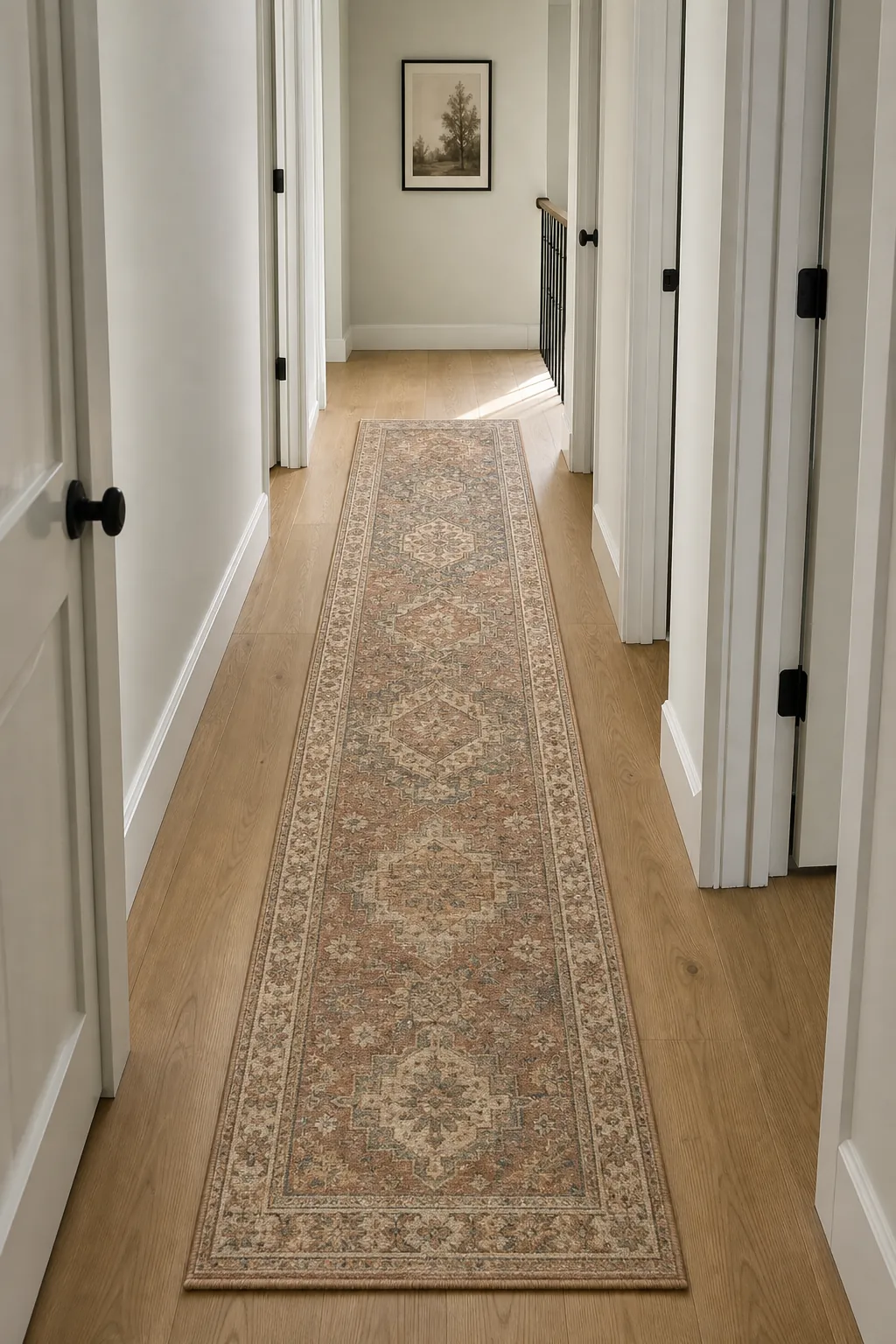
A runner should look like it belongs on the floor, not like carpet that stopped too soon. The easiest rule is to leave visible flooring on both sides. In a very narrow hallway, that might be only a few inches. In a wider entry hall, it can be more generous. What matters is that the visible floor border looks even and deliberate.
Length matters just as much. A runner that stops awkwardly in the middle of a doorway can make the hallway feel chopped up. A runner that runs too close to the front door can catch under the door or trap dirt. Try to let the runner begin and end at natural points: after the door swing, before a threshold, or centered between two openings.
For a quick test, use painter’s tape on the floor before ordering. Mark the width, mark the start and end point, then walk through the hallway as you normally would. Open doors. Carry a laundry basket. Turn with shoes in your hand. If the taped outline already feels annoying, the rug will feel worse.

Choose a Low-Pile Rug That Doors and Feet Can Live With
Hallways are not quiet display zones. They take shoes, bags, packages, wet umbrellas, kids cutting through, and guests who do not know where the rug edge is. That is why pile height is more important here than softness. A thick plush runner may feel nice under bare feet, but it can catch on doors, curl at the corners, and make a narrow hallway feel crowded.
Look for a low-pile, flatweave, indoor-outdoor, wool, cotton, jute-blend, or washable runner depending on your household. For a front entry or mudroom path, washable and low-pile usually wins. For a quieter interior hallway, wool or a natural woven texture can feel warmer and more elevated.
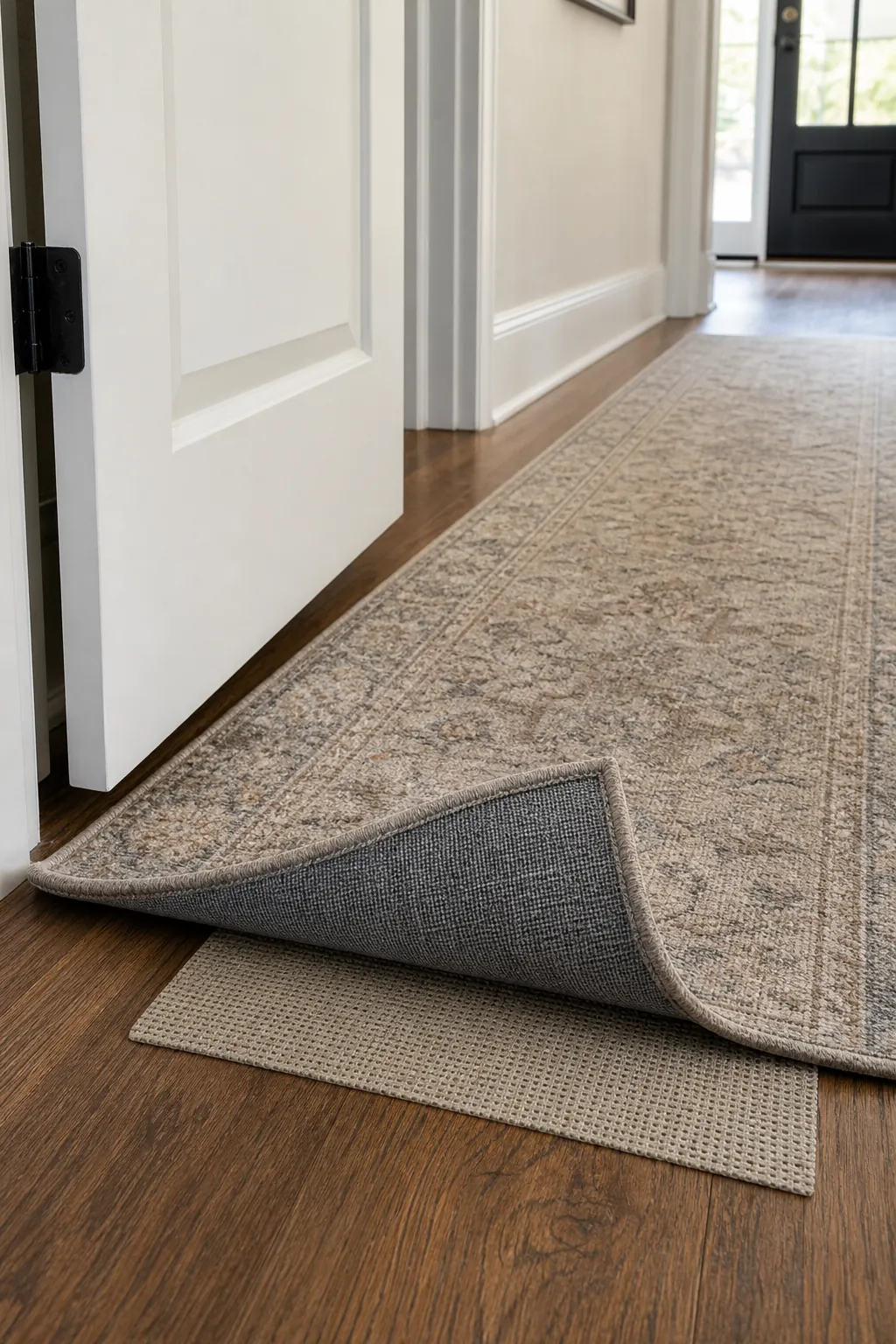
The non-negotiable is the rug pad. A runner without a proper non-slip pad is decor pretending to be a trip hazard. Choose a pad made for your floor type, trim it slightly smaller than the rug, and check that the corners sit flat after a few days of use.
Use Pattern to Hide Real Life, Not to Shout
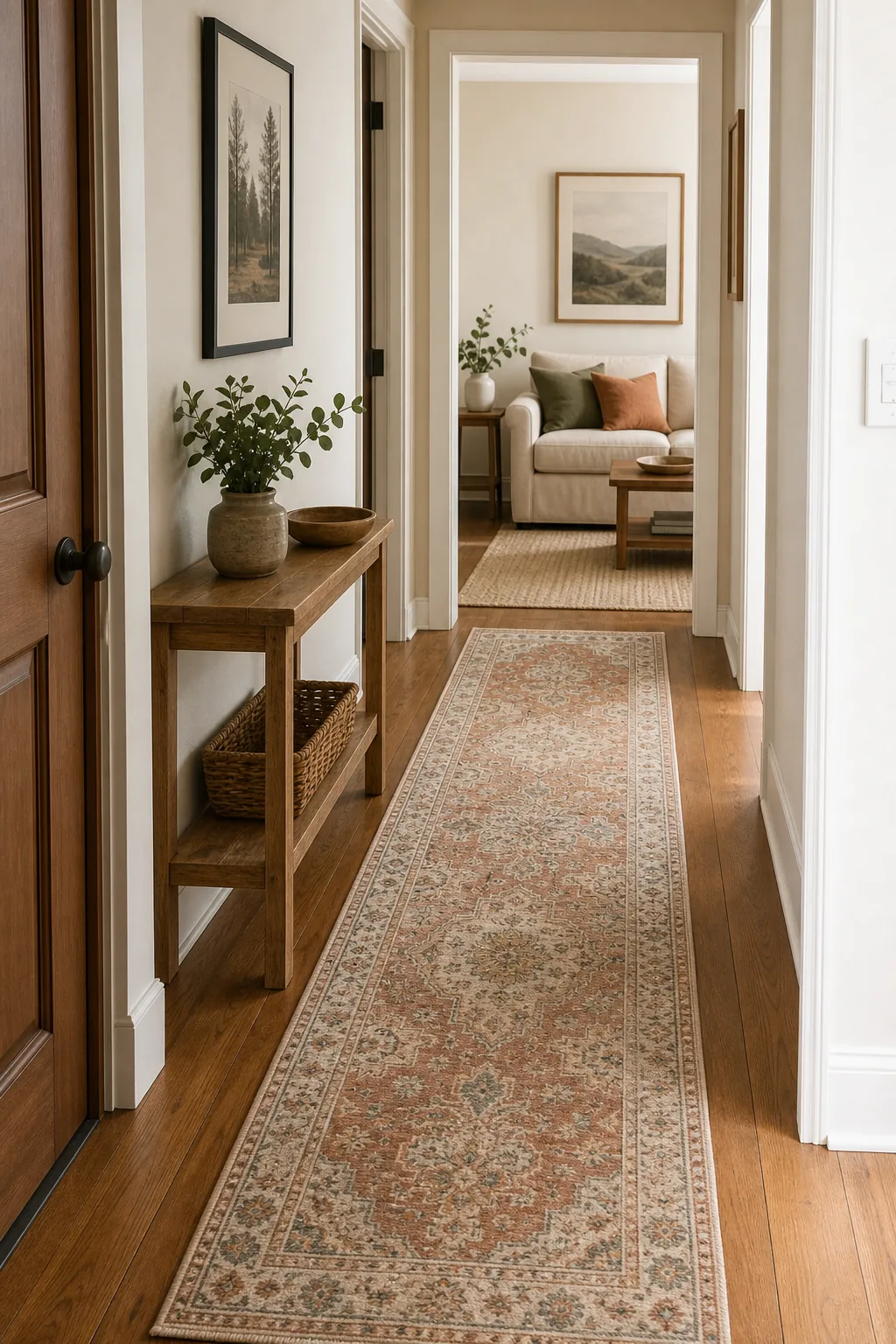
A plain solid runner can work, but in a hardworking hallway it often shows every crumb, footprint, and shifted fiber. A subtle pattern is more forgiving. Vintage-inspired motifs, narrow stripes, small geometrics, tonal borders, and woven texture all add movement without making the hallway feel busy.
Good Rug Styling uses the runner as the bridge between spaces. If the nearby living room has warm wood, pick a runner with a little camel, rust, or oat. If the entryway has black hooks or frames, a thin charcoal line in the rug can make the choice feel connected. If the walls are white and the hallway lacks warmth, bring in natural fiber texture instead of more bright white.
For small space decor, the safest move is a medium-scale pattern. Tiny patterns can read dusty from a distance. Huge patterns can make a narrow hall feel cramped. Choose a runner that looks calm from the front door and interesting when you stand over it.
Place the Runner So It Works With the Entry, Not Against It
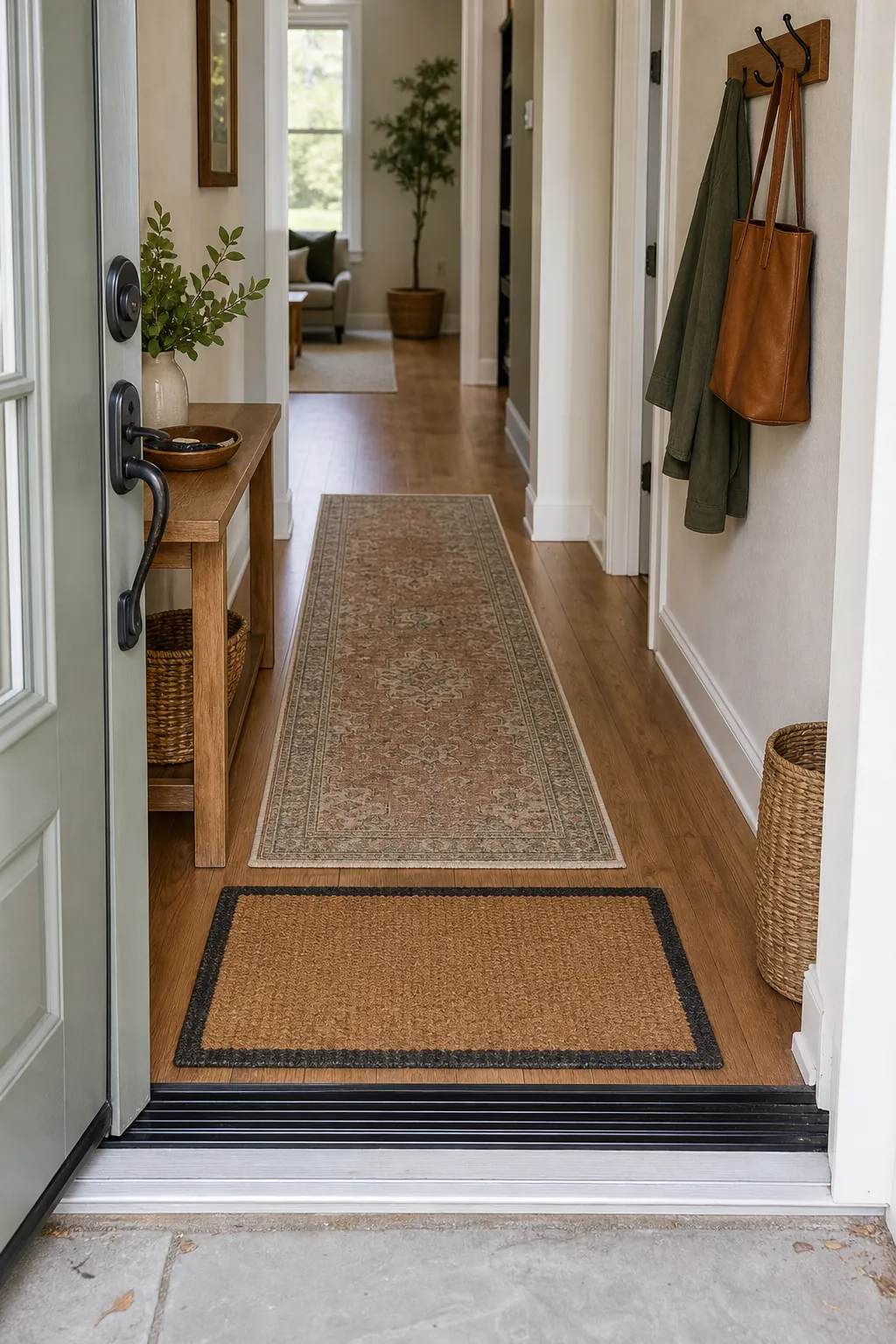
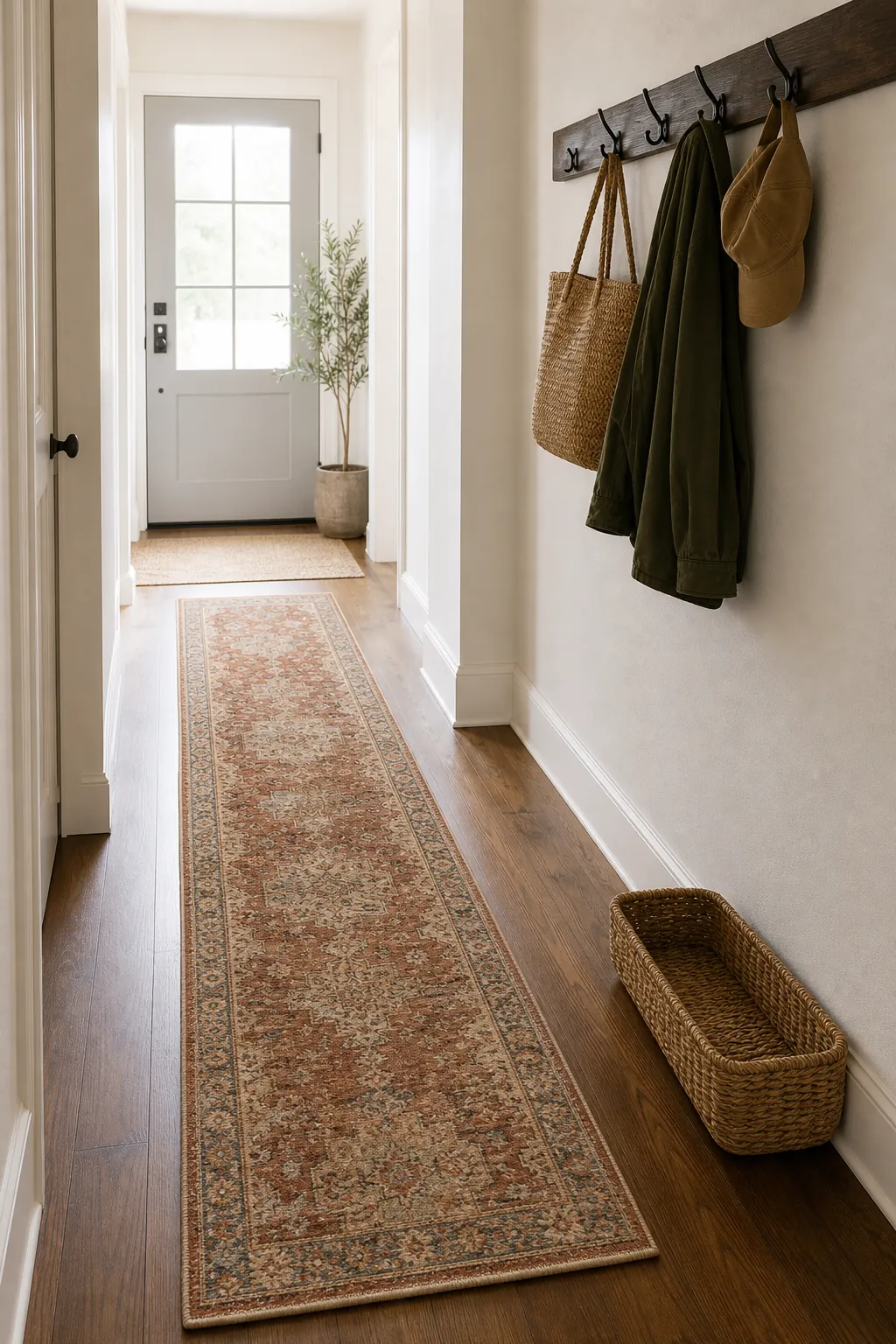
If the hallway begins at the front door, think about the door zone first. The runner should not fight the swing of the door, cover an uneven threshold, or replace a doormat that catches dirt. In many homes, the best setup is a sturdy mat right at the door and the runner beginning just beyond it.
This is where Entryway Decor and practical home organization overlap. The runner creates the path, the mat catches grit, and a slim basket, hook rail, or tray handles the objects that usually end up on the floor. If the rug is doing all the work while shoes and bags pile up beside it, the hallway will still feel cluttered.
For Foyer Ideas, keep the first view clean. When the front door opens, the eye should see a clear path, not a rug edge, shoe pile, or awkward furniture leg. Center the runner with the main walking line, even if the hallway itself is not perfectly symmetrical.
Make a Long Hallway Feel Designed, Not Endless
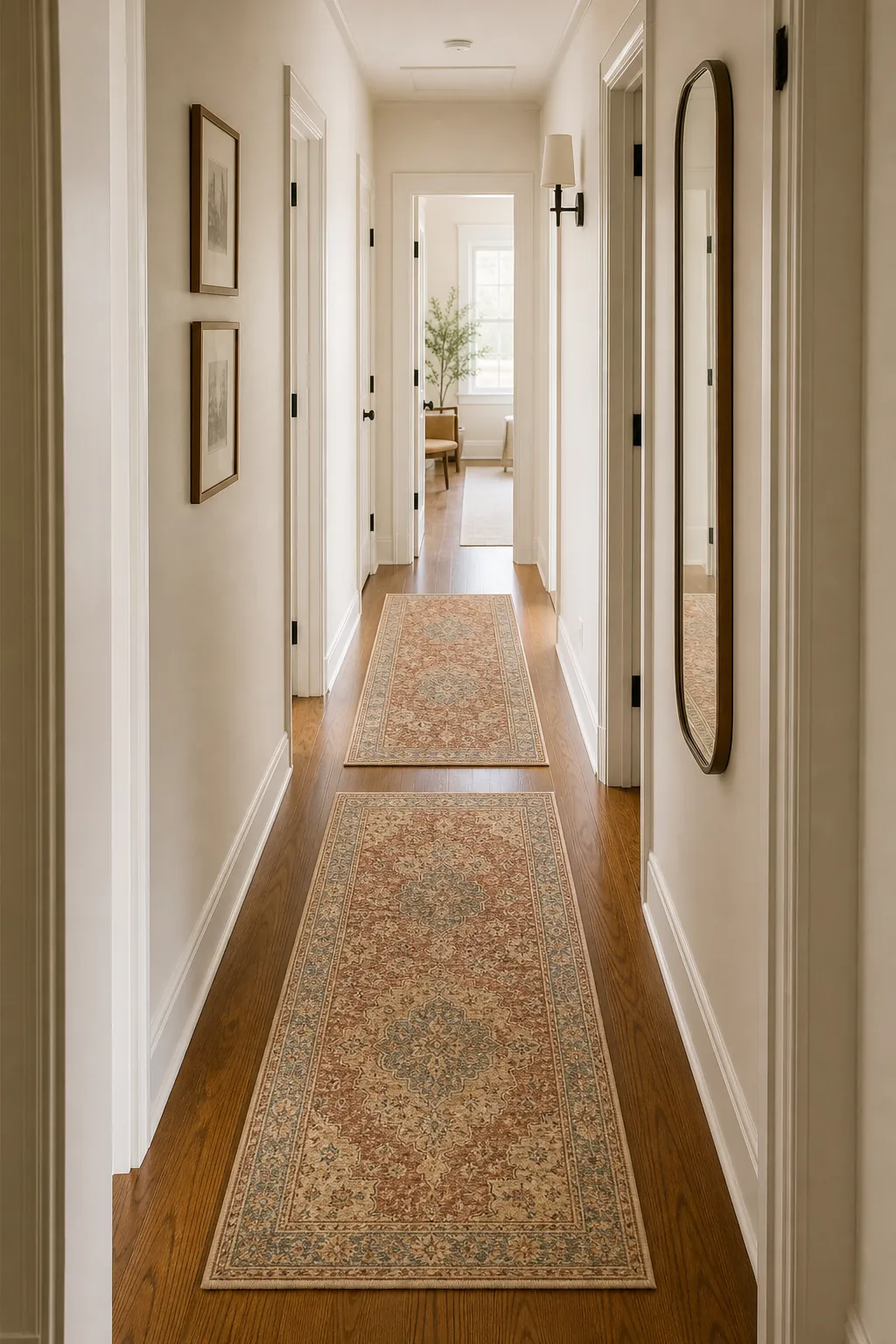
Long hallways need rhythm. A runner with a border, repeated motif, or woven stripe can slow the eye down and make the walk feel more finished. If one extra-long runner is not available or looks too heavy, two matching runners can work as long as the gap between them looks intentional.
The mistake is using two unrelated rugs because both were “close enough.” In a narrow hall, small mismatches are easy to notice. Use the same rug twice, or choose two rugs that share color, scale, and material so the floor still reads as one plan.
For a hallway with many doors, let the rug create the main line and keep the walls quieter. One or two frames, a simple sconce, or a narrow mirror is enough. The longer the hallway, the more discipline the styling needs.
Style the Walls Around the Runner, Then Stop
Once the runner is in place, the walls should support it instead of competing with it. A hallway runner already adds pattern and movement at floor level, so the wall decor can be simpler than you think. Try a narrow mirror, two framed prints, a small picture light, or a hook rail with breathing room around it.
If you want Wall Decor in a narrow hall, choose fewer pieces with stronger placement. Hang art at a consistent center line. Leave blank wall around hooks so coats do not swallow the space. Use a bench only if the hallway is wide enough to pass comfortably when someone is sitting or tying shoes.
This is especially useful for Mudroom Ideas in homes without a true mudroom. The runner defines the walk-through zone, while hooks, baskets, and a small tray define the drop zone. The hallway feels organized because every object has a lane.
Keep the Runner Safe, Flat, and Easy to Clean
A hallway runner succeeds only if it keeps looking good after real life touches it. Vacuum with the beater bar off if the weave is delicate. Shake or wash lightweight runners according to the care label. Rotate the runner occasionally if one end takes more sun, shoes, or traffic than the other.
Check the corners often during the first week. New runners can hold a curl from shipping, and hallway corners get kicked more than living room rugs. Use a proper pad, rug tape approved for your floor if needed, and patience. Heavy furniture is not usually an option in a hallway, so the rug has to stay put on its own.
The best hallway runner is the one you do not have to think about every time you walk through. It should soften the space, guide the eye, handle traffic, and make the hallway feel finished without adding clutter.

The Simple Formula
If you only remember one thing, make it this: measure first, choose low pile, use a forgiving pattern, secure the rug, then edit everything around it. A runner rug should make the hallway easier to read and easier to use. When it does both, even the most forgettable pass-through space can feel like part of the home.