

A small apartment usually does not need more furniture. It needs fewer pieces doing clearer jobs. When every chair, table, basket, and lamp has to earn its floor space, the room starts to feel calmer without turning cold or empty.
The decorating mistake I see in tiny rooms is not minimalism. It is panic buying: a sofa because a living room “should” have one, a coffee table because the sofa arrived, an extra shelf because the coffee table collected clutter, then another lamp because the shelf made the corner dark. The better move is to decide what your apartment must let you do every day, then decorate around those actions with the least amount of full-time furniture.

Start With Empty Space, Not a Shopping List
Before buying anything, mark the footprint of the pieces you are considering with painter’s tape. This one step answers questions that a mood board cannot: whether the sofa blocks the balcony door, whether a coffee table makes the walkway annoying, whether the dining chair can pull out, and whether a “small” accent chair is actually small enough.
Keep at least one clean path through the room. It does not need to be dramatic, but it should be obvious. If you have to turn sideways to pass a table, the room is telling you that piece is asking for too much rent.
- Tape the sofa, table, and chair footprints before ordering.
- Open cabinet, closet, and entry doors while the tape is down.
- Walk the route you use most: entry to kitchen, sofa to bathroom, bed to closet.
- Leave one blank patch of floor so the apartment has visual breathing room.
This is especially helpful when you are tempted by inspiration photos from larger homes. A deep, plush couch can look cozy online and still swallow half of a small living room. Measurements keep the fantasy honest.
Choose One Real Seat, Then Make the Rest Flexible
Most small apartments do not need a sofa, two accent chairs, a bench, and a dining chair set. They need one comfortable primary seat and a few flexible backup seats that disappear when life is normal.
For some rooms, that primary seat is an apartment-size sofa with visible legs. For others, it is a daybed, a loveseat, or one generous armchair. The point is not to buy the tiniest furniture possible. The point is to avoid owning five pieces that all do the same job badly.

Instead of a bulky coffee table, try a small round drink table, a C-table that slides under the sofa, or a storage ottoman with a tray. Instead of two permanent accent chairs, try nesting stools, a pouf, or a folding chair that looks good enough to lean against the wall. Guests can sit; your floor does not have to host unused furniture every day.
If your living room is dark, low-profile seating also helps the room feel less crowded. You see more wall and more floor, which tricks the eye into reading the room as lighter and wider.
Let the Bed Work Harder in a Studio
In a studio apartment, the bed is usually the largest object in the room. Decorating around less furniture means deciding whether the bed can also become seating, storage, or a room divider.
A daybed with drawers, a bed with tall under-bed clearance, or a simple bed turned lengthwise against the wall can replace a separate couch. Add a washable cover, firm back pillows, and one narrow side table, and the bed reads as a lounge during the day. This is not pretending the apartment is bigger. It is making the biggest piece do more than one job.
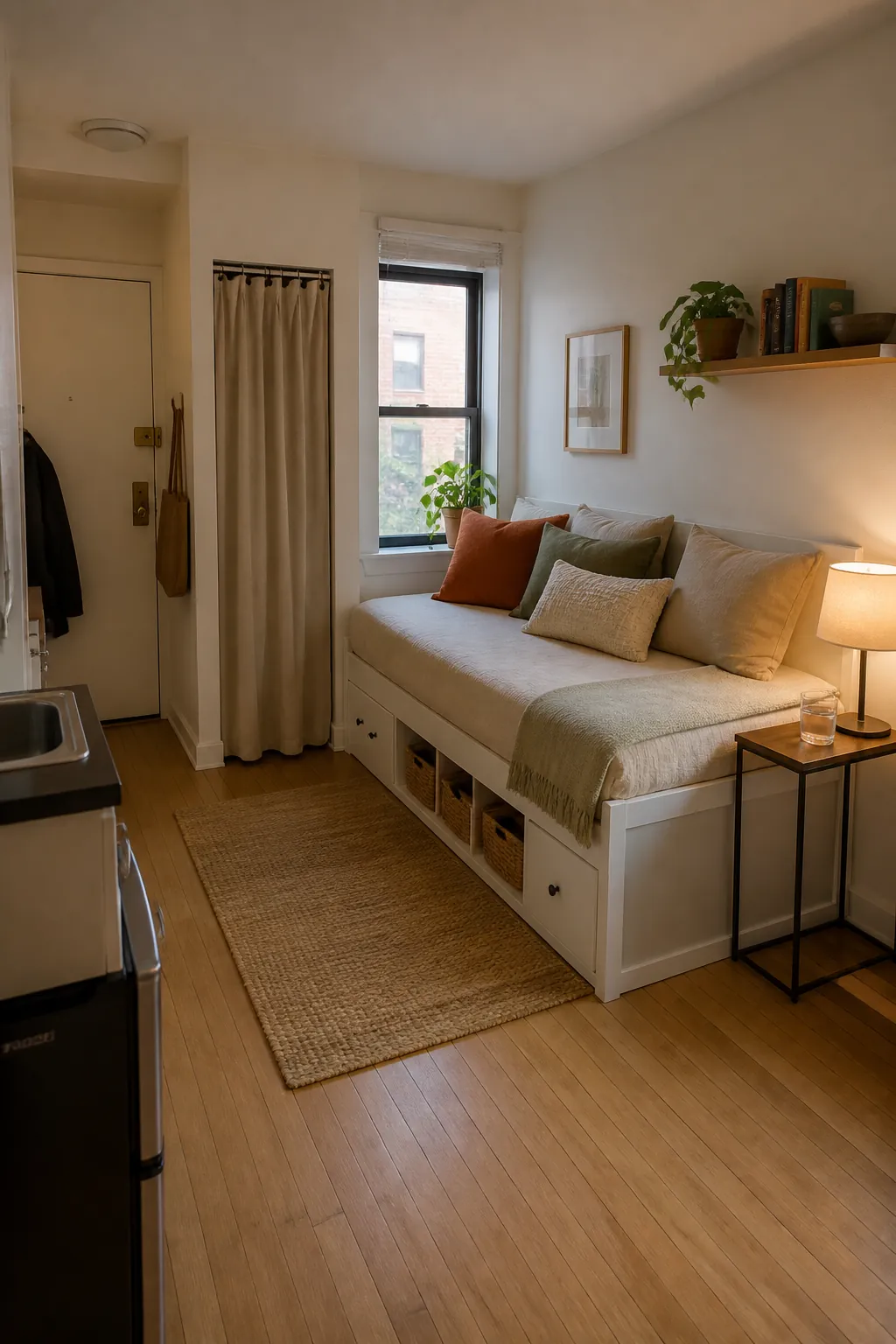
Loft beds can be brilliant when the ceiling height is right, but they are not automatically the best answer. If the ceiling is low, the room may feel boxed in. A lower daybed can preserve air above the sleeping area and still give you drawers, baskets, or rolling bins underneath.
- Use a headboard along the long side to create a sofa-like backrest.
- Choose covered storage under the bed so the room does not feel busy.
- Keep one bedside surface, not two, if you sleep alone and need the width.
- Use a rug to define the sleep zone without adding a physical divider.
Move Storage Up, But Edit What Shows
Less furniture does not mean less storage. It means less storage sitting in the middle of the room. Use wall shelves, over-door hooks, slim entry rails, baskets above cabinets, and under-bed containers before adding another floor cabinet.
The catch is visual noise. Open shelving can save floor space and still make a room feel chaotic if every inch is filled. Use open shelves for the attractive 30 percent and closed baskets or boxes for the messy 70 percent. Books, a plant, a lamp, and one framed piece can stay visible. Cords, cleaning supplies, extra sheets, tools, and seasonal items should get a lid, drawer, or cabinet door.

If you rent and cannot drill, choose tension poles, freestanding ladder shelves with a narrow footprint, adhesive hooks rated for the actual weight, over-door organizers, and furniture that brings vertical storage into one slim piece. The aim is simple: the floor should hold movement and daily living, not every object you own.
Use Soft Goods as the Decoration
When you remove furniture, a room can briefly look unfinished. Do not solve that by adding more hard pieces. Add softness instead: curtains, a rug, bedding, pillows, a throw, textured baskets, fabric shades, and warm lighting.
Soft goods are ideal for small apartments because they change the mood without blocking the room. Curtains can bring color from floor to ceiling. A rug can mark a living area without a bookcase divider. A linen shade can make a basic lamp feel intentional. Texture is how a less-furnished room becomes cozy instead of bare.
Pick two or three repeat colors and let them move through the apartment. For example, olive curtains, a rust pillow, and a warm wood tray can make an open living-kitchen area feel connected without buying a matching furniture set. In a dark room, use color in smaller doses and keep the largest surfaces lighter so the space does not feel closed in.
Replace the Dining Set With a Surface That Earns Its Space
A full dining table is not wrong in a small apartment, but it should match your real habits. If you eat at the sofa, work from a laptop, and host rarely, a four-chair dining setup may be more performance than function.
Try a small round table, a wall-mounted drop leaf, a console table with stools tucked underneath, or a narrow counter-height surface that can switch between breakfast, laptop work, and prep space. Round edges are forgiving in tight rooms, and stools can slide away in a way dining chairs often cannot.
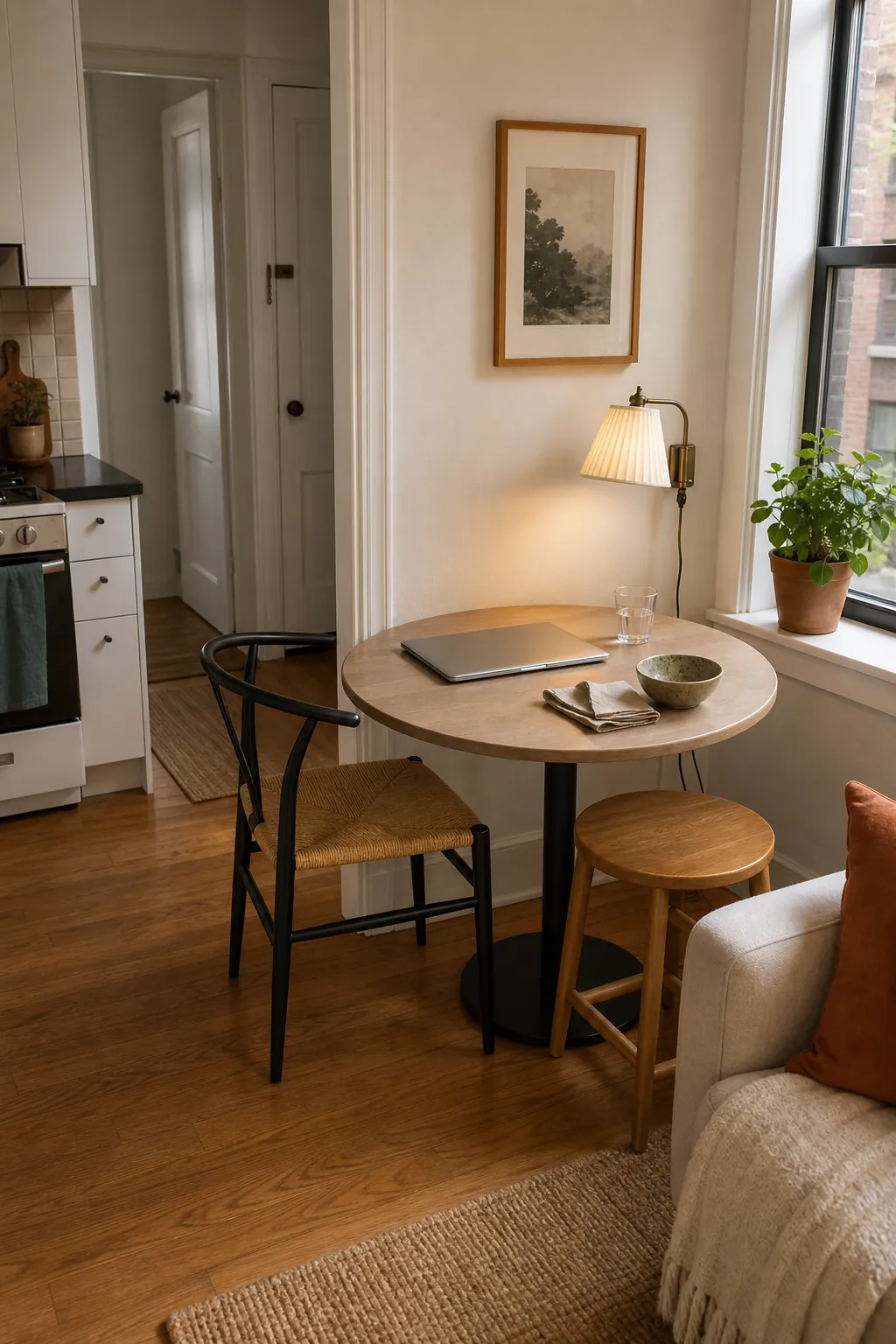
If you do keep a dining zone, make it visually light. Use two chairs instead of four, one bench tucked under the table, or a pair of stackable stools. A pendant-style plug-in lamp or small table lamp nearby can make the area feel deliberate without adding another cabinet or shelf.
Make the Bedroom Calm With Fewer Shapes
Small bedrooms get crowded quickly because the bed, nightstands, dresser, hamper, chair, and mirror all fight for the same wall space. Less furniture works best when the remaining pieces have similar visual weight.
Instead of two chunky nightstands, use a narrow wall shelf on one side and a small table on the other. Instead of a freestanding clothes rack, use the closet better, add under-bed storage, or choose a closed wardrobe if you truly need overflow. The bedroom should not become the place where homeless furniture goes to wait.

One large mirror can help, especially opposite a window or near a dark corner, but use it with restraint. Mirrors amplify what they face. If they reflect clutter, they double it. If they reflect light, curtains, a plant, or a clean wall, they make the apartment feel easier to breathe in.
What to Remove First
If the apartment already feels crowded, do not start by buying organizing products. Remove or relocate the pieces that create the most friction.
- The table that only catches mail: replace it with a wall hook, tray, or single drawer.
- The chair nobody sits in: swap it for a stool, pouf, or nothing at all.
- The oversized coffee table: try two small nesting tables or a tray on an ottoman.
- The open rack that always looks busy: move items behind a curtain, door, or covered bins.
- The floor lamp in the walking path: use a wall sconce, clip light, or table lamp instead.
- The decor cluster that makes dusting impossible: keep the best pieces and give them space.
After each removal, live with the apartment for a few days. Empty space can feel strange at first if you are used to filling every corner. Then you notice the door opens fully, the laundry basket has a home, the morning path is easier, and the room still feels like yours.
A Simple Less-Furniture Formula
For a small living area, start with this formula: one main seat, one small surface, one rug, one lamp, one vertical storage point, and one soft color moment. That might be a loveseat, a C-table, a washable rug, a warm floor lamp, a wall shelf, and patterned curtains. It might be a daybed, a tray table, a jute rug, a plug-in sconce, baskets above the cabinets, and a rust throw.
Once those pieces are working, add only what solves a real problem. Need guest seating? Add a folding chair or nesting stools. Need work space? Add a small table that also handles meals. Need more personality? Change curtains or art before buying another cabinet.
The best small apartment decorating ideas with less furniture are not about proving how little you can own. They are about making the apartment easier to live in. When the floor is open, the storage is edited, and the soft details carry the warmth, a small apartment can feel finished with far less than you thought it needed.