
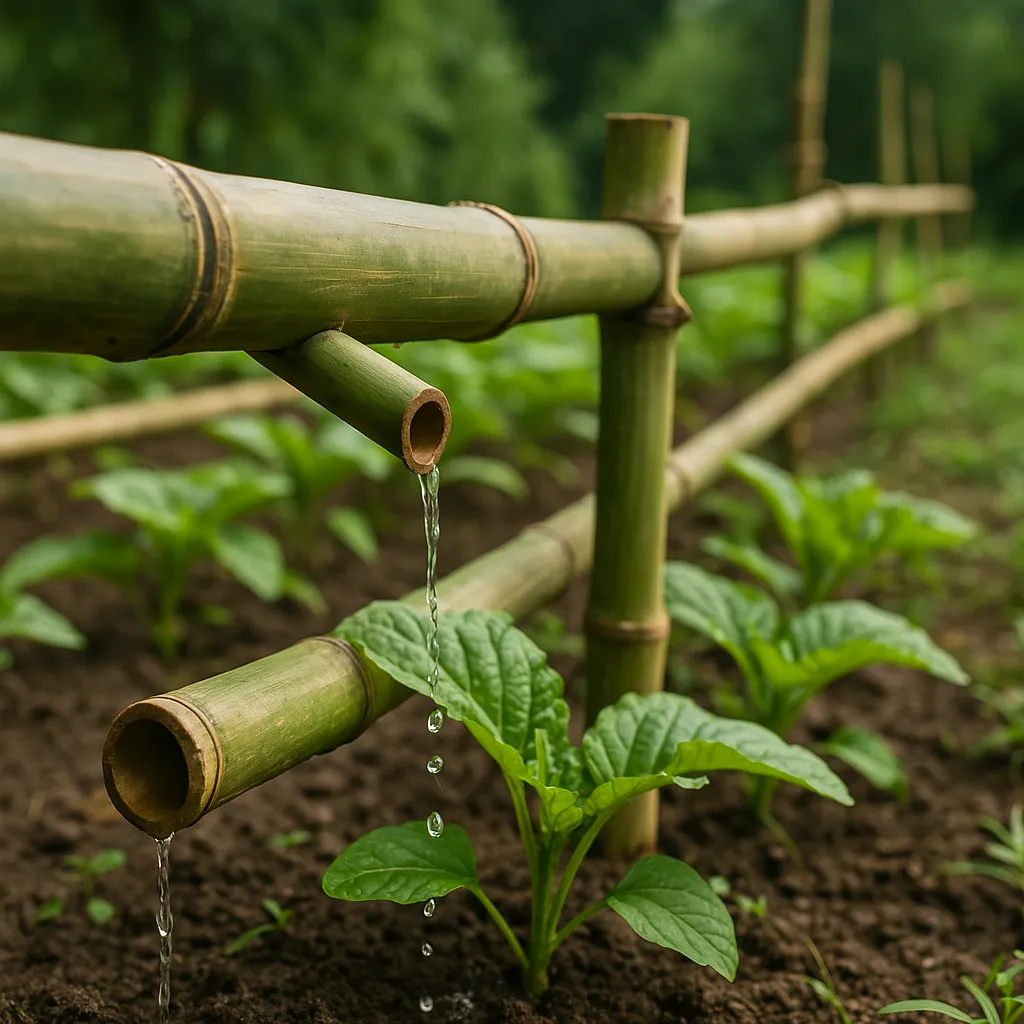
While the technology in automated irrigation systems is relatively new, the concept is much older. Drip irrigation systems have existed for centuries and one of the earliest designs incorporated bamboo. But what is a bamboo drip irrigation system? And are they still relevant today?
Bamboo drip irrigation systems are a network of bamboo pipes allowing water to travel slowly but continuously from a source to your garden. These gravity-fed systems rely on an elevated water source to provide the impetus and different-sized bamboo to control the flow.
These irrigation systems have not changed much since their conceptualization. But when did these systems first develop? What was the driving force behind it? How do they work? Which situations work best with these systems? And should you invest in one?
What You Need To Know About Bamboo Drip Irrigation Systems
Drip irrigation systems are “pathways” that take water from a source and deliver it to plants at a slow yet continuous rate.
These systems are constructed from various materials, but those made with bamboo are some of the oldest examples of these systems.
In modern times, these systems are often connected to rainwater harvesting systems to improve the output. While relatively low-tech, they are still used to irrigate plantations/croplands in rural areas.
How Bamboo Drip Irrigation Systems Work
These systems work with gravity, moving water from an elevated source through a pipe (called channels) network to arrive at the plant(s). Water is diverted from a spring or stream close to the top of a hill/mountain.
Once in the channel, gravity and the slope’s angle guide the water in the desired direction. These systems rely on a “main channel” (a straight gutter) from the water source to the field, which necessitates connecting multiple gutters in a straight line.
However, when the main channel arrives at the farm, it connects to multiple other gutters to distribute the water to all the crops.
These secondary gutters (sub-channels) are tied above the old channel at 900. A small section of cut wood is placed between the main line and the new gutter, acting as a water diverter (i.e., moving water from the main line to secondary lines).
Tertiary lines are connected to the secondary channels to continue the distribution. These lines usually have 4 to 5 diversions. The main line continues down the hill and feeds additional lines as needed.
Thanks to the diversions, the flow rate is significantly reduced when it reaches the plants. For example, if water travels down the main line at 5 gallons per minute, the water arriving at the plants is between 10 and 80 drops a minute after moving through the system.
Water drips (or trickles) onto plants through holes in the bamboo channel positioned at the base of the plant.
For this system to work effectively, it requires a steep gradient (as this speeds up the water and allows you to transport it further along). Roughly 100 feet difference between the start and end provides the right angle. Sufficient diversions to slow the water down before it reaches the plants are also essential.
How Bamboo Drip Irrigation Systems Are Constructed
A surprising amount of technology goes into how these “simple” systems work. However, the backbone of these systems is bamboo of varying thicknesses.
Bamboo is essential for:
- The channels that carry water.
- Diversion pipes that move water from the main line into the secondary line, tertiary, etc.
- The “Y” poles and other supports hold the channels in the air.
- The strips needed to connect pipes (alternatively a fibrous rope).
Once the system is planned, the y-shaped poles are planted, and the channel is placed on top.
Whenever connections between channels (either continuing the main line or when a secondary and tertiary line are added), the strips secure the new channels in position.
Experience has taught farmers how to construct these systems with minimal water wastage (spills and leaks) and the ratio of wider to thinner pipes required to reduce the flow sufficiently for irrigation.
Origins And Purpose Of Bamboo Drip Irrigation Systems
Researchers believe bamboo drip irrigation systems originated roughly 200 years ago in northeast India.
Betel leaves, black pepper, and areca nut farmers in the Jaintia and Khasi hills in Meghalaya (an Indian state) began using this system to transport water from streams and springs to their croplands.
The driving force behind this innovation was the steep hilly topography, shallow soil depth on the slopes, many large rocks, and poor water retention. These factors prevented farmers from effectively carrying water uphill to irrigate their crops.
Farmers used the most abundant resource available at the time to move water to their crops, bamboo.
Fortunately, bamboo was in good supply as some systems ran for several miles. By constructing these irrigation systems, farmers improved their yield while reducing irrigation’s time and labor costs.
Where Would You Use A Bamboo Drip Irrigation System?
Although these irrigation systems were originally designed to water croplands (and many are still used to that end), many garden enthusiasts decorate their flower beds with these systems, albeit on a smaller scale.
The principle remains the same. An elevated water source (like a rainwater tank/harvester) stores the water. A network of bamboo channels connects to this “reservoir,” which regulates the speed and water volume coming through the system (through thinner and thicker bamboo pipes).
These channels are strategically placed around the flower/vegetable garden to provide plants with a continuous water supply.
The fantastic news is you can use one of these systems practically anywhere, provided you have an elevated water source and sufficient space for the network.
The Advantages And Disadvantages Of Bamboo Drip Irrigation Systems
If you’re considering installing a bamboo drip irrigation system to water your garden, it’s best to decide after considering the benefits and drawbacks first.
Advantages Of A Bamboo Drip Irrigation System
Some of the things that work in the favor of these systems include:
- A “fully automated” irrigation system that you set once and then monitor to ensure that it works.
- Relatively inexpensive to construct (especially if you’re considering using mostly bamboo as part of the construction). There are also a few tools needed.
- These systems are fantastic for transporting water a long distance.
- Bamboo is an eco-friendly resource (provided it’s sustainably harvested) and is also usually readily available.
- The primary advantage of these systems is you have a power or fuel-free system to irrigate your plants.
- These systems create an aesthetically pleasing appeal to your garden, and the sound of running water is usually soothing.
- Harvesting rainwater and running it through the system reduces wasting water.
Disadvantages Of A Bamboo Drip Irrigation System
On the other end of the spectrum, there are drawbacks to these systems, including:
- Bamboo is less abundant outside of Asia (particularly if you live in the city), so purchasing enough bamboo might be more expensive.
- The system won’t work well if you don’t have a sufficiently elevated water source.
- Residential gardens might not be large enough to support the full channel network required for creating the drip.
- Depending on where you live, you might have a significant amount of water “loss” through evaporation.
- Unfortunately, the entire system has a 2 to 3-year lifespan before you need to start replacing sections due to the bamboo rotting (exposure to water).
Should You Get/Make A Bamboo Drip Irrigation System?
Deciding to install a bamboo drip irrigation system in your garden is a bold step. While there are several benefits, there are also some poignant disadvantages.
However, these systems are rewarding if you have the time, resources, and capacity (skills to construct, time to maintain it, etc.).
If you live in an area with significant rainfall and actively harvest rainwater, then constructing this irrigation system is practical. However, living in the city makes you less likely to construct this system (space constraints).
You’ll need to weigh up the consequences and make an informed decision.
Conclusion
Bamboo drip irrigation systems are a fantastic way to divert water from an elevated water source (like a stream, pond, or rainwater harvester) to your garden through a network of bamboo channels. This network is essential as it evenly distributes water to your plants while constructed to slow the rate and limit the water volume coming through the system.