

If your front door opens straight into the living room or kitchen, the problem is rarely that the apartment is too small. The problem is that the first few feet are being asked to behave like a coat closet, a shoe closet, a mail station, a bag drop, and a hallway at the same time.
The smartest small apartment entryway ideas when there is no closet start with a different assumption: you are not building a tiny version of a full mudroom. You are building a tight, edited drop zone that catches only what you use every day and quietly sends the rest somewhere else.
That distinction matters. In real small-apartment layouts, the entry often shares space with a sofa, kitchen counter, electrical panel, stair turn, or dog bowl. A beautiful bench will not help if it blocks a cabinet door. A row of hooks will not feel tidy if every coat in the apartment hangs there. The entry needs a system before it needs decoration.
Start With What Actually Lands By The Door
Before buying anything, watch the door for a week. Not in a dramatic way. Just notice what gets dropped there when someone comes home tired: shoes, one jacket, keys, mail, a tote bag, a dog leash, returns, sunglasses, an umbrella, maybe a backpack. Those are the items your entryway has to handle.
Then divide them into four jobs: floor clutter, wall clutter, tiny loose items, and visual boundary. Floor clutter is usually shoes. Wall clutter is coats, bags, leashes, hats, and scarves. Loose items are keys, mail, wallets, and sunglasses. The visual boundary is what tells the eye, “this is the entry,” even if your apartment did not come with one.
Most messy no-closet entries fail because one piece of furniture is asked to solve all four jobs. A coat tree tries to hold bags, jackets, hats, and sometimes umbrellas until it becomes a bulky vertical pile. An open shoe rack keeps shoes available but also broadcasts every pair into the living room. A tiny console looks nice for one day, then becomes a landing strip for receipts and packages.
The better approach is smaller and stricter: one closed place for shoes, one controlled place for current coats and bags, one shallow catchall for small items, and one visual cue that marks the zone.
Use A Closed Shoe Cabinet As Your Fake Closet
If there is room for only one purchase, make it a slim closed shoe cabinet. Shoes create the fastest visual clutter because they sit low, spread outward, and make even a clean entry look unfinished. A narrow tilt-out cabinet changes that instantly because it uses wall length instead of floor depth.

For a very tight entry, look for a cabinet that is shallow enough to keep the walking path clear, tall enough to hold daily shoes, and flat on top so it can become the landing spot for keys. The top does not need much: a tray, a small bowl, or a lidded box is enough. The mistake is adding a lamp, plant, basket, mail pile, candle, and framed art until the surface starts acting like another shelf.
Use the cabinet with a rule: the entry stores today’s shoes, not every shoe you own. One or two pairs per person can live there. Dress shoes, off-season boots, and backup sneakers belong in a bedroom closet, under-bed bin, wardrobe, or covered rack elsewhere. If you skip that edit, even the best shoe cabinet becomes full by Tuesday.
Renters should anchor tall cabinets when allowed, especially narrow pieces that children might pull on. If wall anchoring is not possible, choose a lower cabinet with a wider base, keep heavier shoes on the bottom, and avoid stacking decor on top.
Put Hooks On A Diet
No-closet entries need hooks, but they need fewer hooks than people think. The goal is not to hang every coat in the open. The goal is to hold the coat, tote, hat, or leash that is actively in rotation.

A short hook rail often works better than a tall coat tree because it keeps belongings flat against the wall. Staggered hooks help bulky jackets breathe instead of forming one thick lump. If the door opens into the living room, place hooks on the least visible side wall when possible, not directly in the sightline from the sofa.
Give each person one everyday hook. That sounds severe, but it is what keeps the entry from becoming a public closet. Extra coats move to a bedroom wardrobe or garment rack. Bags that are not used daily move to a bedroom, office corner, or under-bed storage. Open hooks stay calm only when they hold the current layer of life.
For keys and mail, do not rely on the same hooks. Add a shallow wall pocket, small mail caddy, or tray above the shoe cabinet. Keep it thin. Deep baskets encourage paper piles, and paper piles are what make a small entry feel chaotic even when the floor is clear.
Let A Bench Earn Its Floor Space
A bench is useful only if someone actually sits to put on shoes or if it creates storage you cannot get another way. In a narrow apartment entry, a decorative bench with no storage can become expensive dead space. A storage bench, however, can be the right answer for households that remove shoes at the door, have kids, or need a place for grocery bags while unlocking the door.

The best small-entry bench is not very deep, has a clean front, and offers either drawers, cubbies, or room for labeled baskets underneath. Baskets are better for flexible items such as gloves, dog towels, cloth shopping bags, or kids’ outdoor accessories. Closed drawers are better for visual calm. Open cubbies are useful if your household will truly put shoes away neatly; if not, they simply frame the mess.
Place the bench where it does not interrupt the door swing, appliance doors, closet doors, electrical panels, or the path into the room. This sounds obvious, but many awkward entries stay awkward because the furniture technically fits while daily movement does not. A small apartment entry should feel easy to pass through with a bag in your hand.
If the entry has almost no width, skip the bench and use a wall shelf plus shoe cabinet. The absence of a bench is not a design failure. In a tiny entry, clear floor can be the most luxurious feature.
Create An Edge When The Door Opens Into The Living Room
Many apartments do not have an entryway at all. The front door opens into the living room, beside the kitchen, or directly into a studio. In that layout, storage is only half the job. You also need a soft boundary so the apartment does not feel like the living room begins at the doormat.

A freestanding wardrobe or armoire can act like a closet and a room divider at the same time. Put the cleanest side toward the living area and use the hidden side for coats, umbrellas, vacuum attachments, or extra bags. If a wardrobe is too heavy visually, try a narrow bookcase, open shelving with baskets, a slatted divider, or a console placed perpendicular to the wall.
A rug can also define the entry, but it should be practical. Choose a low-profile washable rug or indoor-outdoor runner that catches dirt without creating a tripping edge. The rug’s job is to visually say “landing zone,” not to become the star of the room.
Mirrors help in these layouts because they create a getting-ready moment and bounce light into the door area. Hang one above a shoe cabinet, beside hooks, or on the back of a nearby door. Just avoid placing a mirror where it reflects the clutter you are trying to hide.
Use Vertical Inches Without Blocking What Opens
When the entry is narrow, vertical storage is the obvious move. The trick is using vertical space without blocking the things that must still open: the front door, breaker panel, kitchen cabinets, closet doors, bathroom door, or hallway path.
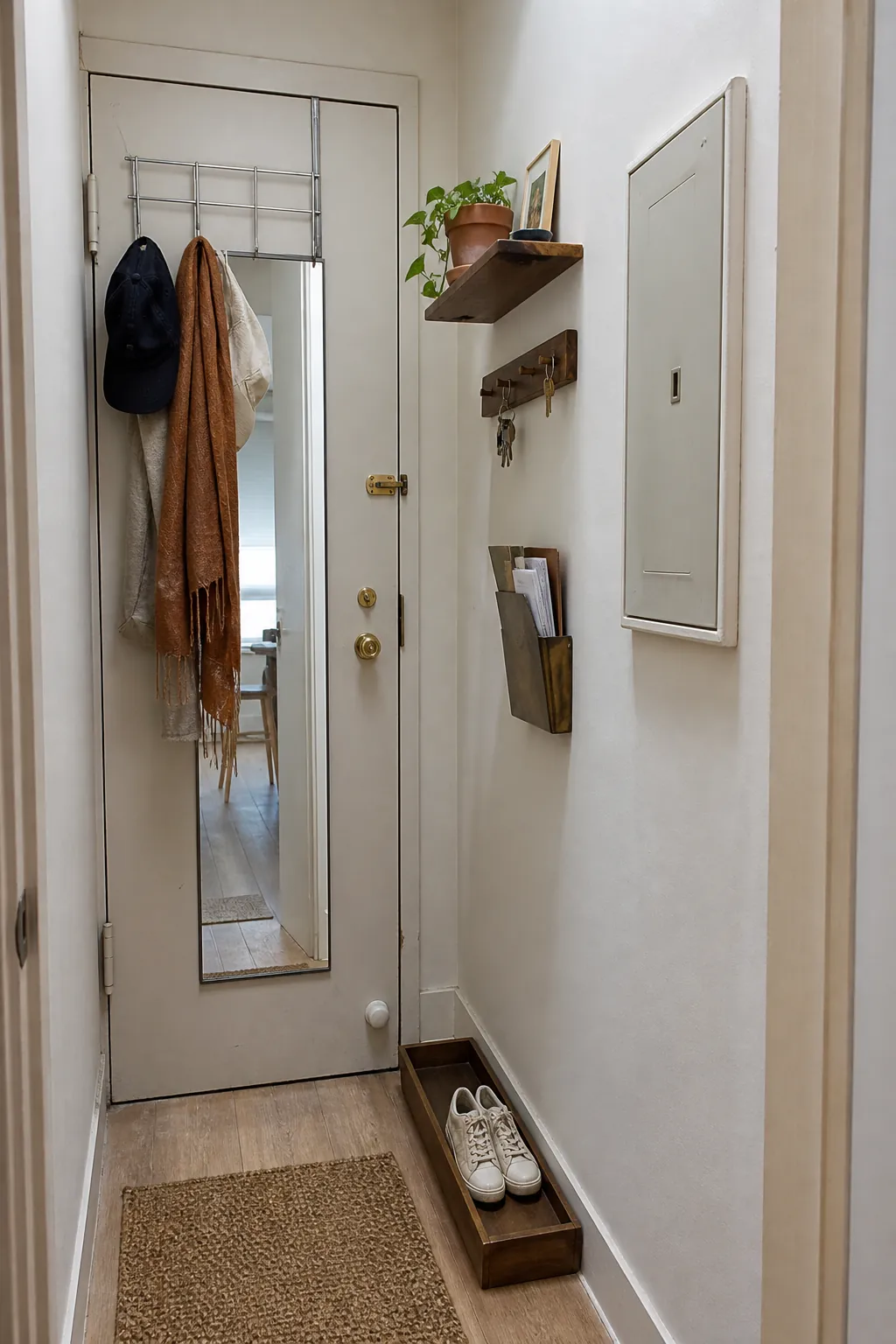
Useful vertical ideas include a slim over-door rack for scarves or caps, a back-of-door mirror, a peg rail, a magnetic key strip, a shallow floating shelf, or a wall-mounted mail holder. Choose pieces with a low profile. In a tight entry, every inch of projection matters because bulky organizers make the room feel squeezed even when they technically fit.
If you have an electrical panel near the door, keep access simple. A mirror on the panel door, removable hooks, or a lightweight rail may work better than furniture in front of it. The entry should not require rearranging a shoe rack every time a breaker trips.
For renters, removable hooks can be useful, but do not overload them. Follow the weight limits, clean the wall properly, and use them for light items: keys, a cap, a dog leash, a small crossbody bag. Heavy coats need a sturdier rail, wardrobe, or freestanding solution.
The Real Secret Is Seasonal Rotation
There is one idea that makes every no-closet entryway work better: stop storing all seasons at the door. A small entry can handle daily traffic. It cannot handle winter coats, rain boots, summer sandals, umbrellas, backpacks, reusable bags, sports gear, and returns at the same time.
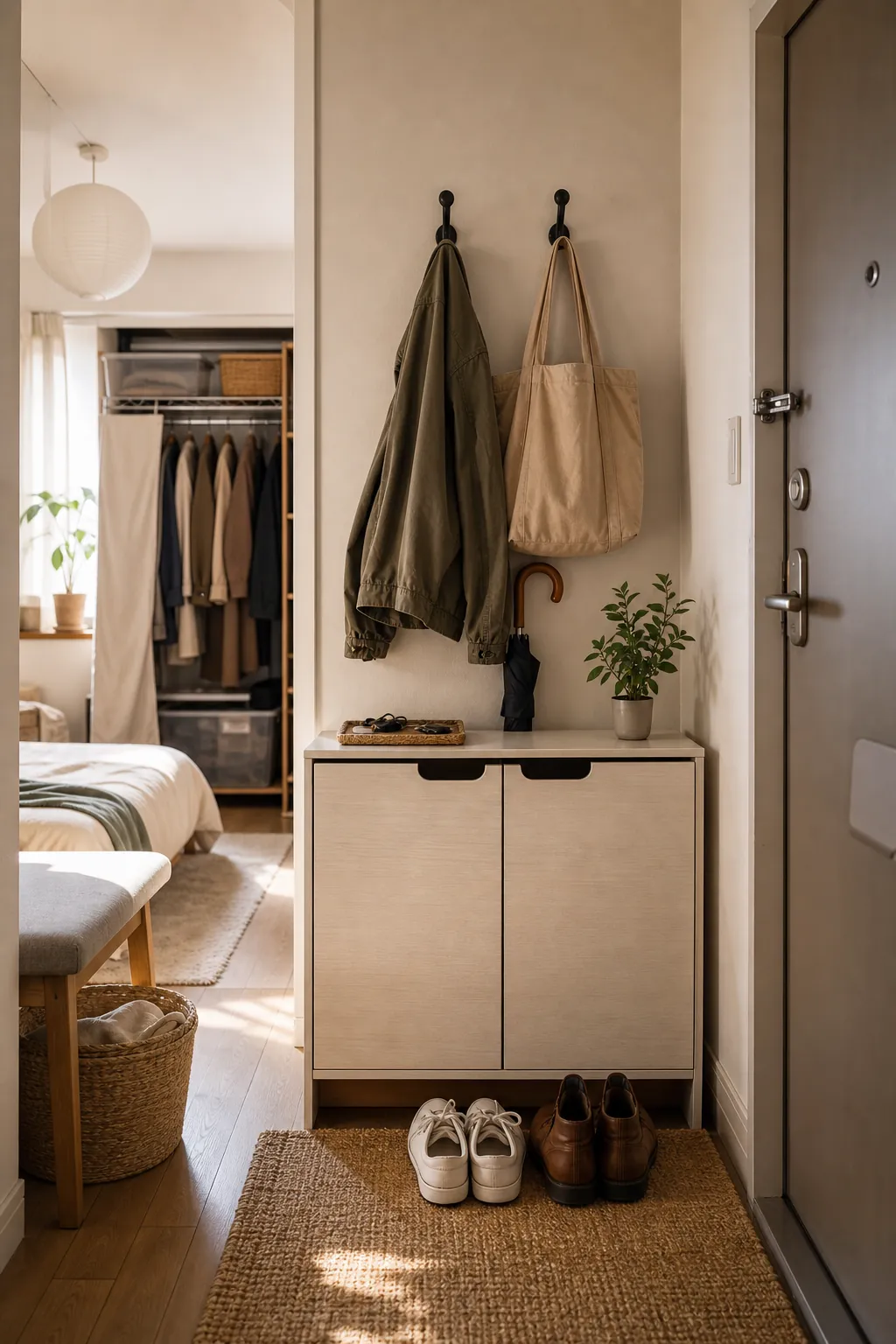
Use a rotation system. Keep current-season daily items in the entry. Keep occasional but nearby items in a secondary zone, such as a bedroom wardrobe, covered rack, under-bed bin, or storage ottoman. Move true off-season items farther away. This is less glamorous than a new piece of furniture, but it solves the reason the entry keeps collapsing.
A simple rule works: if you did not use it this week, it probably does not deserve prime entryway space. Exceptions exist, of course, but the rule catches most clutter. It also prevents the common cycle where every new hook becomes permission to keep more stuff by the door.
Returns and outgoing items need a time limit too. Use one small tote, bin, or basket for items leaving the house, and empty it on a set day. Without a limit, the “outgoing” basket becomes a permanent storage category with better branding.
Layout Recipes For Common No-Closet Entries
- Door opens into the living room: use a closed shoe cabinet on the nearest wall, a short hook rail on the less visible side, and a rug to define the zone. If you need more privacy, add a wardrobe or open bookcase as a divider.
- Door opens beside the kitchen: keep storage shallow and washable. A slim cabinet, wall hooks, and a tray for keys usually work better than a bench, especially if cabinet doors or appliance doors need clearance.
- Very narrow hallway: prioritize wall-mounted pieces. Use a tilt-out shoe cabinet, narrow mirror, peg rail, and one low-profile runner. Avoid anything that makes two people turn sideways to pass.
- Studio apartment: treat the entry as a zone, not a room. Use a rug, mirror, shoe cabinet, and one vertical piece to separate the door from the sleeping or sitting area.
- Household with kids or pets: choose closed shoe storage, labeled baskets, washable surfaces, and hooks at reachable heights. If shoes are tempting for a pet, open racks will probably create more stress than convenience.
What To Avoid In A Tiny Entryway
A few common choices look useful online but create daily friction in real apartments. Oversized coat trees take up floor space and become heavy-looking fast. Open shoe racks work only for people who naturally line shoes up neatly. Deep baskets hide clutter for a while, then turn into mystery bins. Tiny console tables with no storage often collect piles because they offer a surface without solving a problem.
Also be careful with too many small organizers. A key hook, mail sorter, basket, tray, umbrella stand, hat rack, and shoe rack may each be useful, but together they can make the entry feel busier than the original mess. Small spaces usually need fewer categories, not more containers.
A Simple No-Closet Entryway Checklist
- Hide daily shoes in a slim closed cabinet or controlled bench storage.
- Limit visible hooks to active coats, bags, and leashes.
- Add one shallow landing spot for keys, mail, wallet, and sunglasses.
- Use a mirror, rug, divider, or cabinet to visually define the entry zone.
- Keep door swings, panels, and walking paths clear.
- Move off-season and rarely used items out of the entry.
The best small apartment entryway with no closet is not the one with the most clever storage. It is the one that makes coming home easier without making the first view of the apartment feel crowded. Start with the daily items, hide what looks messy, keep the hooks disciplined, and let the rest of your storage happen somewhere that is not the front door.