
Wall sconces beside a bathroom mirror can solve the shadow problem that overhead vanity lights often create, but only when the mirror, fixture width, and electrical boxes are planned as one composition. The most common regret is choosing a beautiful sconce first and discovering that it crowds the mirror—or centers on the wall while the sink sits somewhere else.
Start with the usable wall, not a generic mounting rule. Mock up the mirror and fixtures at full size, check the tallest user’s eye line, and confirm that shades clear doors and side walls. For grooming, paired side light generally produces more even facial illumination than a single ceiling source. Choose bathroom-suitable fixtures, high color rendering, and dimmers or separate controls where possible.
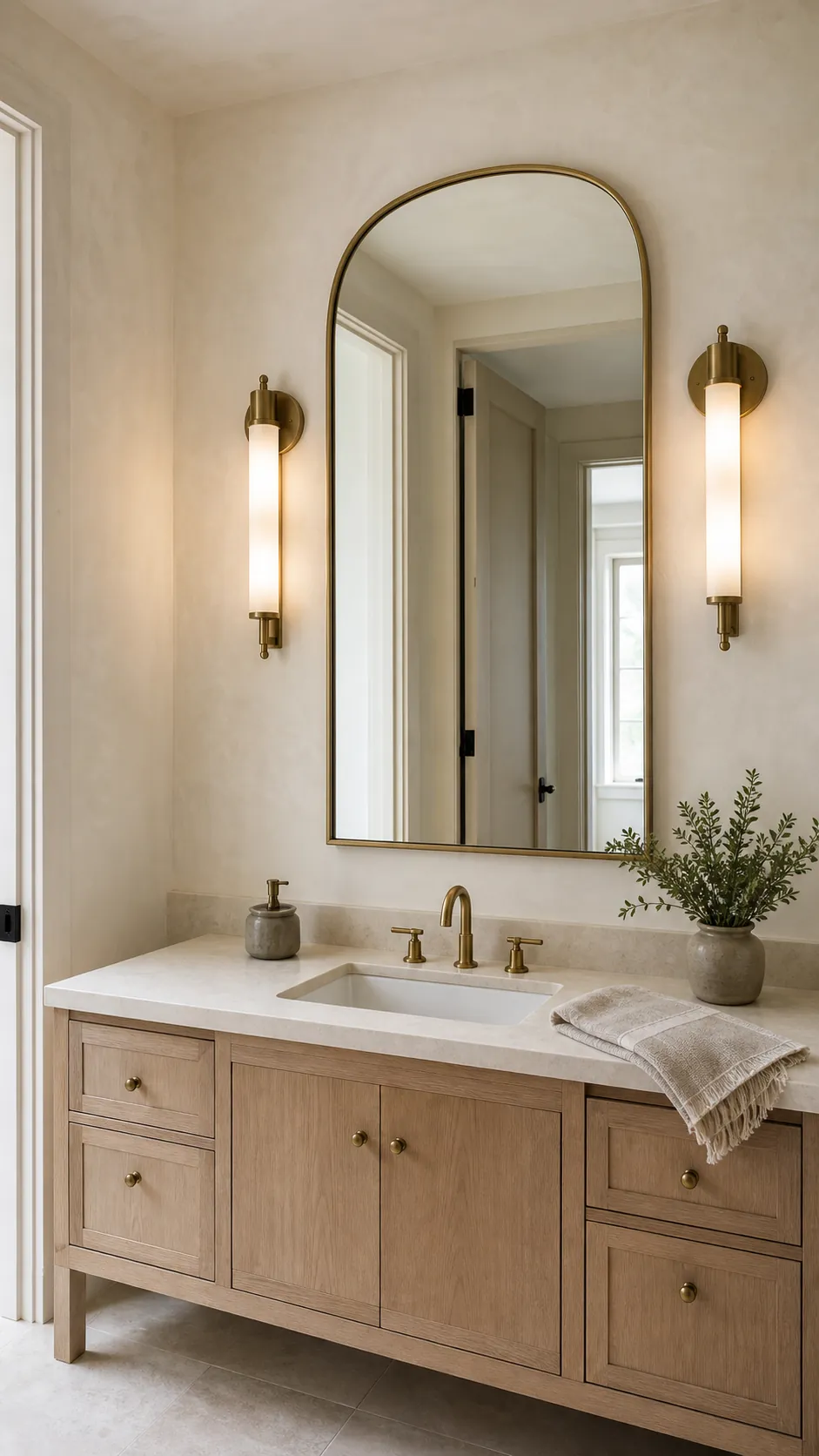
Opal Globes With an Arched Brass Mirror
Matte opal globes conceal the bulbs and spread a gentle glow across the face instead of exposing a sharp point of light. Compact aged-brass stems repeat the slim metal edge of the arched mirror without consuming much wall width. Pale oak and white quartz keep the composition light enough for a modest primary bathroom.
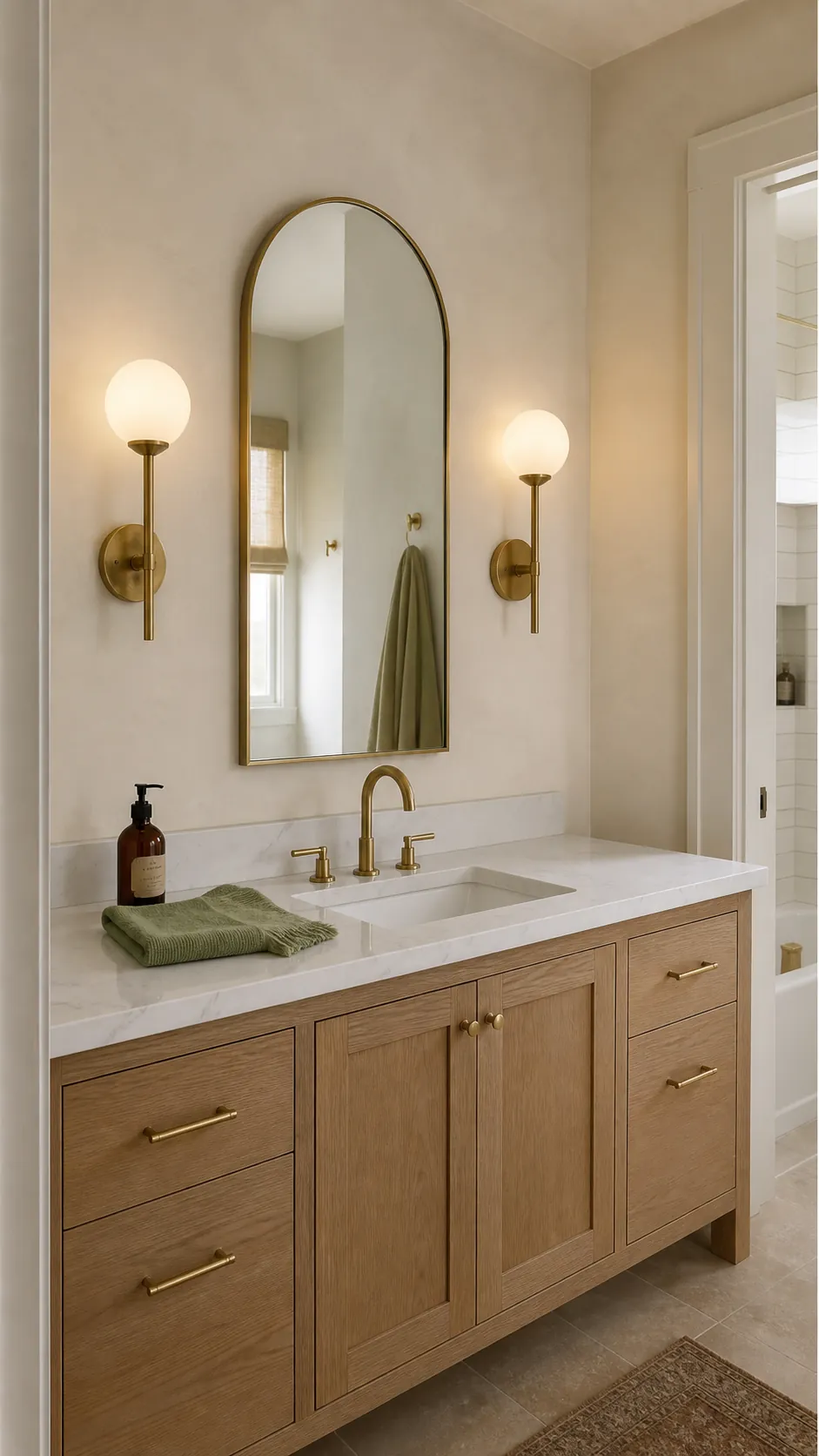
Mock up the mirror and both backplates together, using the basin rather than the entire wall as the visual center. Let both adults check the arrangement from their normal standing positions before the electrical boxes are finalized. If the globes look bright in the reflection, add dimming or a softer lamp rather than raising the fixtures until they feel disconnected from the vanity.
Vertical Ribbed Glass for Even Face Light
Long ribbed-glass diffusers create a strong vertical line beside a wide frameless mirror, giving a low bathroom more visual height. Chrome sharpens the look, while the walnut vanity prevents the cool finishes from becoming clinical.
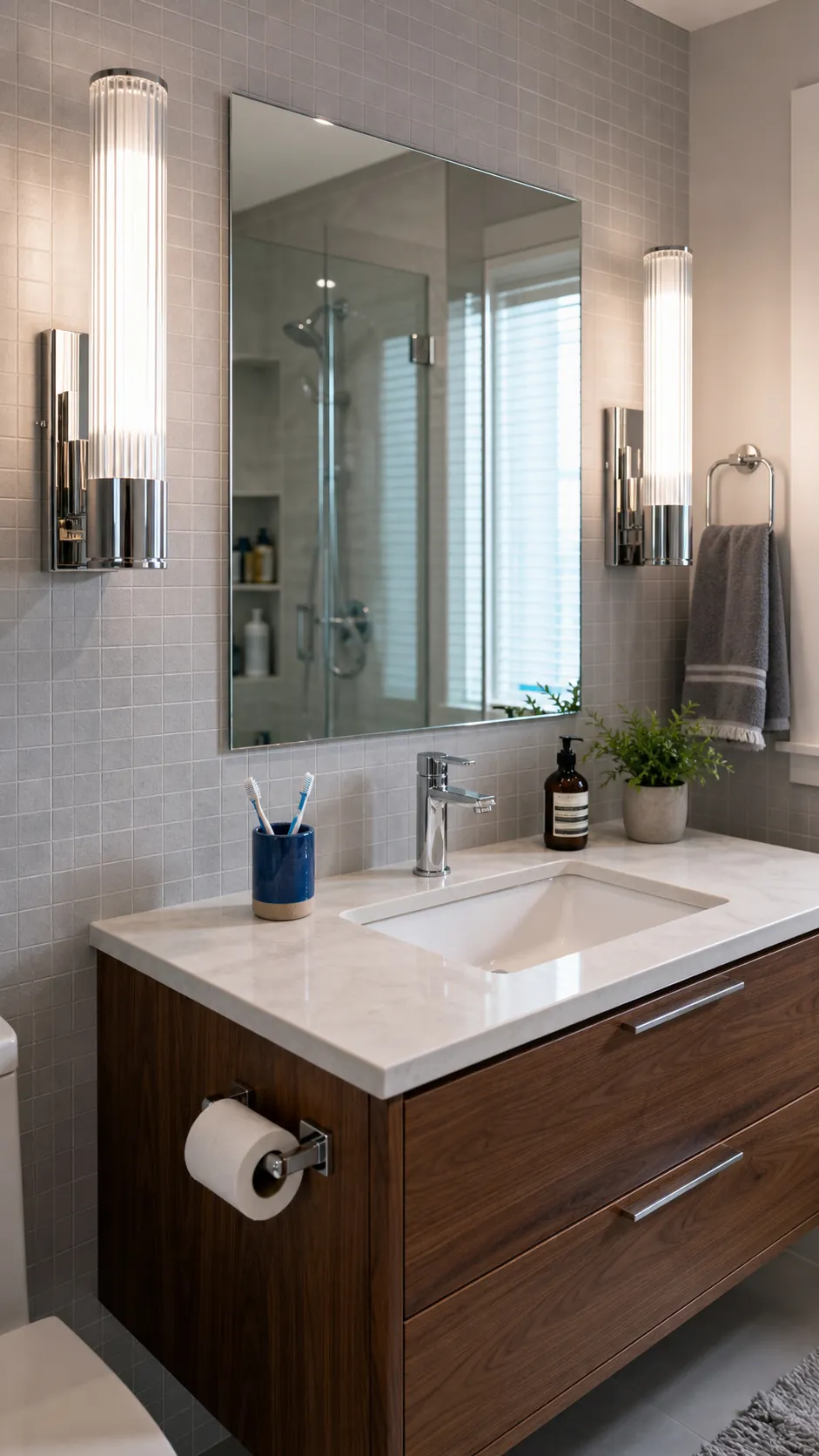
Ribbing changes the appearance of the light but does not guarantee that it will flatter a face, so inspect the specified diffuser and lamp while they are illuminated. Stand at both sink positions and look for dark shadows beneath the eyes or chin. In a family bathroom, favor sealed surfaces and glass tubes that can be wiped without dismantling delicate trim.
Petal Ceramic Sconces Around a Round Mirror
Handmade ceramic petals give the vanity one sculptural moment, and their curves sit naturally beside a round mirror. A terracotta rim and dusty-coral cabinet can carry the warmth through the scheme without adding patterned tile or more decorative objects. Keep the surrounding plaster quiet so the irregular ceramic edges remain intentional.
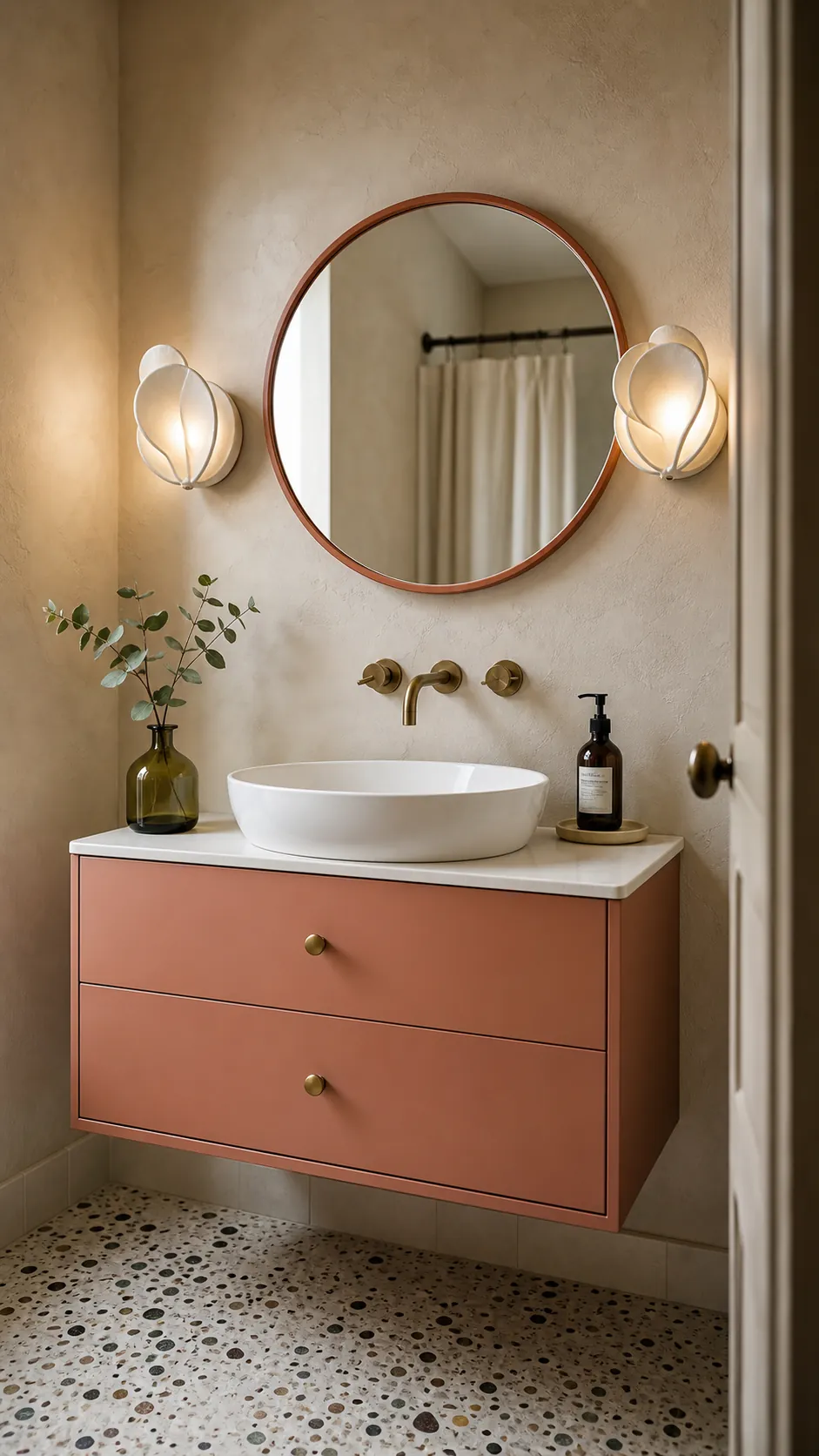
Because handmade shades may differ slightly, review the pair together before installation and check whether the projecting petals clear nearby doors, shelves, and shoulders. The expressive pair is especially well suited to a powder room, where character can take priority as long as the basin and mirror remain comfortable to use.
Matte Black Cones Beside a Racetrack Mirror
Downward-facing black cones add definition to a narrow vanity without widening its footprint. White inner reflectors keep the shades from reading as two dead black shapes, and the tall racetrack mirror continues their vertical emphasis. The concrete basin and pale oak cabinet soften the graphic contrast. A cone concentrates light more than an opal globe, so test for facial shadows before relying on this pair for grooming.
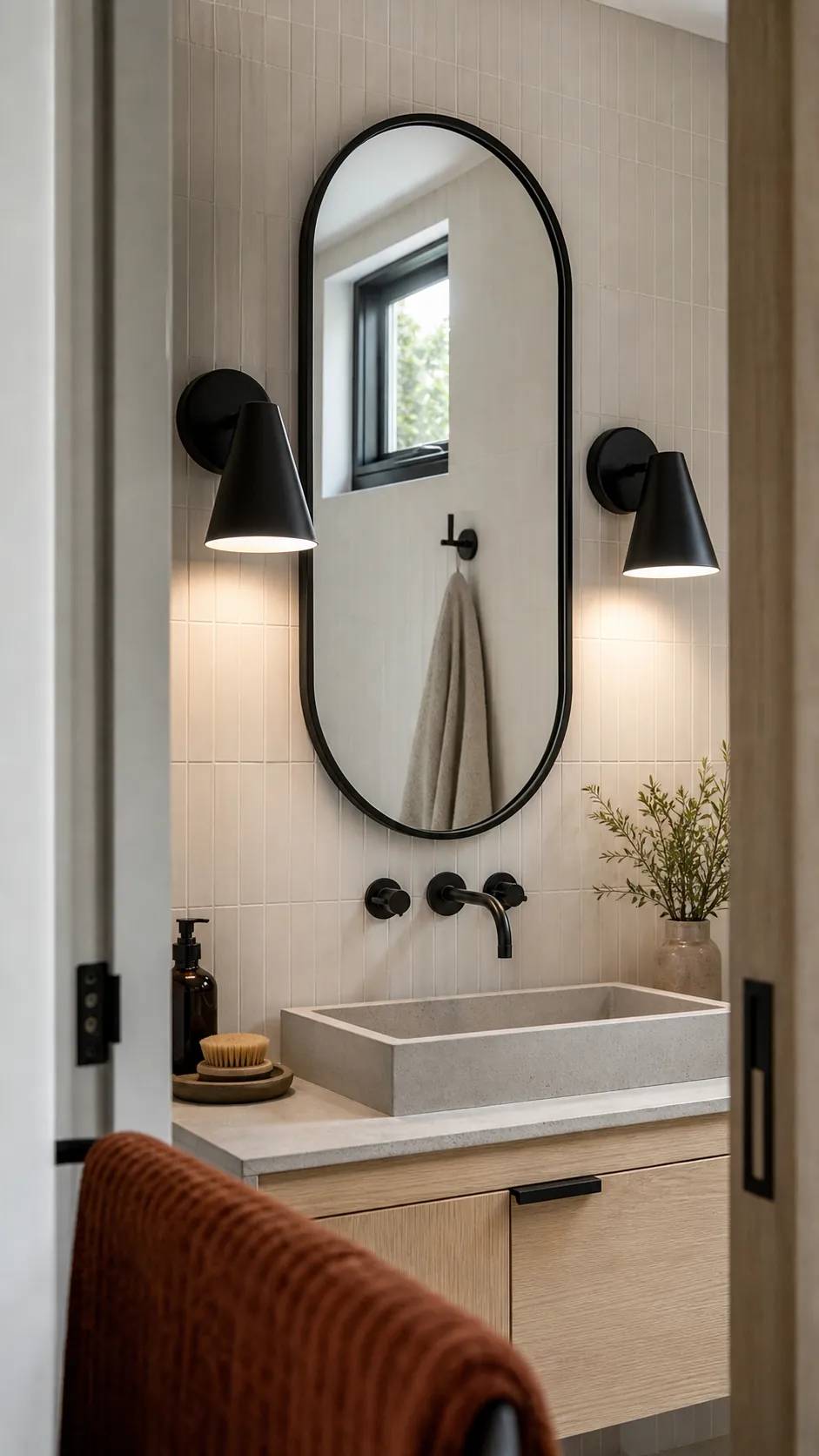
Leave enough room to clean between the shade, mirror edge, and stacked tile. When wall width is tight, a slightly narrower mirror usually looks calmer than squeezing the sconces against the side walls.
Alabaster Discs for a Soft Spa Glow
Thin alabaster discs contribute texture through natural veining rather than added ornament, and their backlit halos suit an oval champagne-framed mirror with a quiet rift-oak vanity. Ivory stone and clay-colored microcement allow the translucent material to remain the focal point.
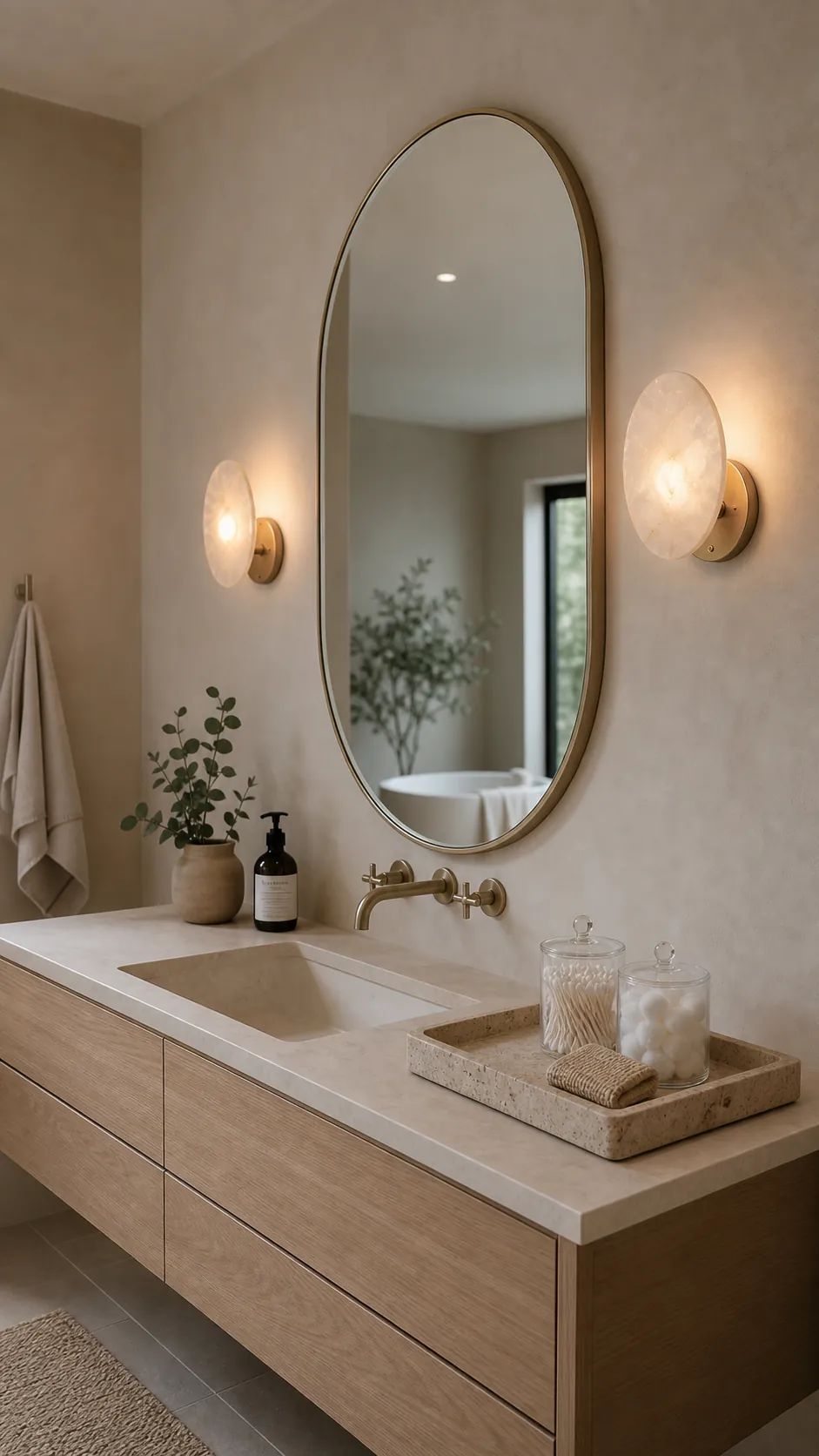
View the actual stone while it is lit, because veining and opacity can vary noticeably between fixtures. Confirm that the fixture’s driver—or the selected replaceable lamps—is compatible with the planned dimmer, particularly if the bathroom is used at night. Soft decorative light may still need a separate grooming layer if the discs leave the front of the face underlit.
Aged Bronze Candle Forms for Traditional Character
Slender candle-form sconces reinforce traditional millwork without making the bathroom feel like a period set. Cream glass sleeves temper the bronze, while a dark-walnut mirror relates to the furniture-style navy vanity. Brass pulls can remain as a secondary warm metal rather than matching every bronze note exactly.
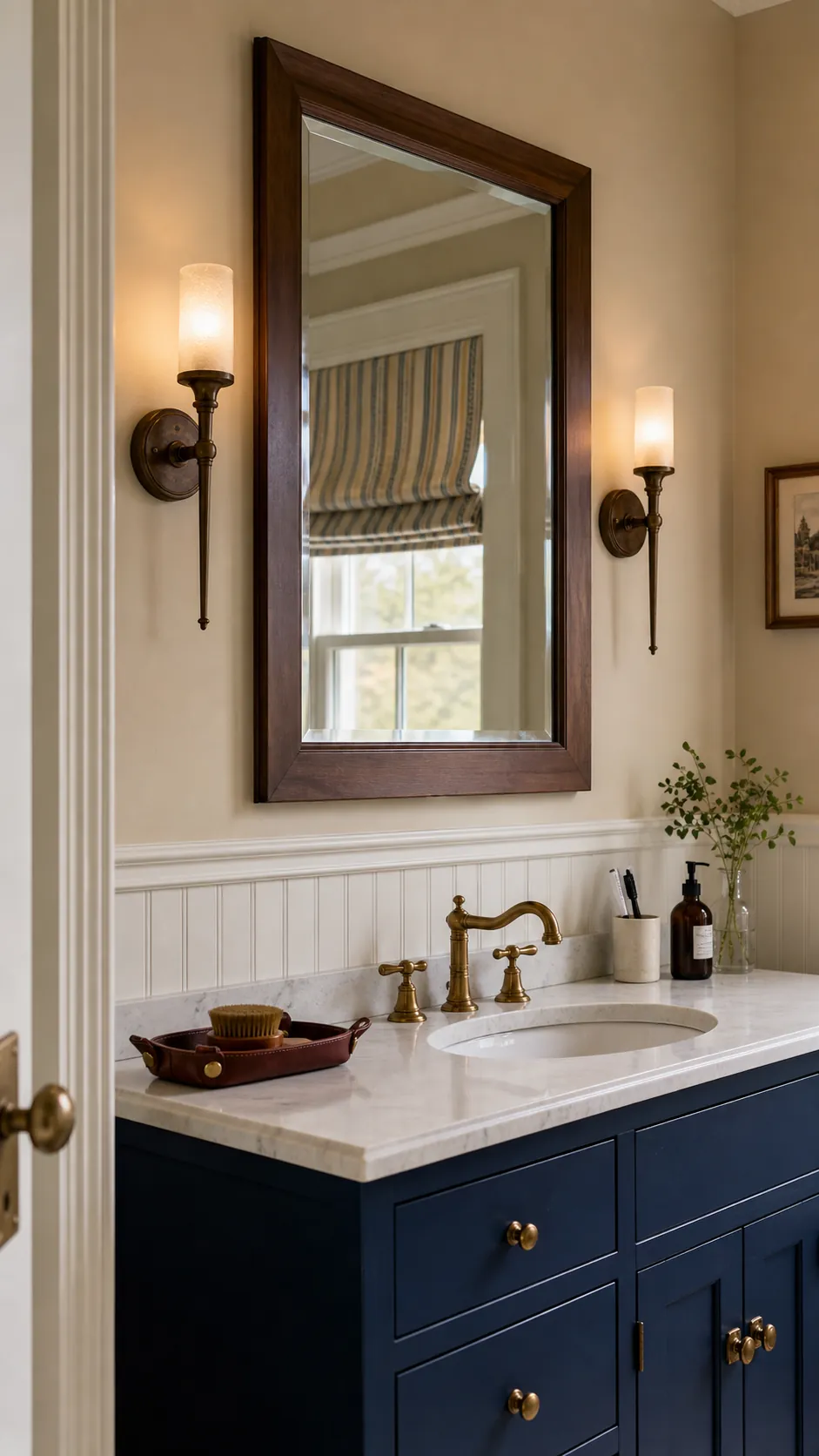
Check the mirror reflection from the doorway to ensure that bare lamp hardware does not become the first thing visible. Set the fixtures in relation to the beveled glass and basin rather than the beadboard joints alone, then confirm that the fittings are suitable for bathroom use. Concealed wiring matters more than preserving a perfectly antique appearance.
Slim LED Bars for a Minimal Vanity
Narrow LED bars work well when the mirror and integrated sink are meant to read as one uninterrupted plane. Frosted edge-to-edge diffusers reduce visual clutter, and satin aluminum blends more quietly with pale microcement than a contrasting decorative sconce would. Handleless cabinetry supports the same low-maintenance direction. Compare color quality, color temperature, dimming behavior, and replacement provisions before choosing an integrated fixture.
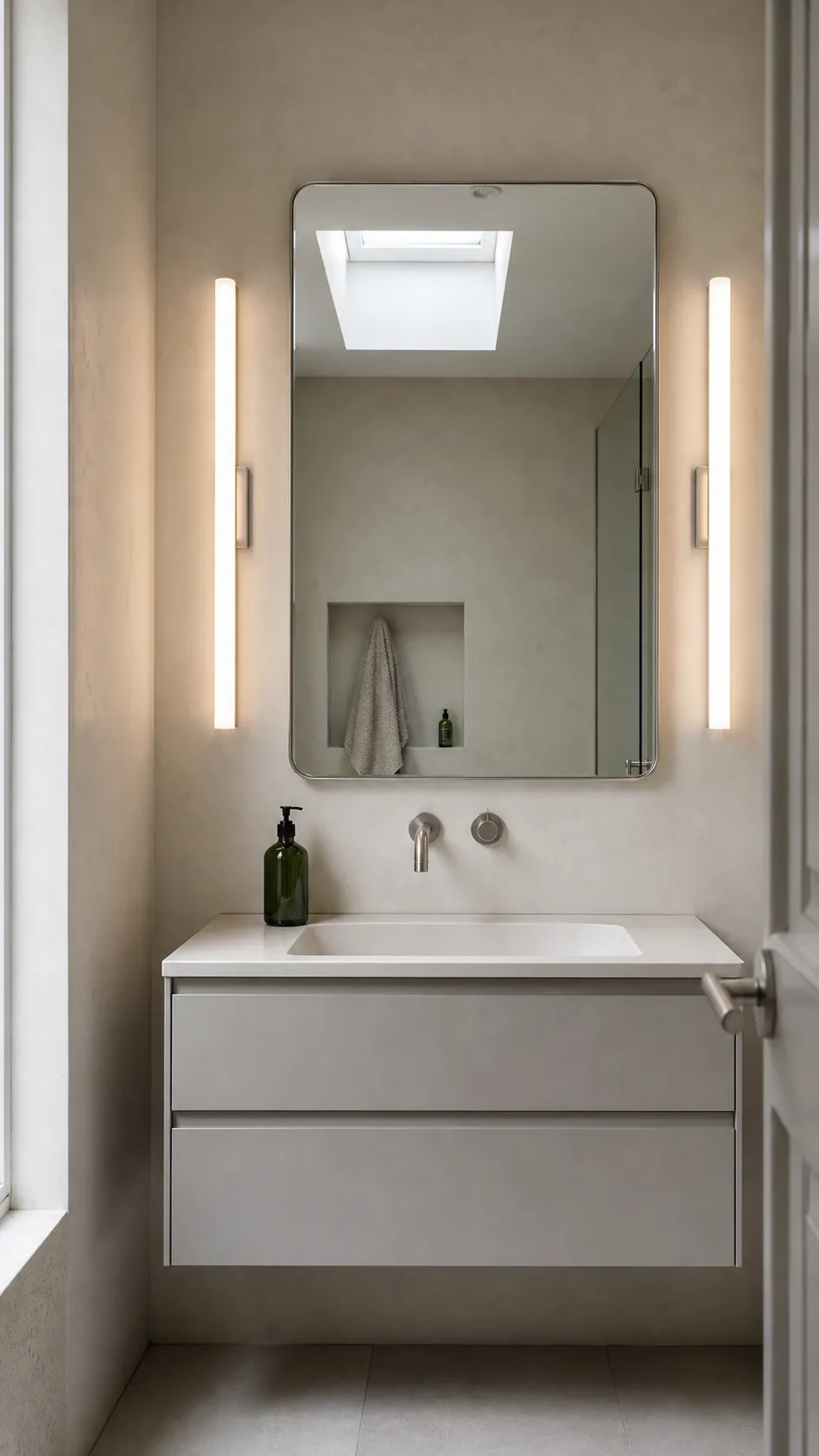
A minimal bar with poor light will be frustrating long after its clean profile stops feeling novel. Detail the mirror edges and wall junctions carefully, since gaps and uneven sealant become more noticeable in such a stripped-back composition.
Pleated Shades That Make the Vanity Feel Furnished
Small pleated shades can make a guest bathroom feel furnished in the same way a lamp does in a bedroom. Burgundy lacquer around the scalloped mirror gives the ivory pleats a crisp boundary, while dusty pink walls keep the contrast warm. The cream vanity and restrained quartz pattern prevent the palette from becoming sugary.
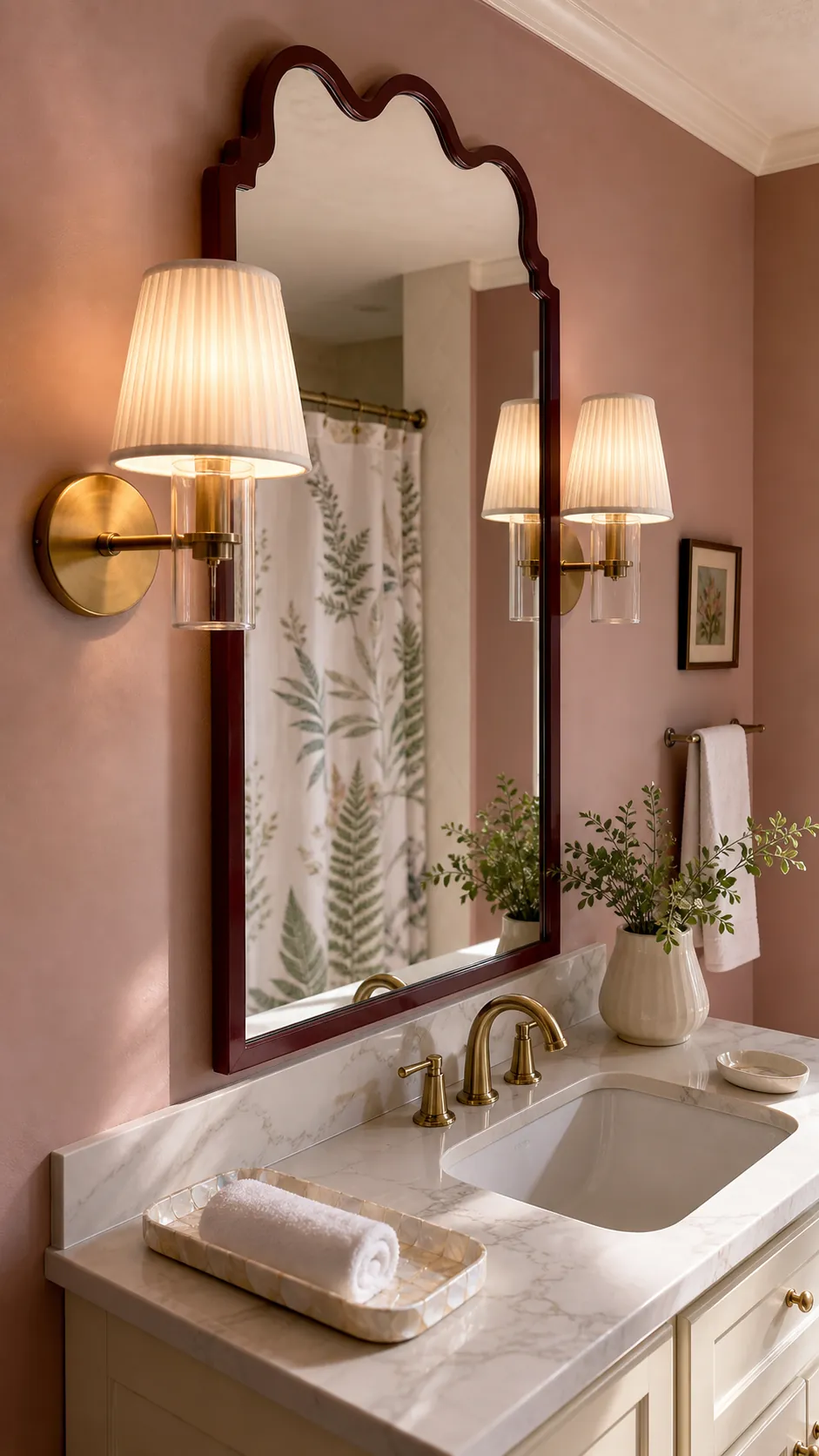
Choose fixtures specifically constructed for bathroom conditions, with the decorative fabric protected from moisture by the intended sealed assembly. Check how far the shades project before placing them near a door or narrow passage. Since guests may use the mirror for quick grooming, retain a simple ceiling light to fill any shadows created by the pleats.
Fluted Glass and Nickel for a Crisp Classic Look
Polished nickel and long fluted tubes bring a clean classic finish to a deep-green vanity, while the clipped corners of the mirror echo the precision of the metalwork without repeating the same shape. White brick tile and marble keep the darker cabinet from absorbing too much light.
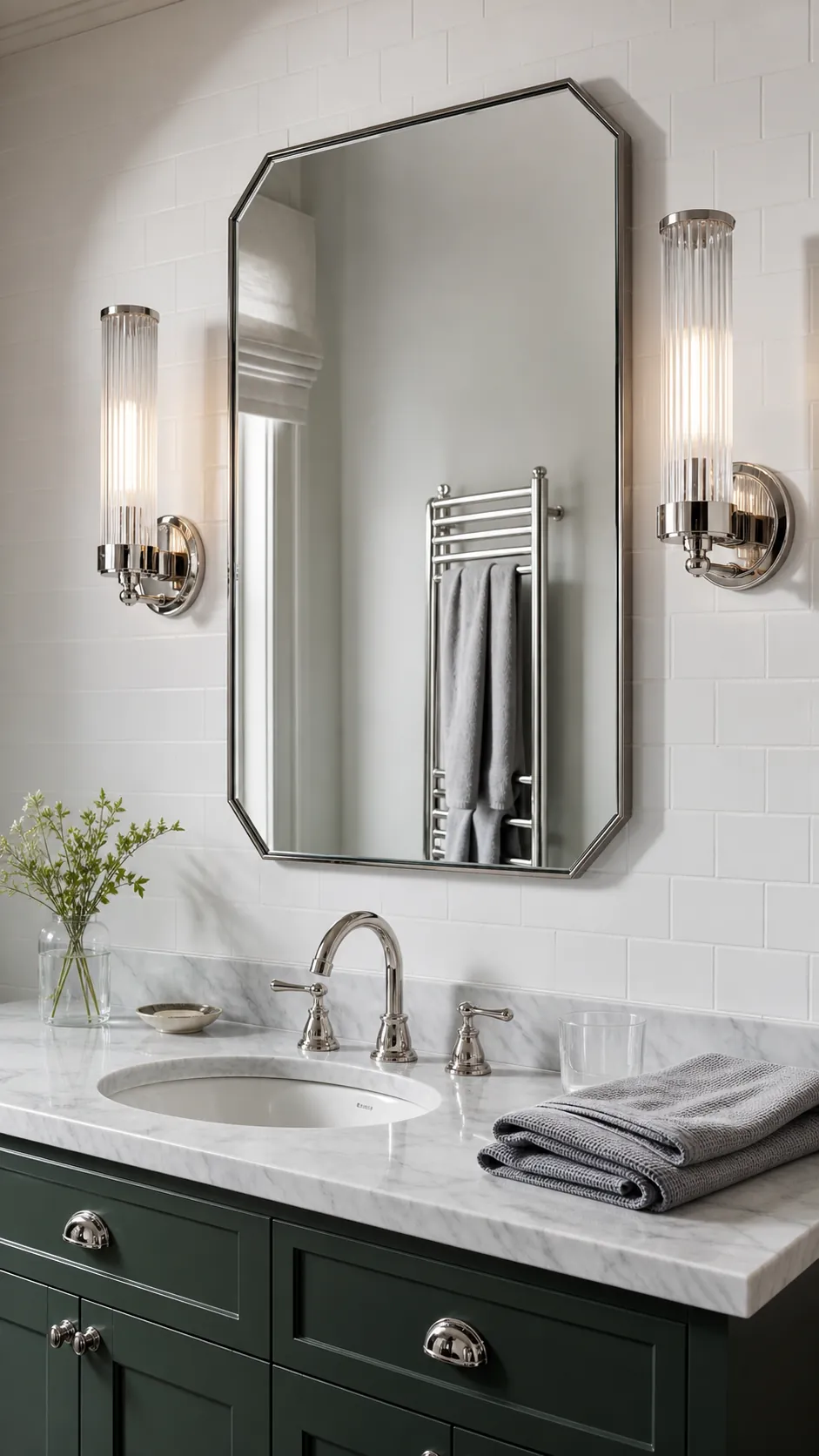
Fluted channels collect residue more readily than plain glass, so make sure the tubes can be reached and cleaned easily. Look at the nickel beside the faucet and cabinet hardware under the room’s actual light; cool reflective metals can shift noticeably against green paint. For a shared bathroom, prioritize diffusers that hide the lamps and remain comfortable when viewed from either side.
Sculptural Plaster Sconces on a Textured Wall
Curved plaster sconces can disappear into a troweled wall by day and reveal its texture after dark. Up-and-down light traces the uneven surface, while the pebble-shaped mirror keeps the composition loose rather than architectural. A monolithic vanity and rough limestone basin extend the tactile idea below.
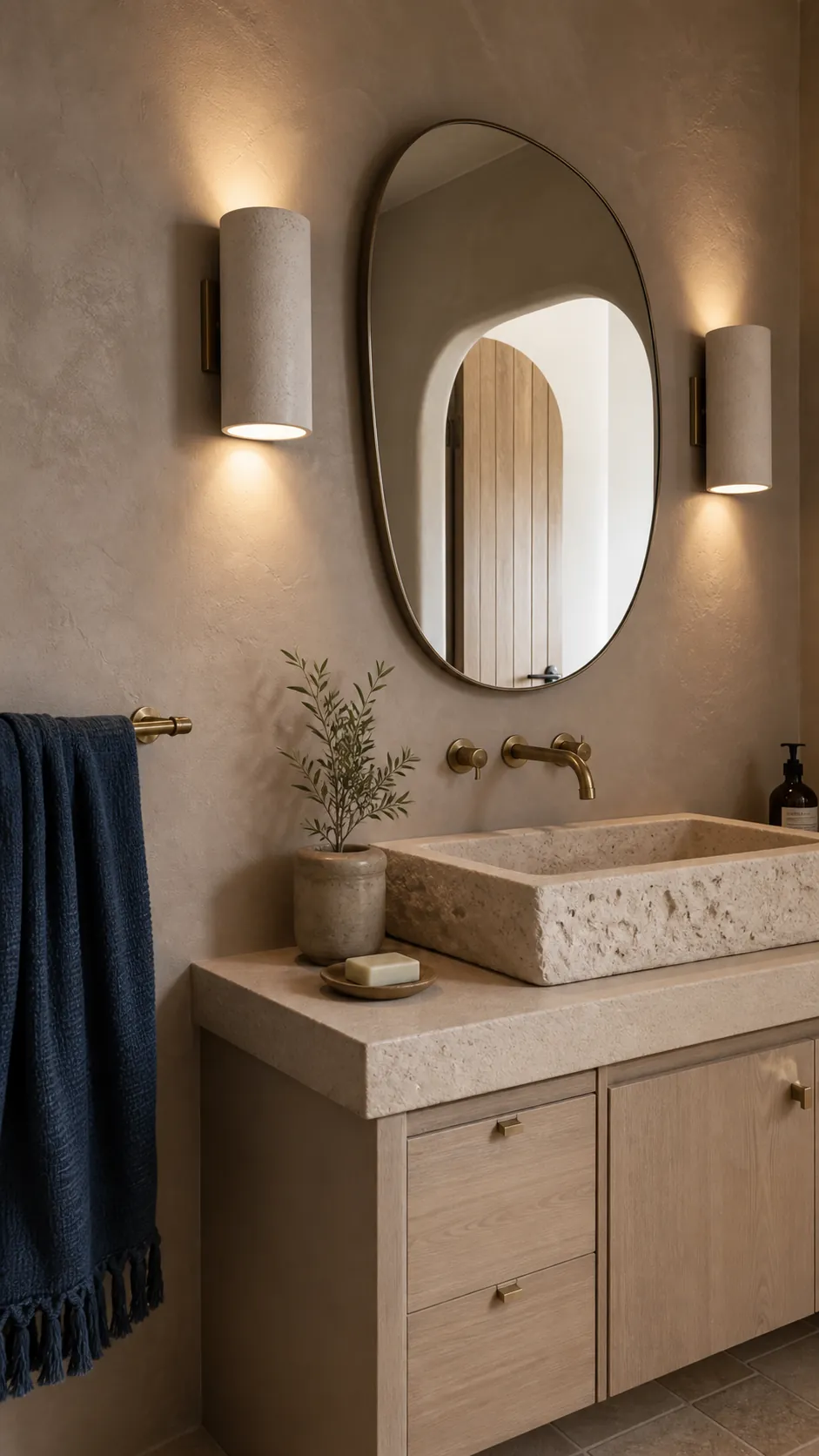
Ask for a finish sample under the proposed fixture because grazing light exaggerates every ridge, patch, and repair. Verify that the sconce is suitable for the room and that its lamp remains accessible; in a compact space, one sculptural pair is enough without extra relief competing with the shadow pattern.
Adjustable Arms for a Deep Medicine Cabinet
A projecting medicine cabinet can leave fixed sconces sitting behind the mirror plane, which narrows useful light. Short articulated arms bring the diffusers forward while preserving storage in the recessed cabinet. Bronze joints and a walnut vanity make the functional adjustment look deliberate. Open the cabinet fully in the mock-up and trace the paths of both doors before settling the arm angles.
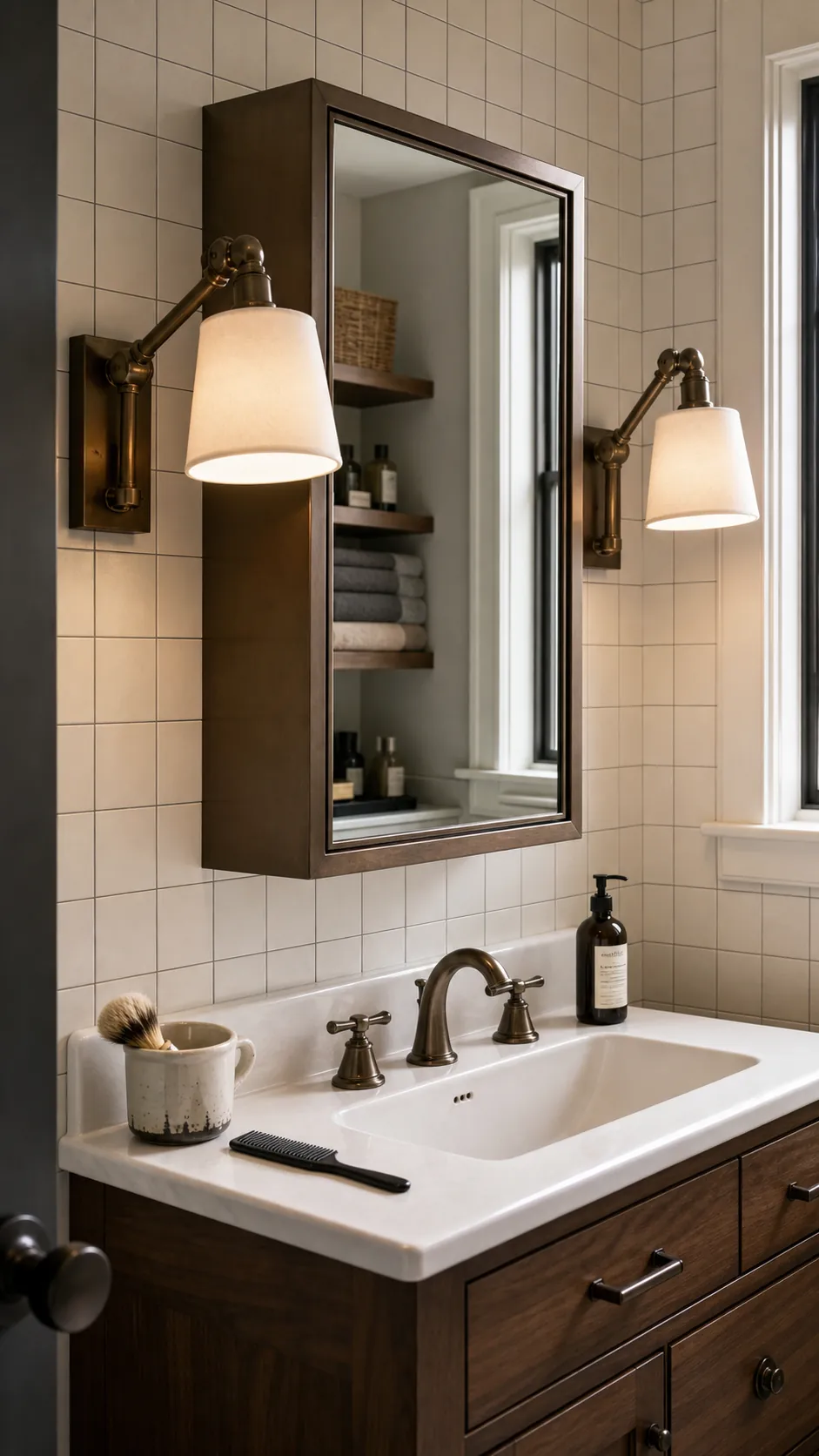
The joints should hold their position without placing a shade where it can be knocked during cleaning. Aim for an even relationship to the face, then verify that the extended fixtures do not create glare in the thick bronze frame.
Smoked Glass for a Moody Powder Room
Smoked-glass globes deepen an aubergine powder room, but they also absorb light, so the effect should be judged with the fixtures switched on. Frosted lamps keep the bulbs from becoming harsh dots inside the dark glass. A blackened-steel mirror and walnut console continue the mood without introducing another decorative color.
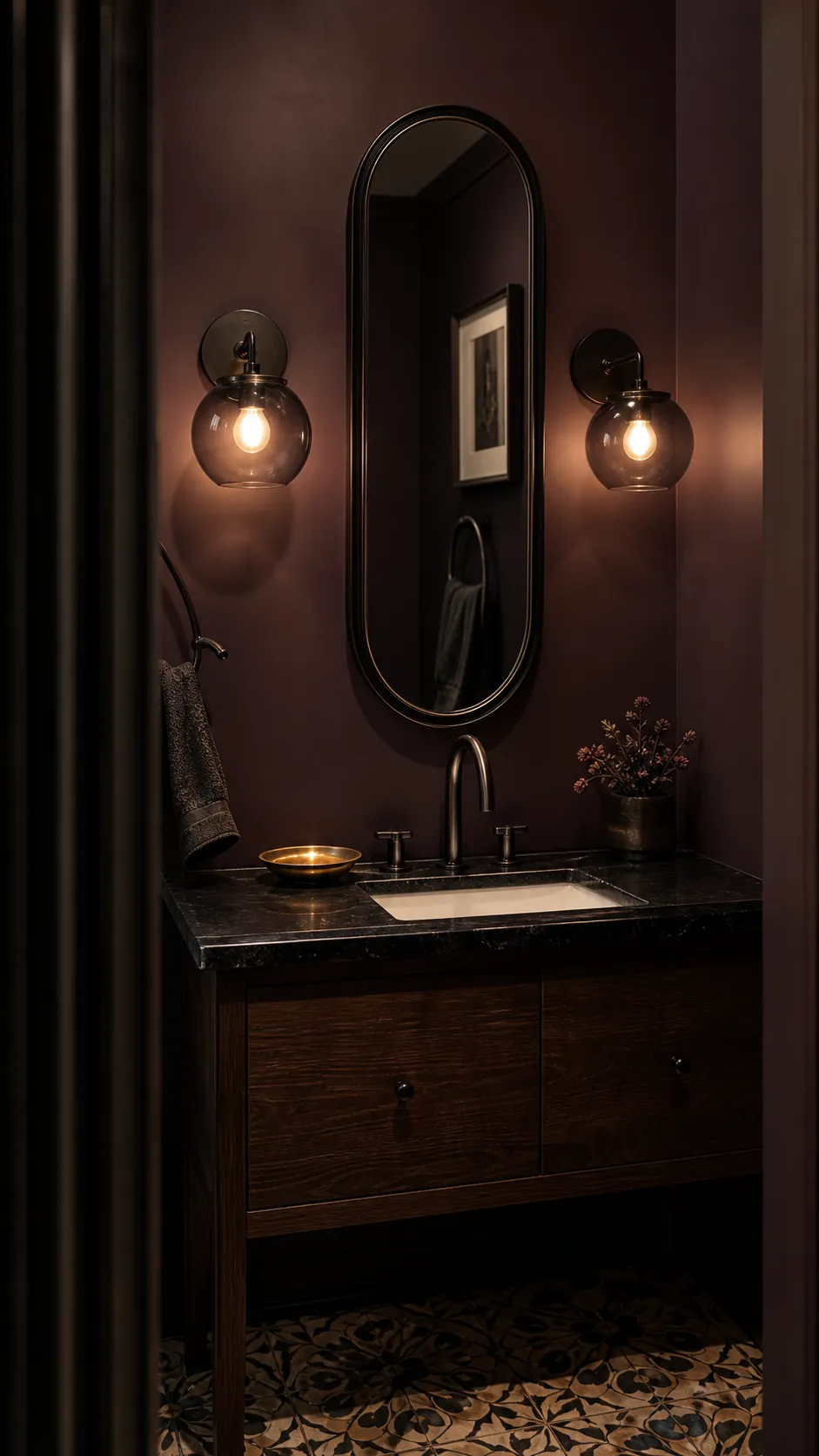
Use this treatment where atmosphere matters more than detailed grooming, or support it with unobtrusive ambient light. Test the lowest and highest dimmer settings after sunset, when the dark finishes will have their strongest effect. Leave a slim highlight on the face and basin so the room feels intimate rather than murky.
Milk Glass Schoolhouse Sconces for Vintage Ease
Schoolhouse shades introduce a familiar vintage shape without requiring an elaborate vanity, and opaque milk glass sits comfortably with a blue-painted mirror and white tongue-and-groove paneling. A pedestal sink keeps the lower half visually open, while a narrow marble shelf replaces some of the missing counter space.
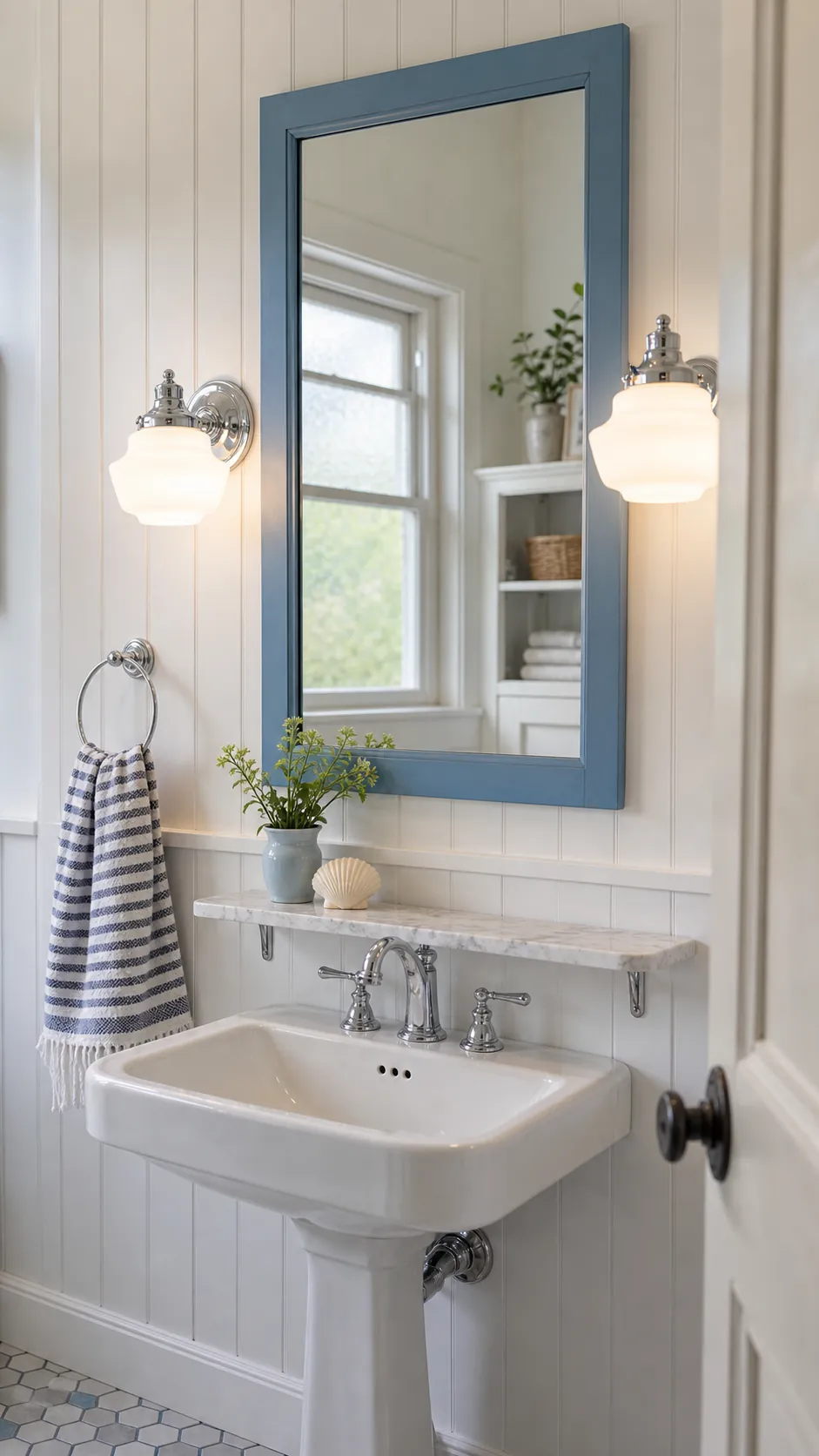
In an older cottage, locate the existing boxes and wall framing before assuming the pair can move outward. Compact chrome backplates are easier to integrate when the panel grooves and mirror edge are already competing for space. Repeat the blue once in a towel or small object, then let the glass and porcelain carry the brightness.
Double-Arm Sconces When Wall Space Is Generous
Double-arm sconces earn their width above a broad two-sink vanity because each fixture supplies more than one point of light. Paired opal cylinders break up the long span of mirror and prevent the charcoal cabinetry from feeling heavy. A thin brass edge keeps the extra-wide glass visually contained.
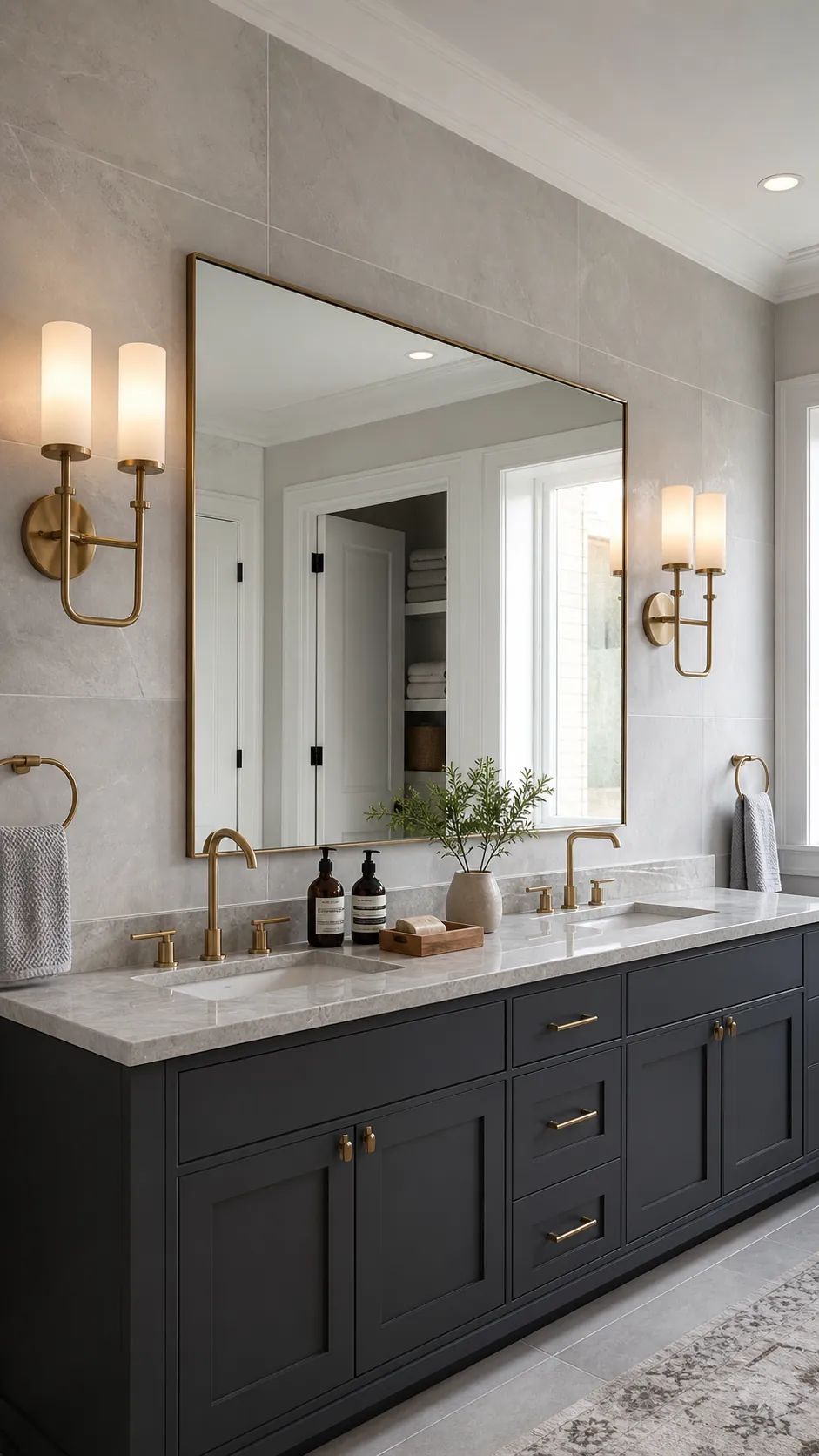
Center the lighting composition on the two users and their basins rather than on the room as a whole. Full-size templates should include every cylinder, cabinet door, and end wall so the generous layout does not become crowded; separate controls for the sconces and brighter overhead light can then make the vanity comfortable at different hours.
Tiny Globes That Leave Breathing Room
Petite globes preserve mirror width in a bathroom where a large decorative shade would make the vanity feel pinched. Frosted lamps soften the view through clear glass, and pale oak prevents the nearly wall-wide mirror from looking severe. A sage cabinet adds color below eye level without shrinking the wall. Work with the existing electrical locations in a rental unless the owner approves a change.
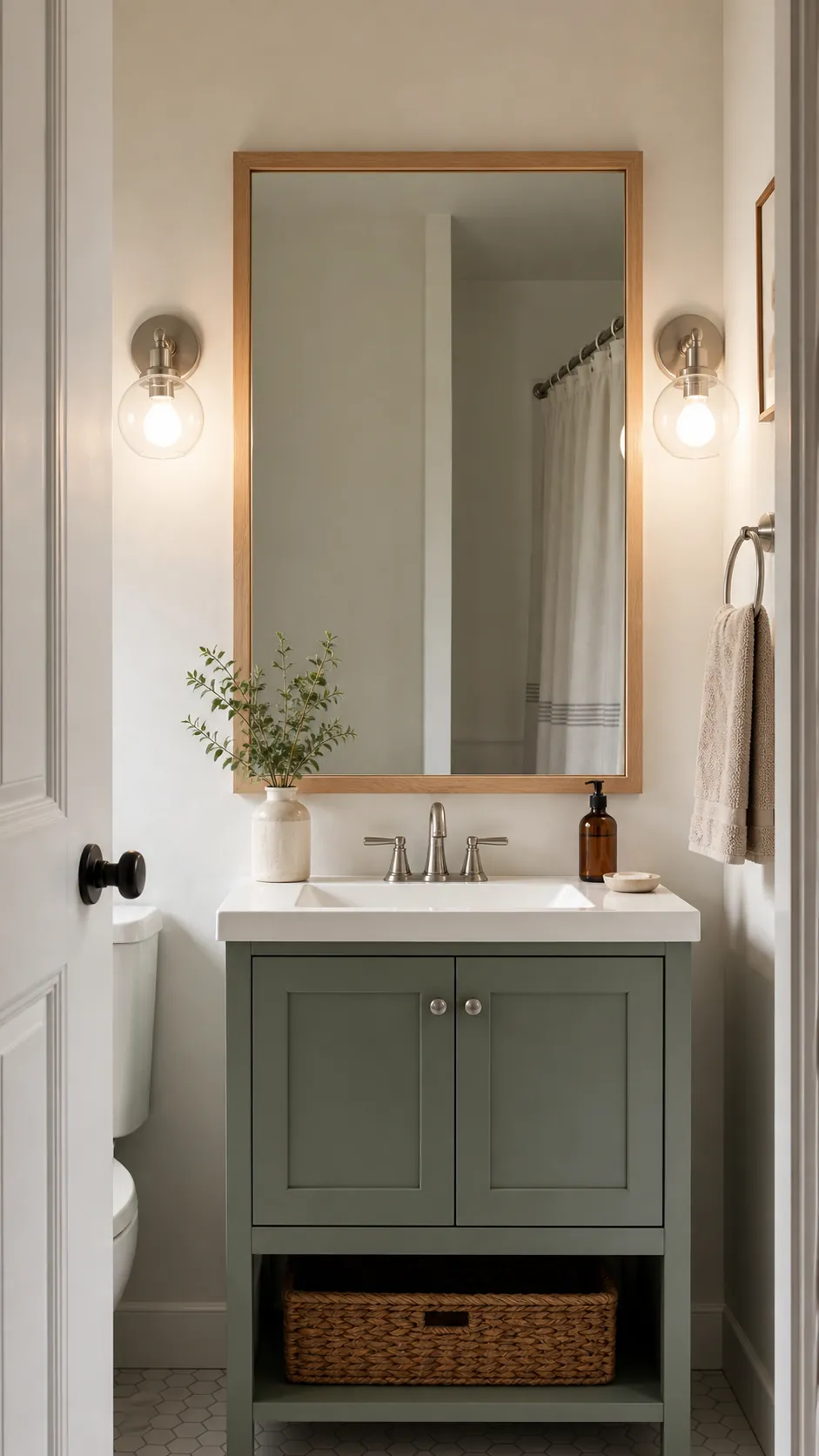
Check that the small backplates cover the boxes and that the globes can be removed for cleaning without hitting the mirror. Clear glass exposes dust and lamp shape, so choose simple components that still look tidy when the light is off.
Art Deco Fans With a Stepped Mirror
Fan-shaped sconces and a stepped mirror share an Art Deco vocabulary, allowing the theme to read without extra motifs. Ribbed translucent glass softens the brass geometry, while the black vanity grounds a vivid green-marble top. Cream handmade tile gives the stronger forms a quieter background.
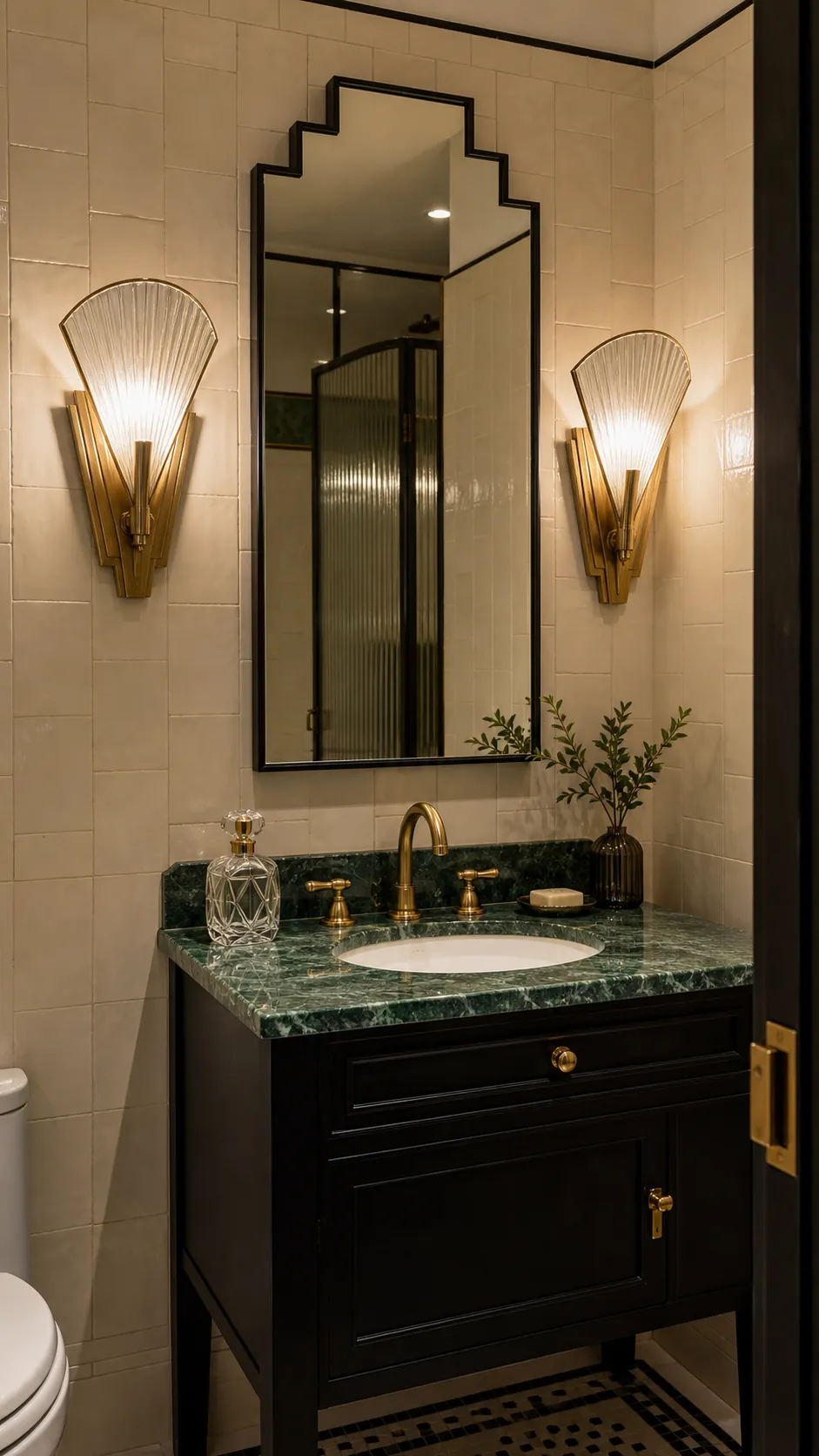
Decorative ribbing may cast patterned highlights, so evaluate the face in the mirror rather than judging the fixtures only from the doorway. A discreet ambient source can fill shadows without diluting the period character. Keep towels, pulls, and accessories plain; repeating fans and steps everywhere would turn restoration-minded detail into pastiche.
Blue Ceramic Sconces as the Color Moment
Cobalt ceramic cylinders can provide all the color a simple family bathroom needs, while a round white-oak mirror and white Shaker vanity give the glaze room to stand out. Blue-gray paint creates a softer transition than a stark white wall, and perforated lower edges add a small pattern only when the lights are on.
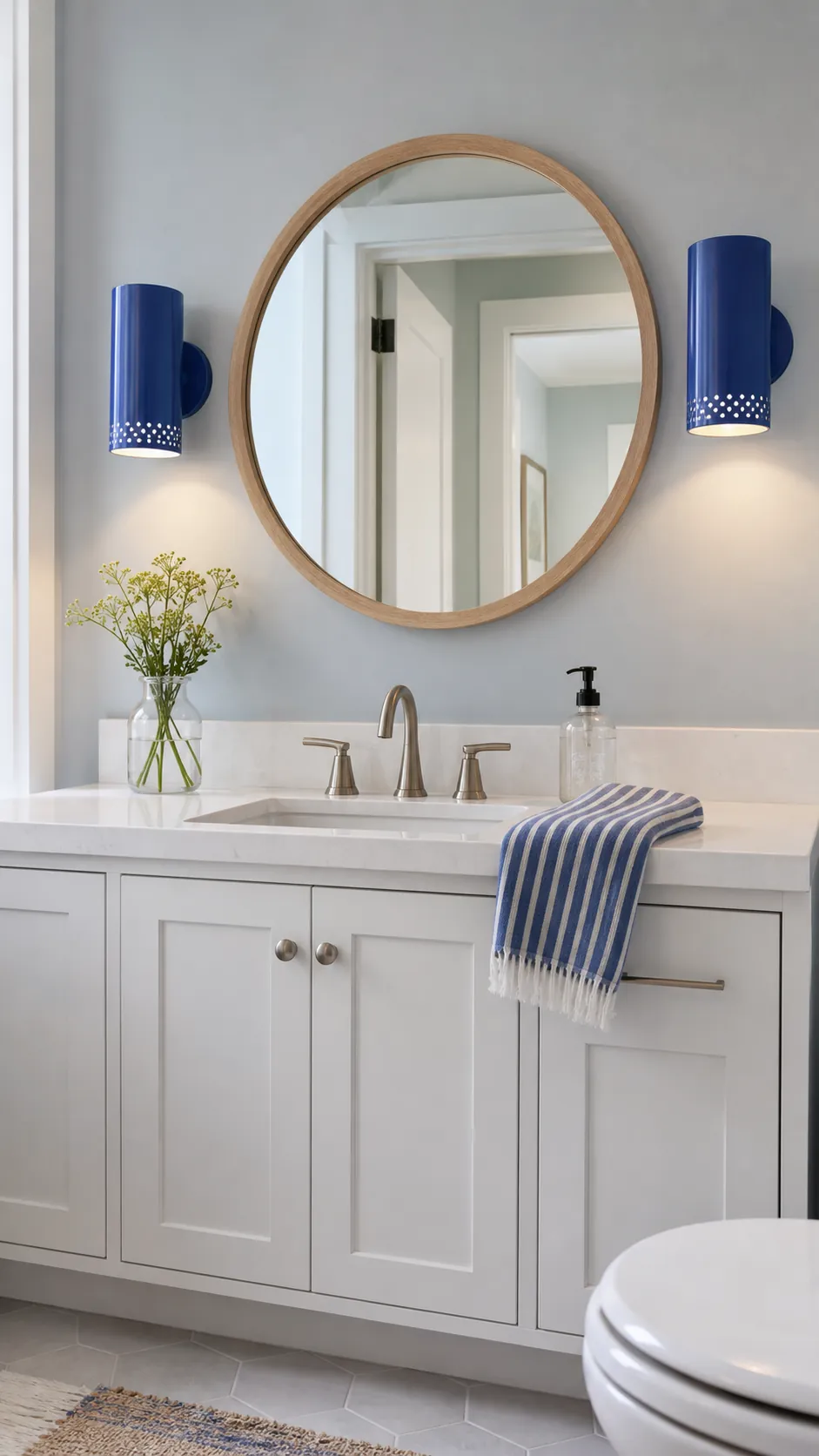
Glaze color and sheen vary between batches, so compare both sconces before mounting them. Confirm that the perforated light is decorative rather than the only illumination reaching the face. Repeating cobalt in one washable textile is enough to connect the fixtures to the room without building a rigid matching scheme.
Reeded Brass Backplates That Echo the Mirror
Reeded brass backplates can tie sconces and mirror together through texture instead of adding more decor. Slim opal lamps keep the repeated metalwork from becoming too dense. Mushroom cabinetry, limestone, and ivory plaster give the grooves a calm neutral setting.
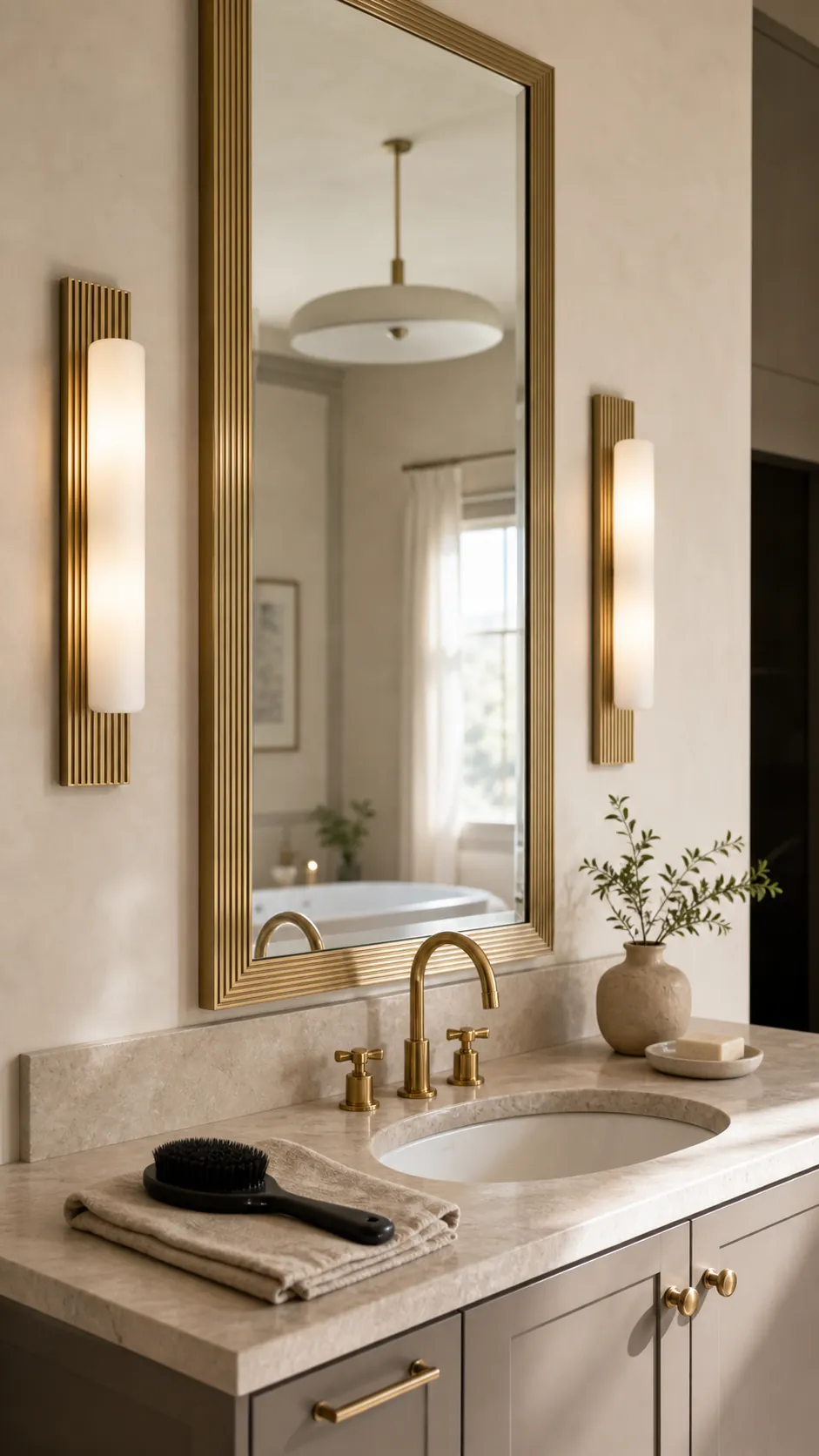
Align the vertical reeds carefully where the backplates approach the mirror frame, since a near miss will be conspicuous. Allow enough separation for cleaning the channels when needed, while keeping the coordination subtle enough that the vanity still reads as a quiet whole from the doorway.
One Sconce on Each Outer Edge of Twin Mirrors
With two mirrors, three sconces can define two complete grooming zones: one fixture at each outside edge and one shared between them. This layout follows the sink centers instead of forcing the installation to obey the midpoint of the wall. Bronze frames and natural oak keep the repeated vertical elements cohesive. Draw the basins, mirrors, and all three backplates on one elevation before ordering anything.
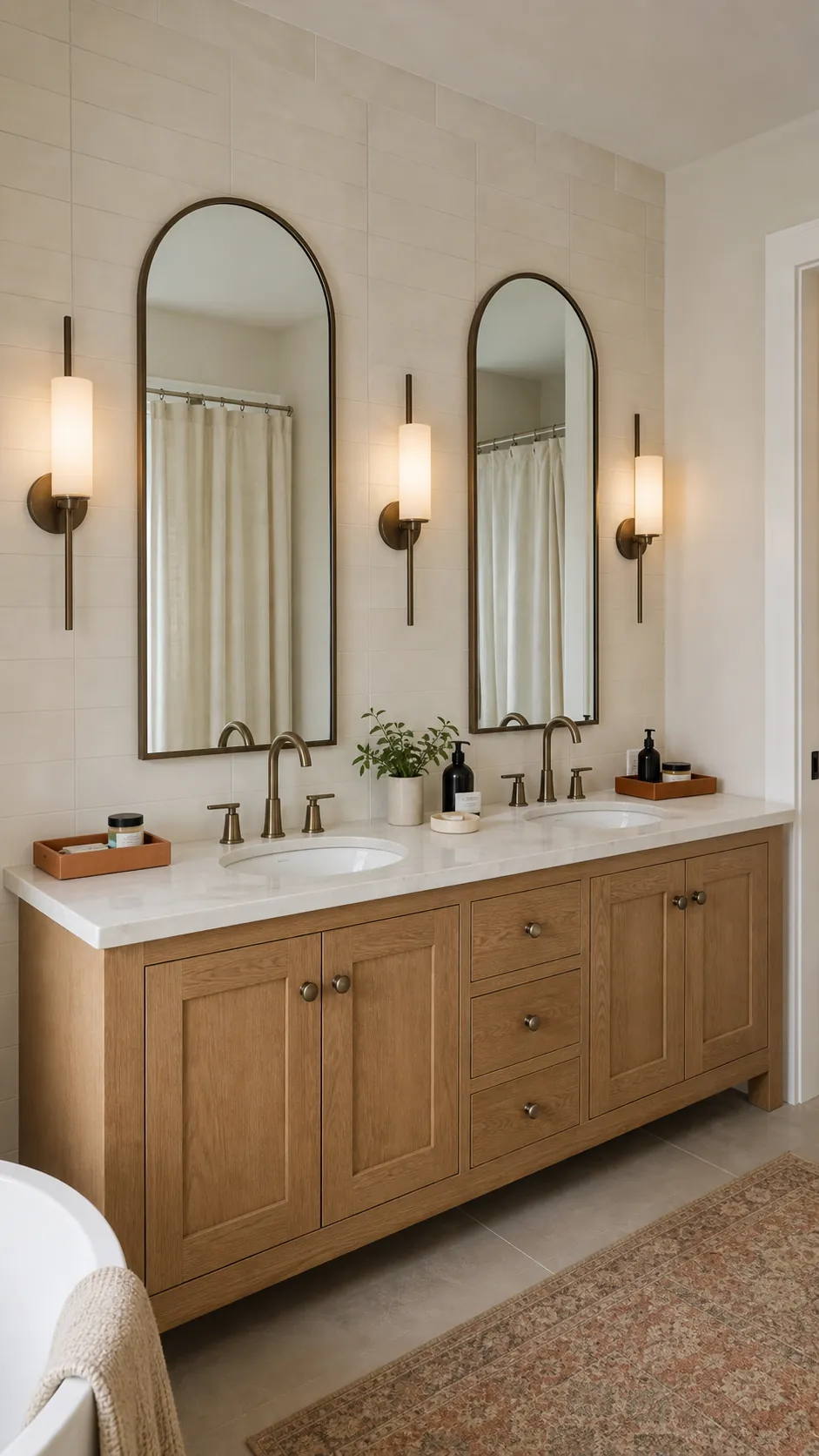
The middle fixture needs enough breathing room from both mirrors and should not interfere with a medicine cabinet or shared storage. Let small differences at the end walls remain if the two users receive balanced, practical light.
Four Slender Sconces for a Long Double Vanity
Four pencil-thin sconces can make an eight-foot vanity feel like two related stations rather than one endless run. Each rounded mirror receives a light on both sides, giving the black lines a clear purpose. White oak and pale stone keep the repeated fixtures from creating a heavy grid.
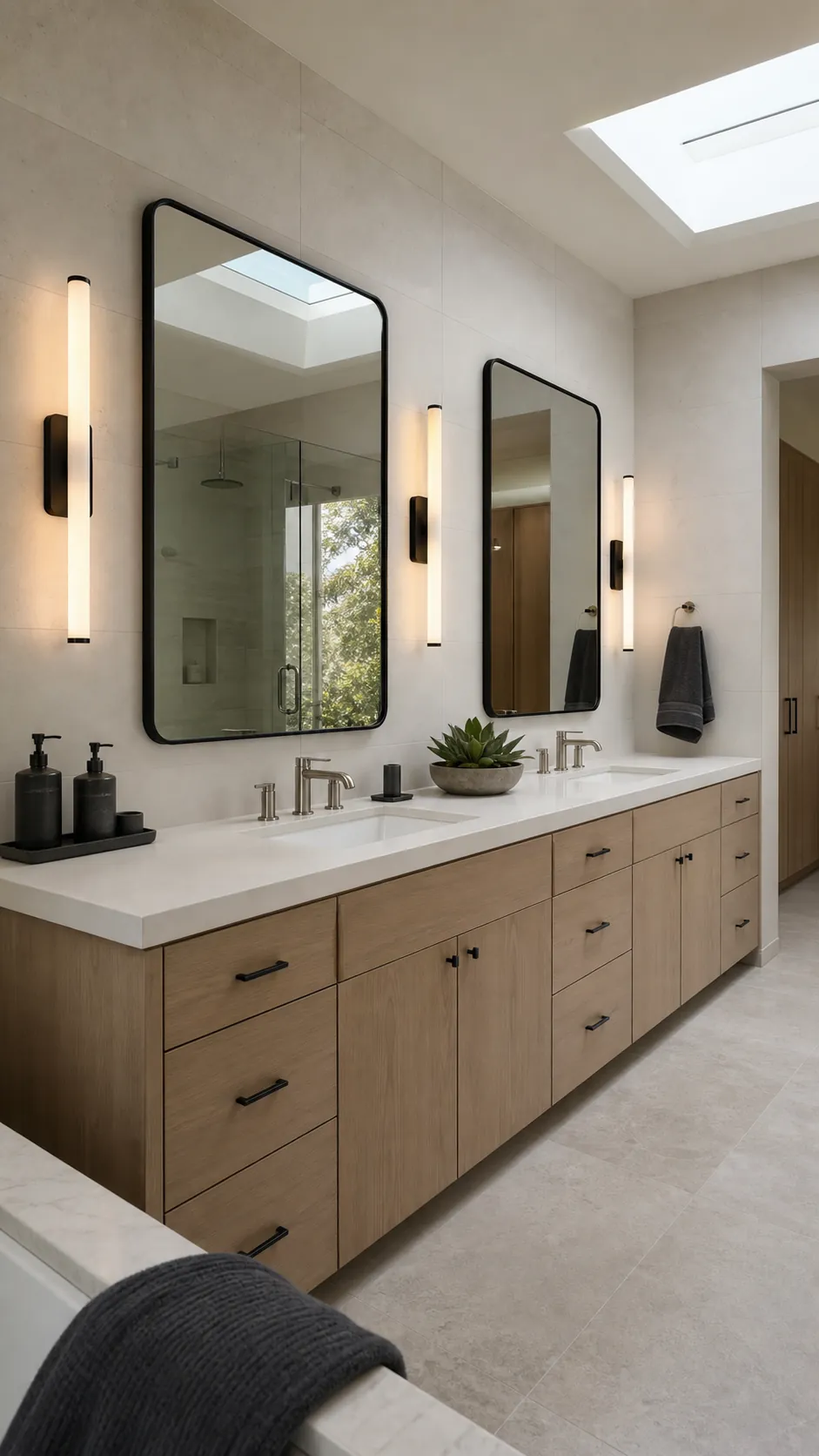
Check the full elevation for crowding at the outer walls and in the gap between mirrors. Coordinate the combined electrical load, drivers, and dimming with the electrician instead of treating four integrated fixtures as interchangeable with a simple pair. Repeating the black finish only in the mirror edges is usually enough to hold the composition together.
A Sconce Mounted Through the Mirror
Mounting a sconce through mirror glass creates a precise built-in effect and frees the composition from narrow side margins, while chrome globes appear to float against a full-height reflective backsplash. Walnut below adds warmth and visual weight, making the result suitable for a planned renovation rather than an improvised finishing detail.
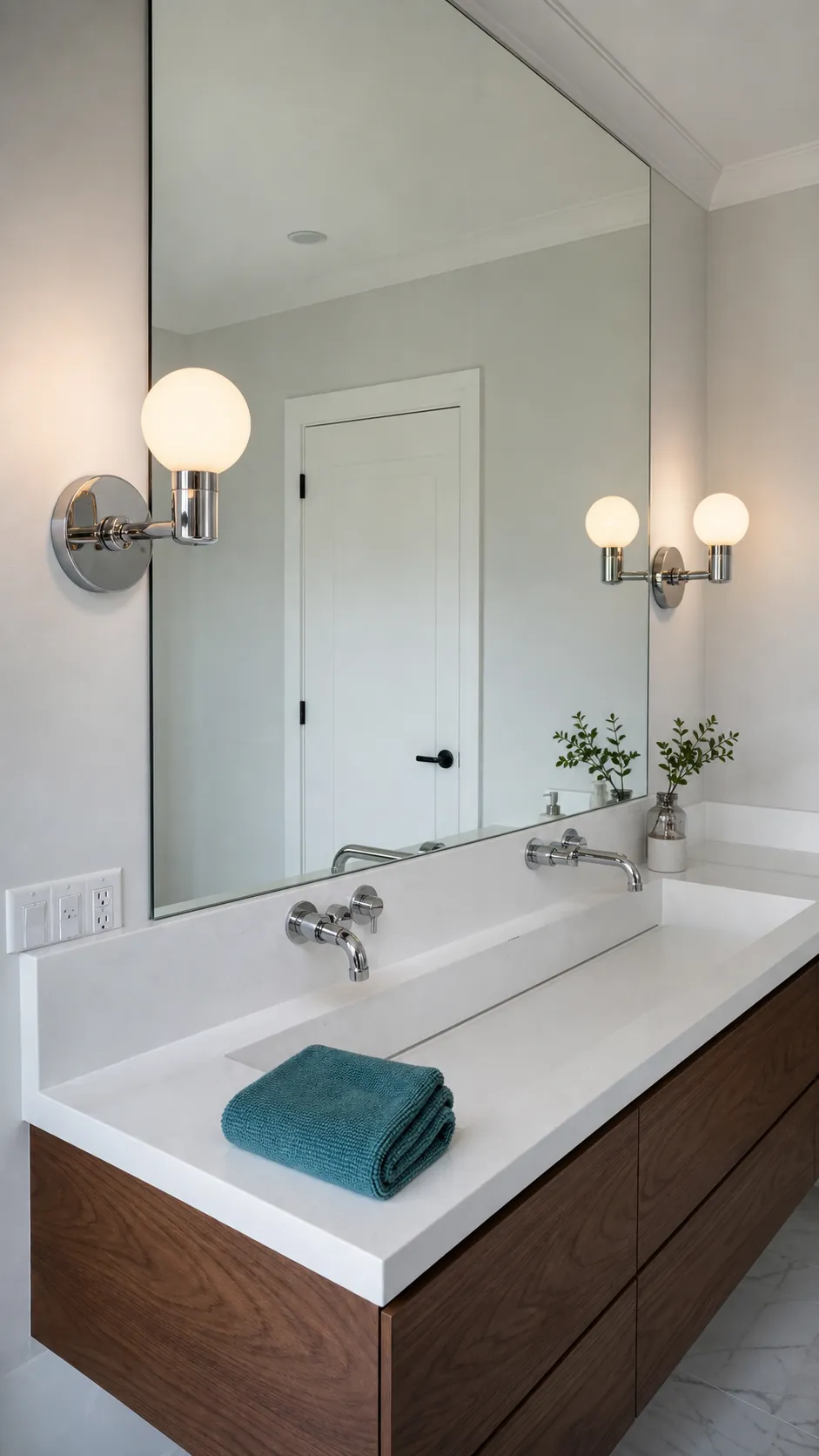
The glass fabricator, electrician, and installer must coordinate the cutouts, backing, boxes, and final fixture dimensions before production. Required openings belong in the approved fabrication plan, and tempered glass cannot be drilled after tempering to correct a misplaced box. Preserve access for future electrical service, and approve a full elevation before any irreversible work begins.
Warm Bronze Against Cool Blue Tile
Warm bronze takes the chill off glossy blue-green tile without hiding its watery color variation. Etched-glass tubes soften reflections, and an arched bronze mirror carries the metal across the center of the vanity. Navy cabinetry and pale terrazzo connect the cool wall to the warmer fittings below.
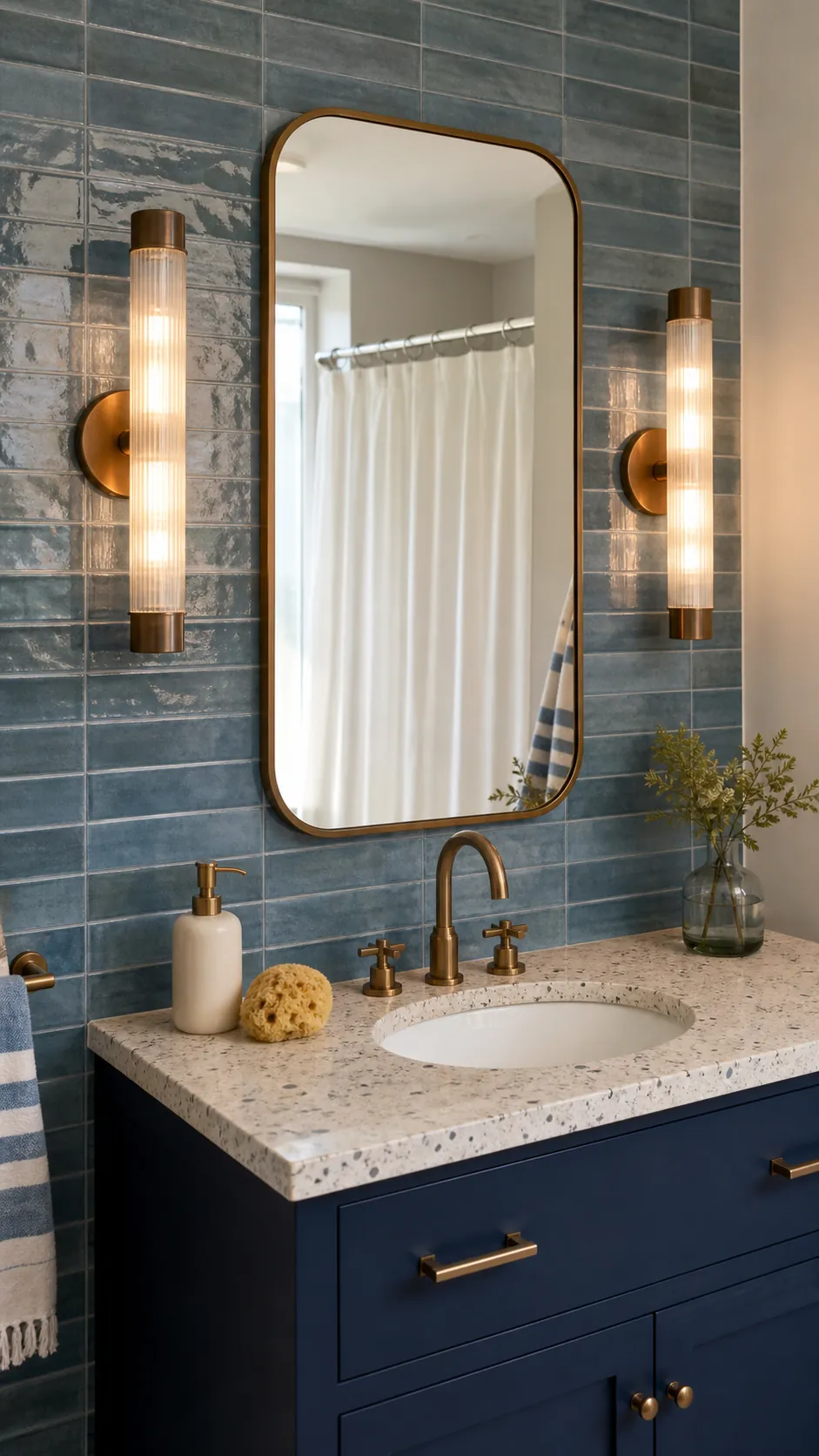
Compare tile, bronze, grout, and terrazzo samples together in daylight and under the selected lamps. A humid coastal bathroom benefits from wipeable surfaces whose grout lines and fixture edges remain reachable, while one other permanent bronze fitting is enough to connect the palette.
Unlacquered Brass That Will Age Naturally
Unlacquered brass changes with handling, moisture, and cleaning, making its patina part of the design rather than a defect. Clear bell shades reveal the living finish, while an antiqued mirror and Carrara marble prevent the metal from looking newly polished everywhere. Warm gray cabinetry provides a steady backdrop as the sconces evolve. Confirm that the product is genuinely unlacquered and ask how the maker recommends cleaning it.
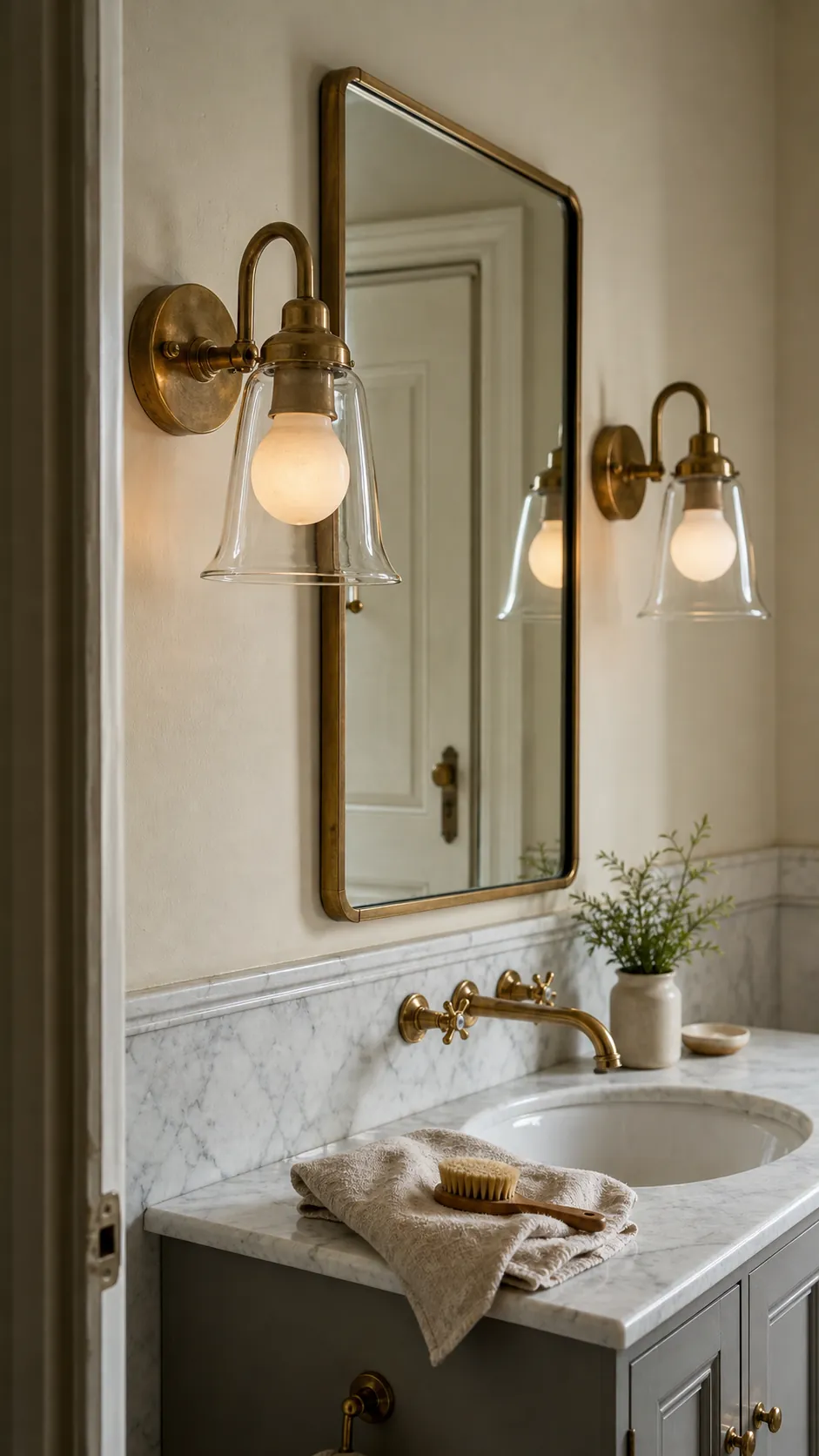
Owners who want a uniform bright finish will be happier with a protected alternative; natural aging is difficult to control precisely. If patina is welcome, accept differences between the sconces, faucet, and frame instead of trying to make every brass surface age identically.
Mixed Metal Sconces Without Visual Clutter
A satin-nickel sconce with a small black collar can bridge a nickel faucet and black mirror frame in one object. Opal shades soften the transition, and walnut gives both metals a warm background. This approach is useful when a phased renovation leaves some permanent finishes in place.
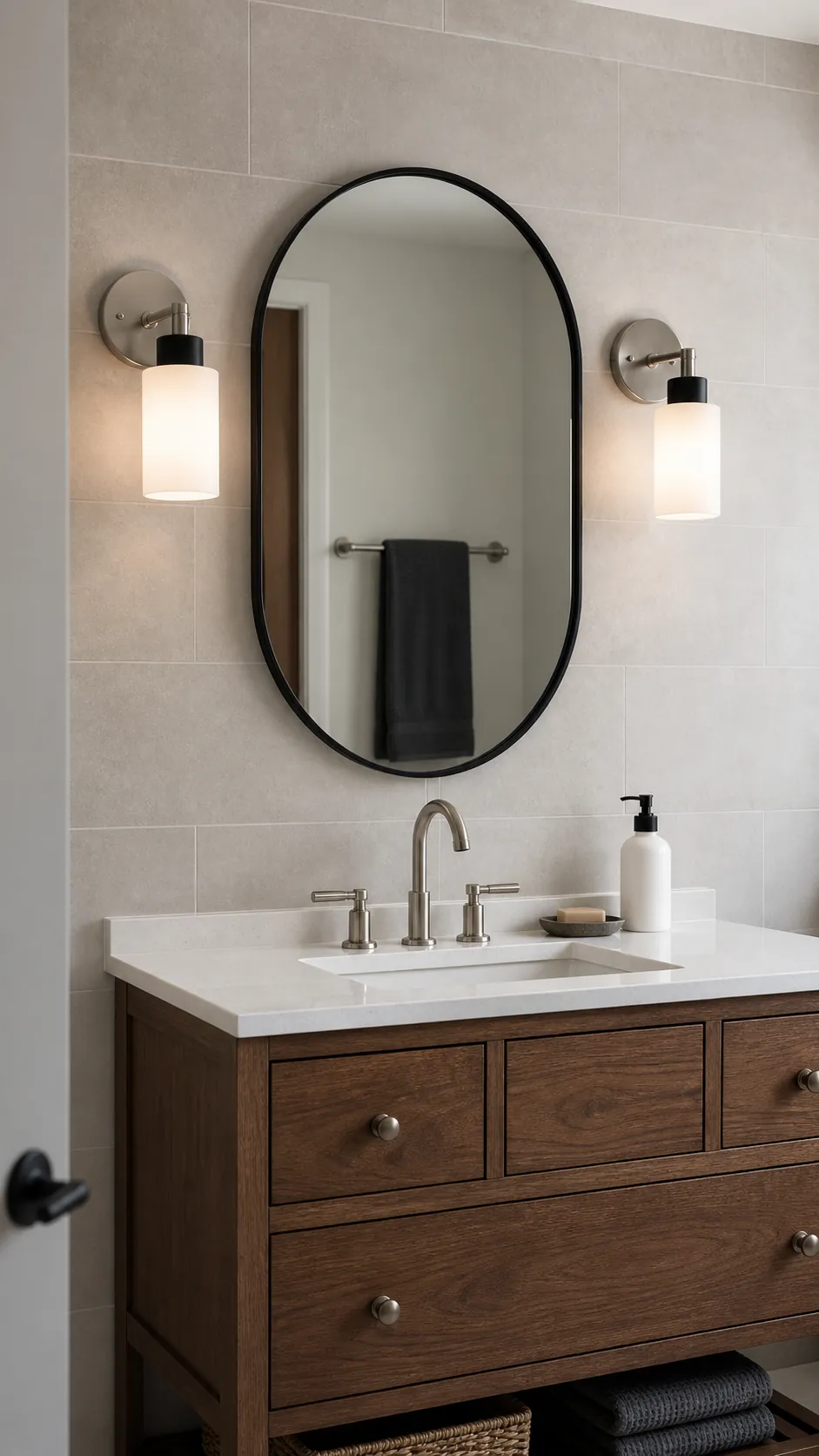
Make a simple inventory of the metals already visible at the vanity before adding another. Repeat each dominant finish at least once where it feels functional, then allow minor screws and internal parts to disappear from the palette. Satin surfaces also tend to show handling less readily than highly polished ones, which suits a frequently used bathroom.
Low-Glare Sconces for a Calm Night Routine
Shielded sconces hide the direct view of the lamp and send softer light sideways, reducing the bright reflection that can feel abrupt at night. Dark bronze blends into muted clay walls, while a rounded walnut mirror, cream basin, and opaque fixture fronts keep the vanity warm but visually quiet.
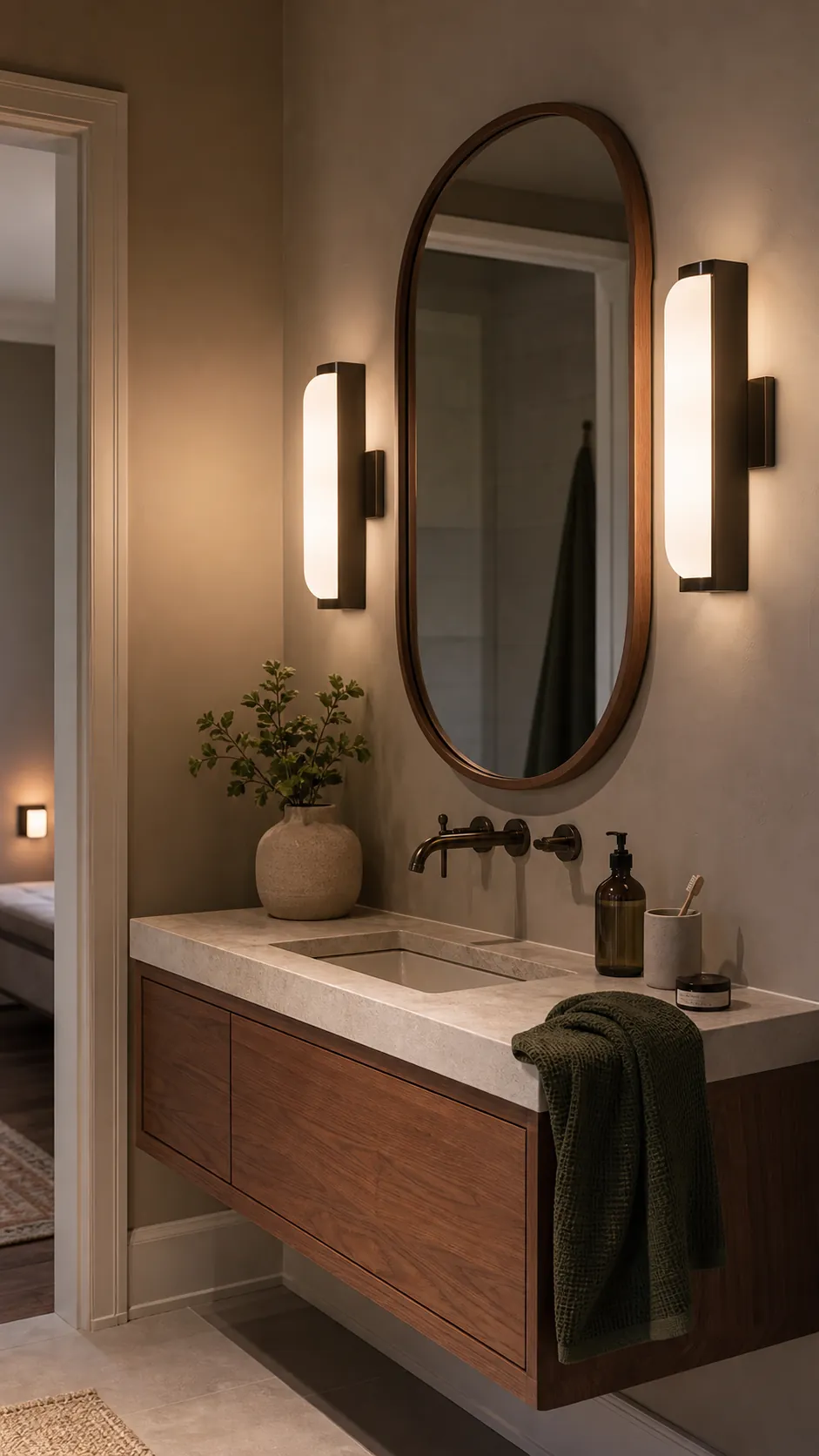
Place the night setting on a separate control or compatible dimmer so it can be reached without turning on the brightest overhead source. Confirm that the reduced light still makes the path, faucet, and floor changes easy to see. Keep a stronger grooming layer available for daytime tasks rather than asking the low-glare pair to serve every need.