
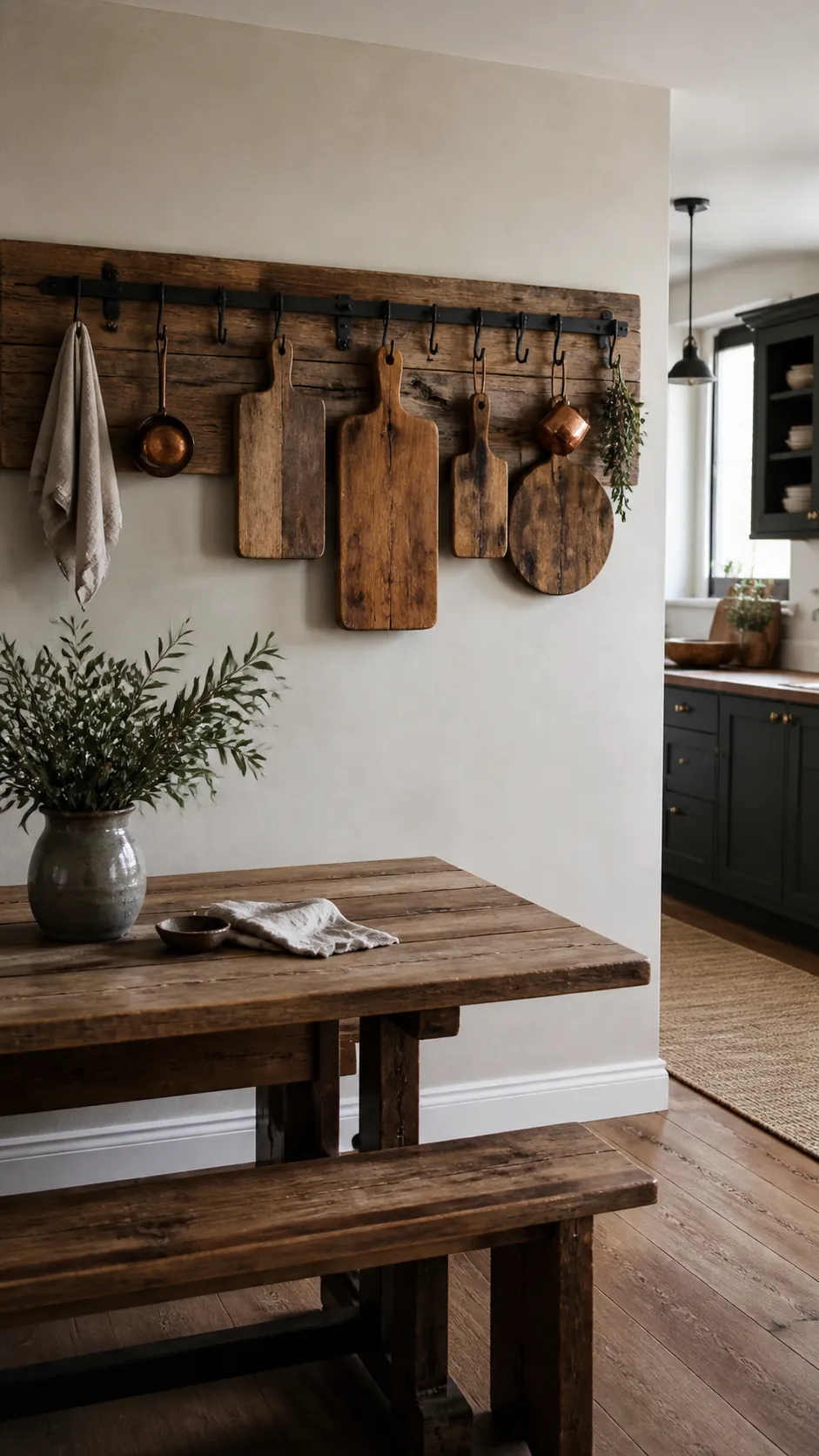
Rustic kitchen wall decor should feel shaped by real materials and time, not manufactured distress. These 30 rustic kitchen wall decor ideas use reclaimed wood, forged iron, copper, pottery, plaster, and vintage finds while answering the practical questions that matter in a working kitchen: scale, mounting, dust, grease, and clear circulation.
Reclaimed Plank Accent Wall
An entire wall of varied chestnut planks gives a breakfast nook enough character that it needs little additional decoration. Keep the boards within one clearly defined plane instead of wrapping every corner, which lets the grain and old saw marks read as deliberate; pale plaster, simple seating, and quiet cabinetry will prevent the darker wood from making the nook feel compressed.
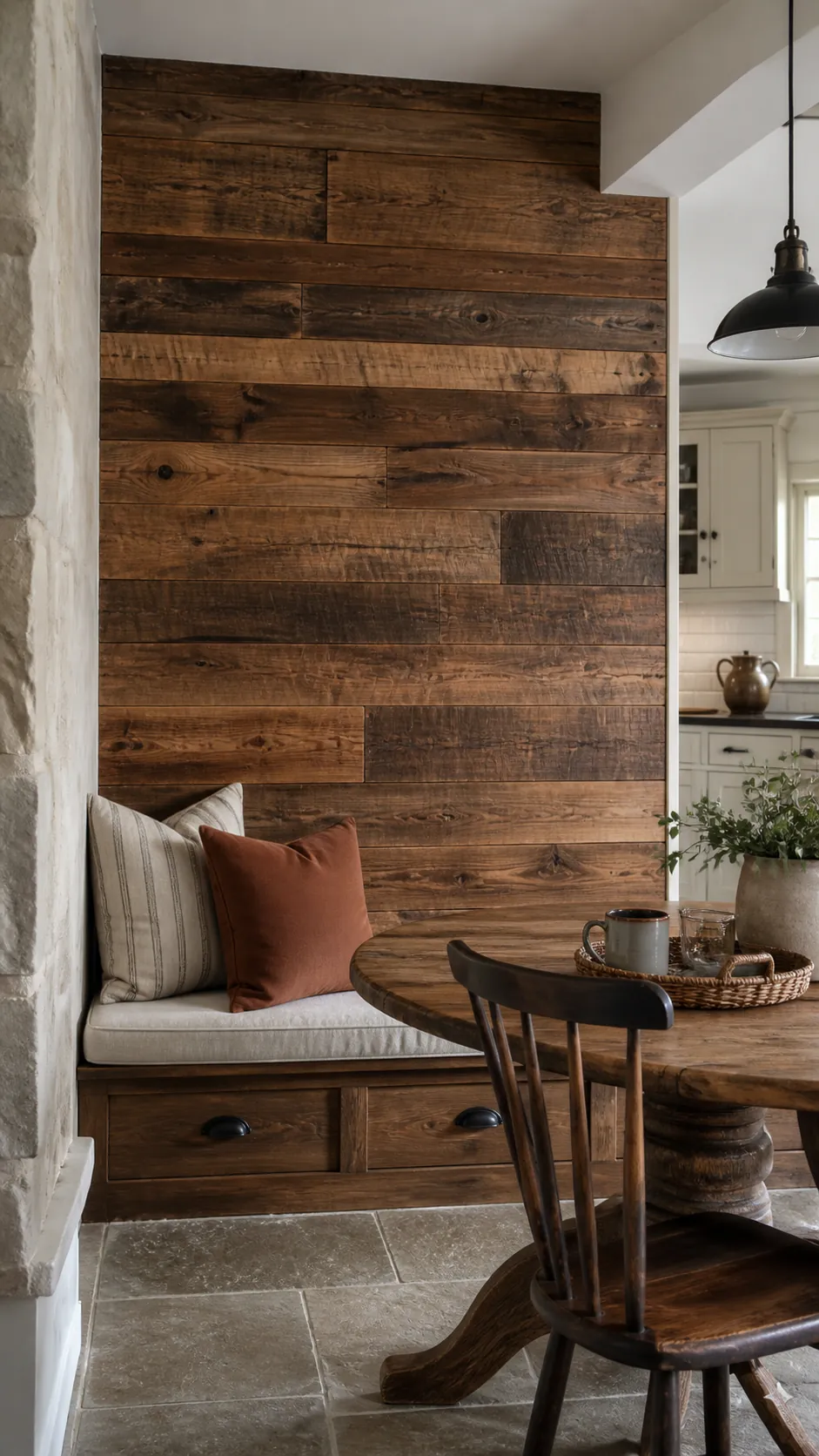
Inspect salvaged boards for loose finish, insect damage, protruding nails, and unstable splits before they enter the kitchen. Clean and seal the usable faces with a finish suited to the wood and the room, then fix the assembly to sound framing rather than relying on finish nails alone. A dining wall or bench backdrop is a better home for this tactile surface than the zone beside a range, where grease would settle into every groove.
Weathered Breadboard Gallery
Worn maple and walnut breadboards make a convincing collection when their silhouettes, tones, and handle shapes differ. Arrange the full group on the floor first, using one larger board to steady several smaller pieces rather than forcing them into a rigid grid. Over a galley-end console, the cluster can fill an awkward blank wall without stealing any working surface.
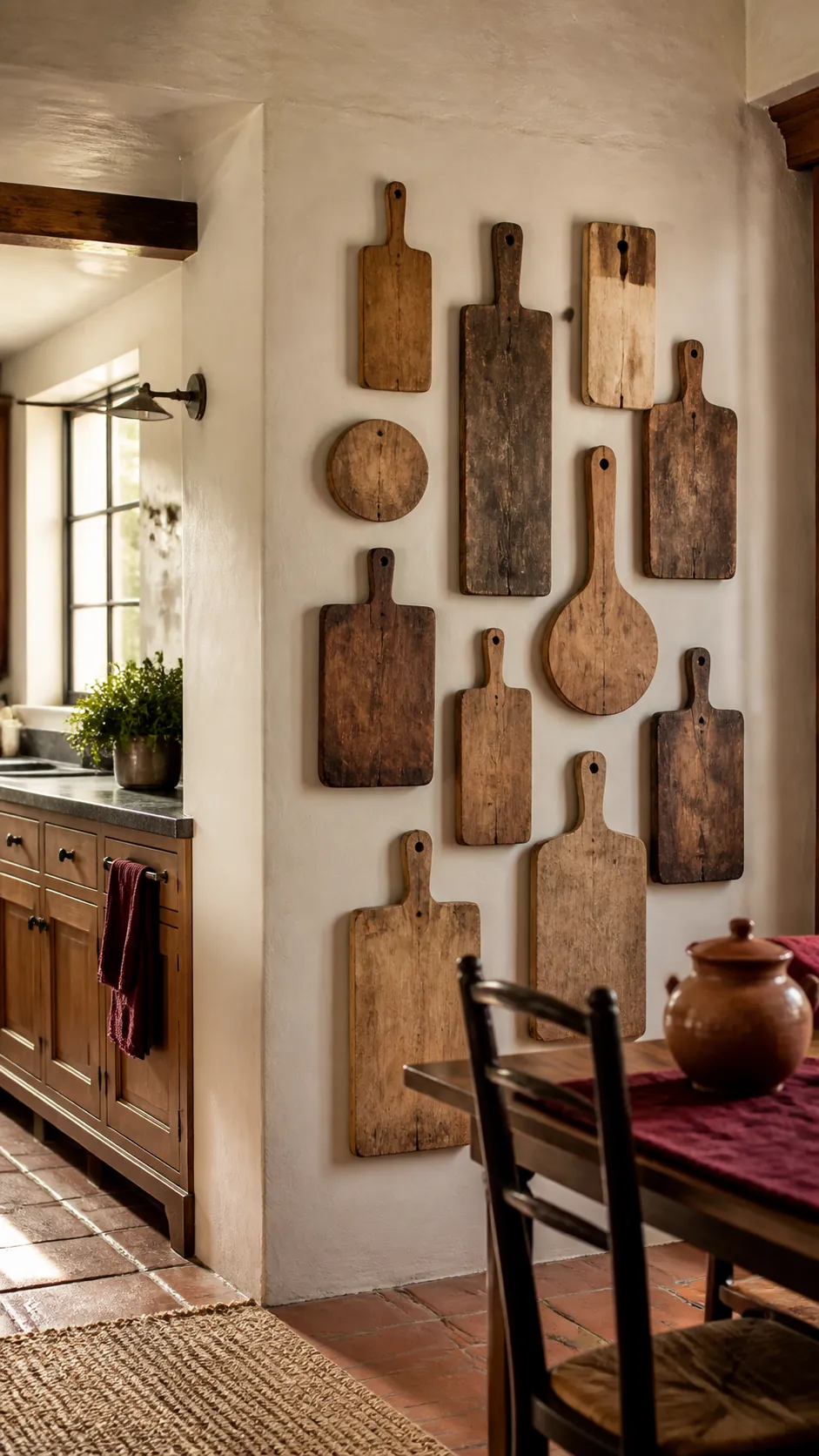
Choose boards that are dry, clean, and structurally sound; deep cracks or flaking finishes belong in a workshop, not above a dining spot. Give each piece its own secure hanger so one failure cannot pull down the entire arrangement; leave enough room around the outer edges for a cloth or duster, and keep the gallery beyond the reach of cooking splatter.
Hammered Copper Collection
A measured cluster of shallow copper pans and molds brings warm reflection to a country dining corner without needing bright color. Mix round and fluted forms, but repeat the copper finish so the wall still feels composed. A loose arc or tapered arrangement usually suits the irregular pieces better than perfect rows.
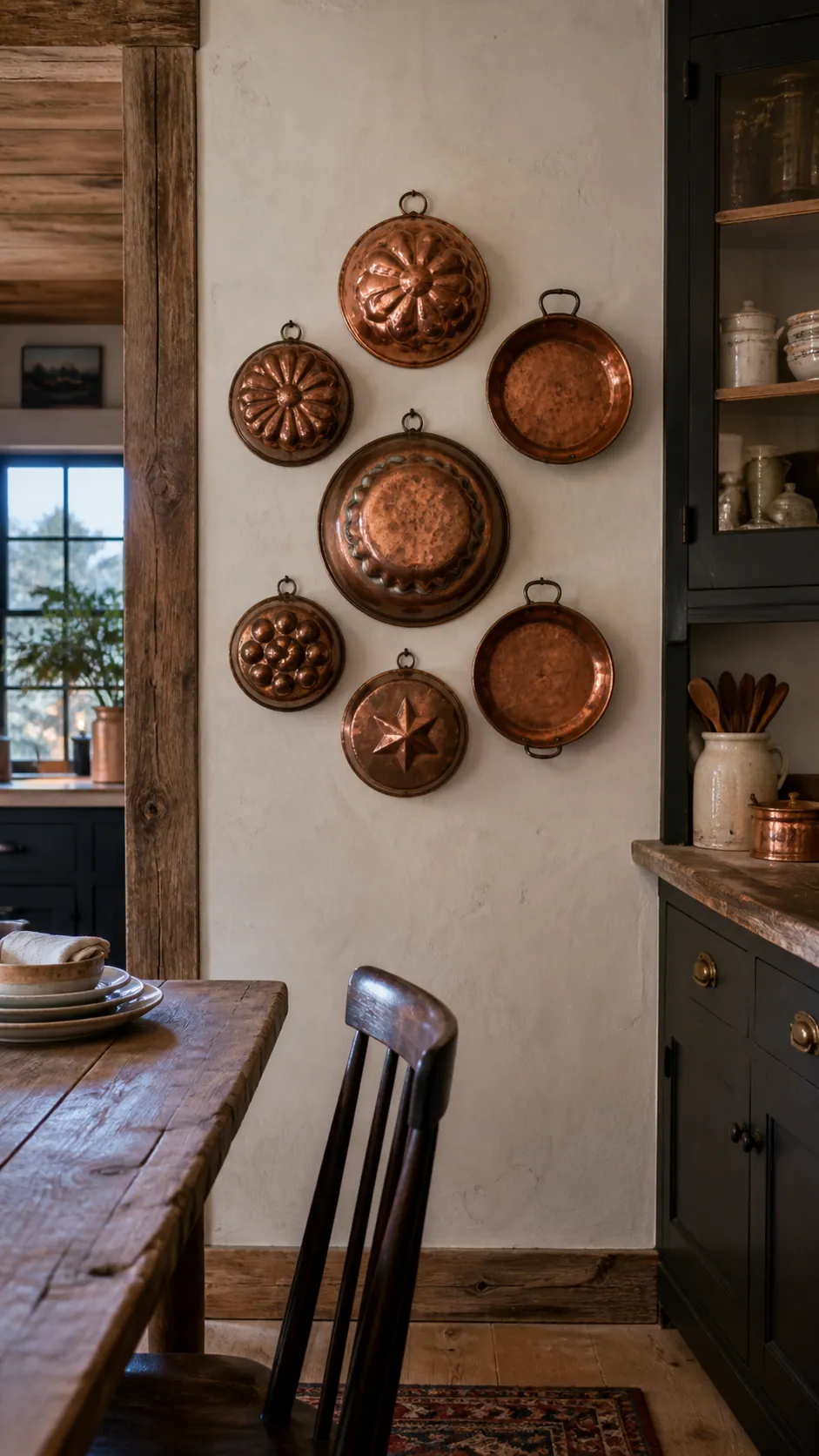
Decide whether to preserve the existing patina or polish the metal before hanging, since a mixed treatment can look accidental. Use the original hanging eyes only if they remain sound; otherwise add discreet hardware that supports the weight without deforming a thin rim. Position the group where daylight can skim the hammered surfaces, yet far enough from the cooktop that routine cleaning stays manageable.
Hand-Forged Iron Rail
A blacksmith-made rail introduces a strong horizontal line that can settle a tall barn-kitchen alcove. Hang only a restrained set of handsome, genuinely useful tools so the ironwork remains visible between them; the result feels more authentic when the pieces vary slightly in length instead of mimicking a showroom set.
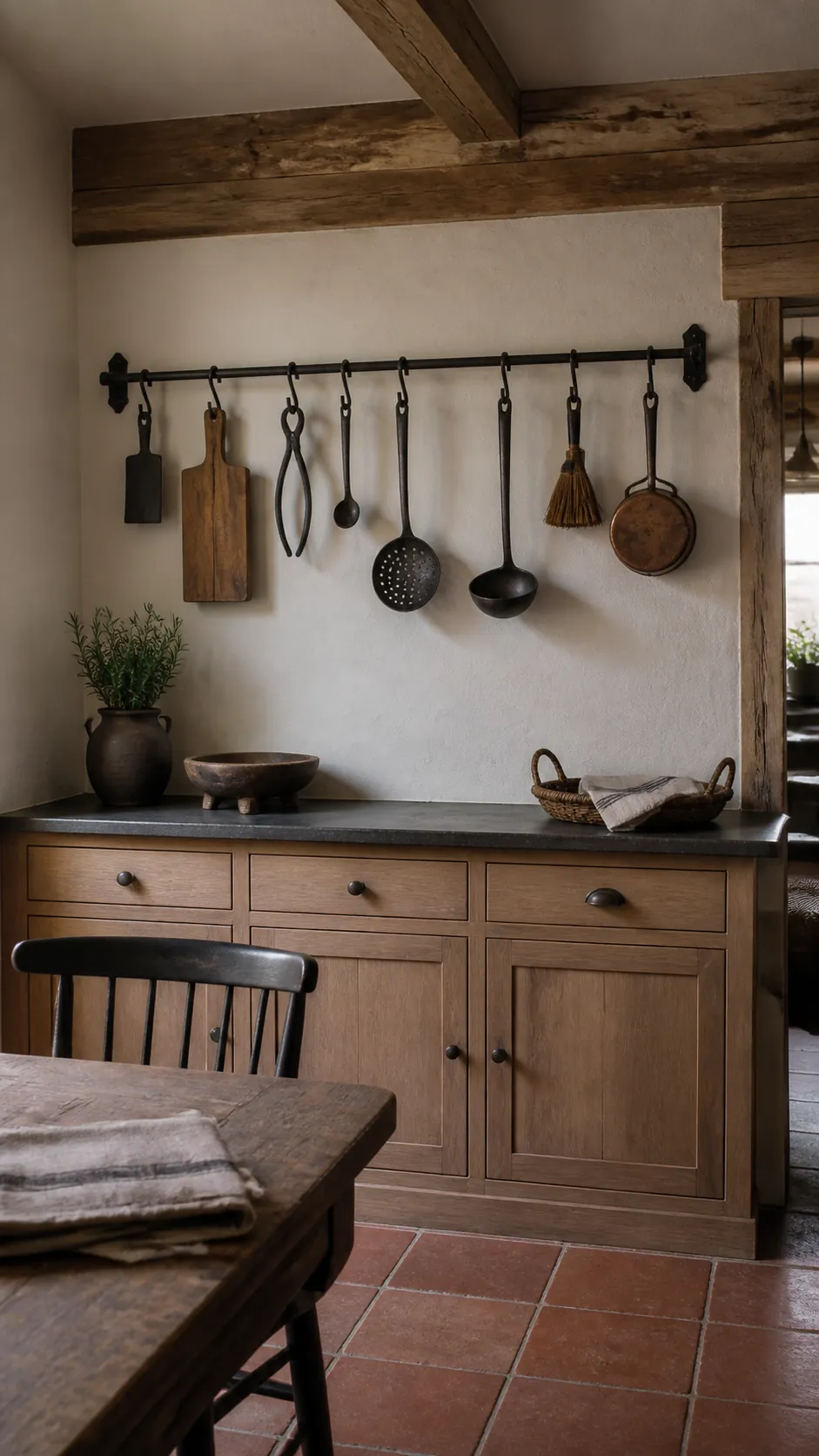
Fasten every bracket into suitable structure and check that the rail cannot twist when an item is lifted from one end. Keep sharp or heavy utensils outside shoulder-level circulation, particularly beside a narrow passage. Dry tools before returning them, and locate the display away from steady steam so both the iron and the wall finish are easier to maintain.
Antique Botanical Cabinet
A shallow specimen cabinet turns pressed culinary herbs into a quiet focal point while protecting their delicate shapes behind glass. Rosemary, thyme, and seed heads look most convincing when each compartment has breathing room rather than being packed like a craft display. In a narrow kitchen passage, the cabinet should sit close to the wall and clear the path at shoulder height.
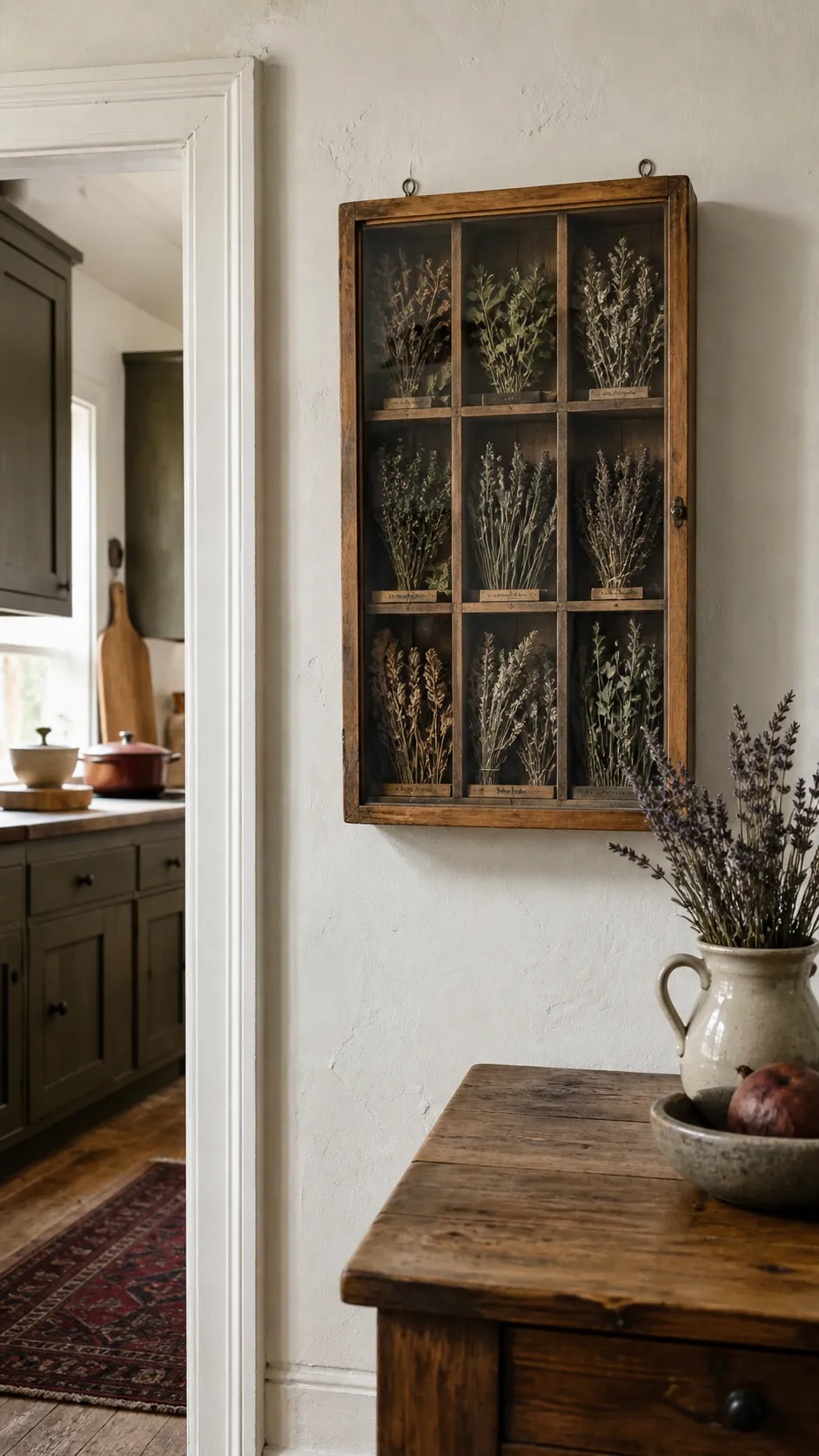
Treat the contents as display material rather than herbs for cooking, and replace anything that shows moisture or deterioration. Stabilize loose joints, clean unknown old coatings cautiously, and use wall fixings rated for the cabinet and glazing together; a spot away from direct sun, the sink, and the range will slow fading and make the glass less troublesome to clean.
Rough-Hewn Beam Shelf
One deep salvaged-oak shelf can give an open dining wall the visual weight of built-in architecture. Let a few broad stoneware forms occupy the ends and keep cookbooks upright in the middle, where their smaller scale breaks up the timber. Visible checks and adze marks are enough decoration; crowded accessories would hide the feature that makes the beam special.
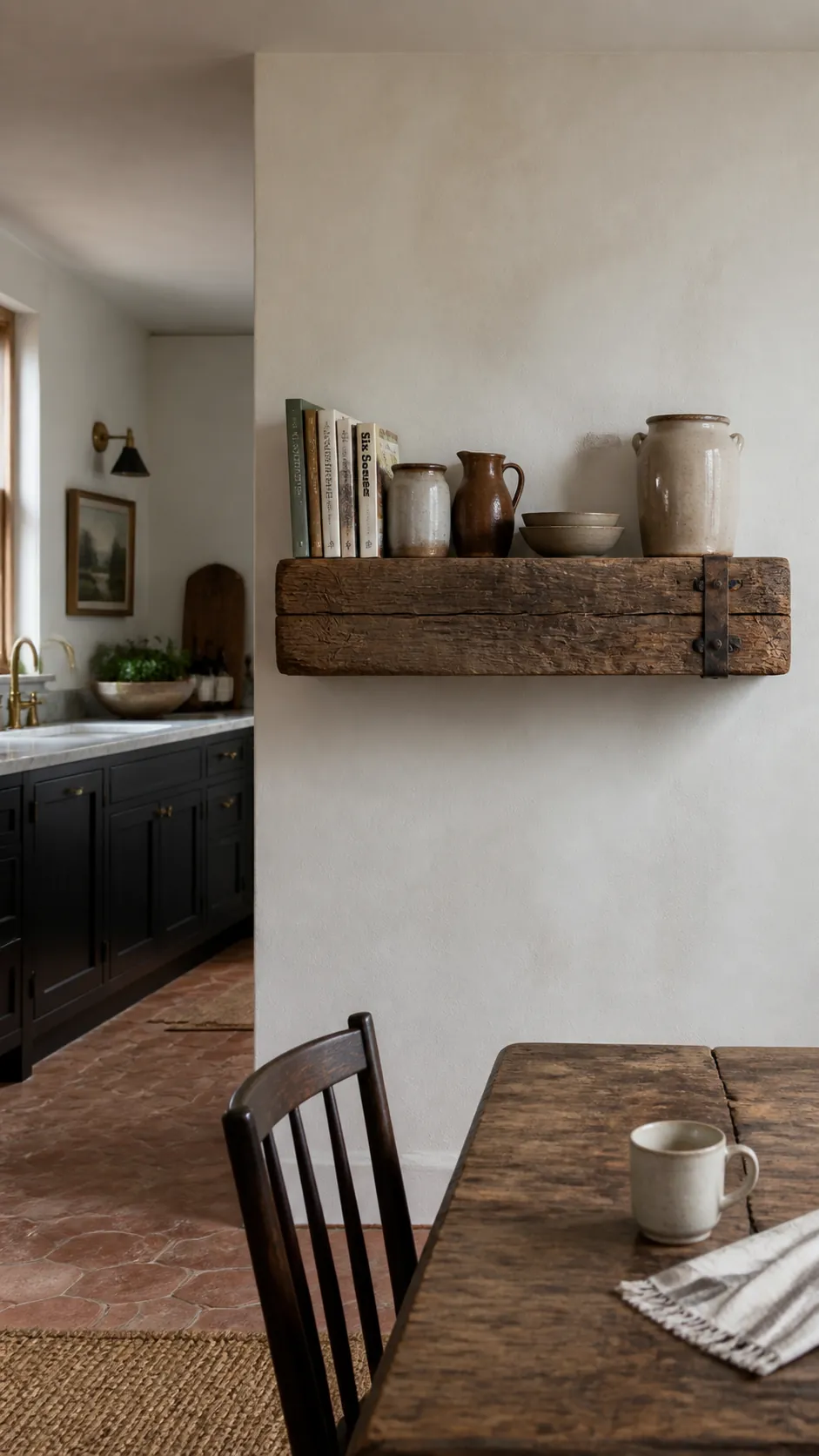
Because reclaimed oak is heavy before anything is placed on it, have the support method sized for the full anticipated load and matched to the wall construction. Check head clearance over chairs and allow space to lift each vessel safely from the shelf. Books and porous wood will fare better on the table side of the kitchen than above a sink or active cooking run.
Vintage Bakery Rack
Mounted flat, a narrow iron bakery rack becomes a useful graphic grid rather than another freestanding object. Fold linens into one or two sections and reserve the remaining rails for a couple of shallow trays, allowing the black framework to show; this approach adds storage to a cottage nook while keeping the floor open for chairs.
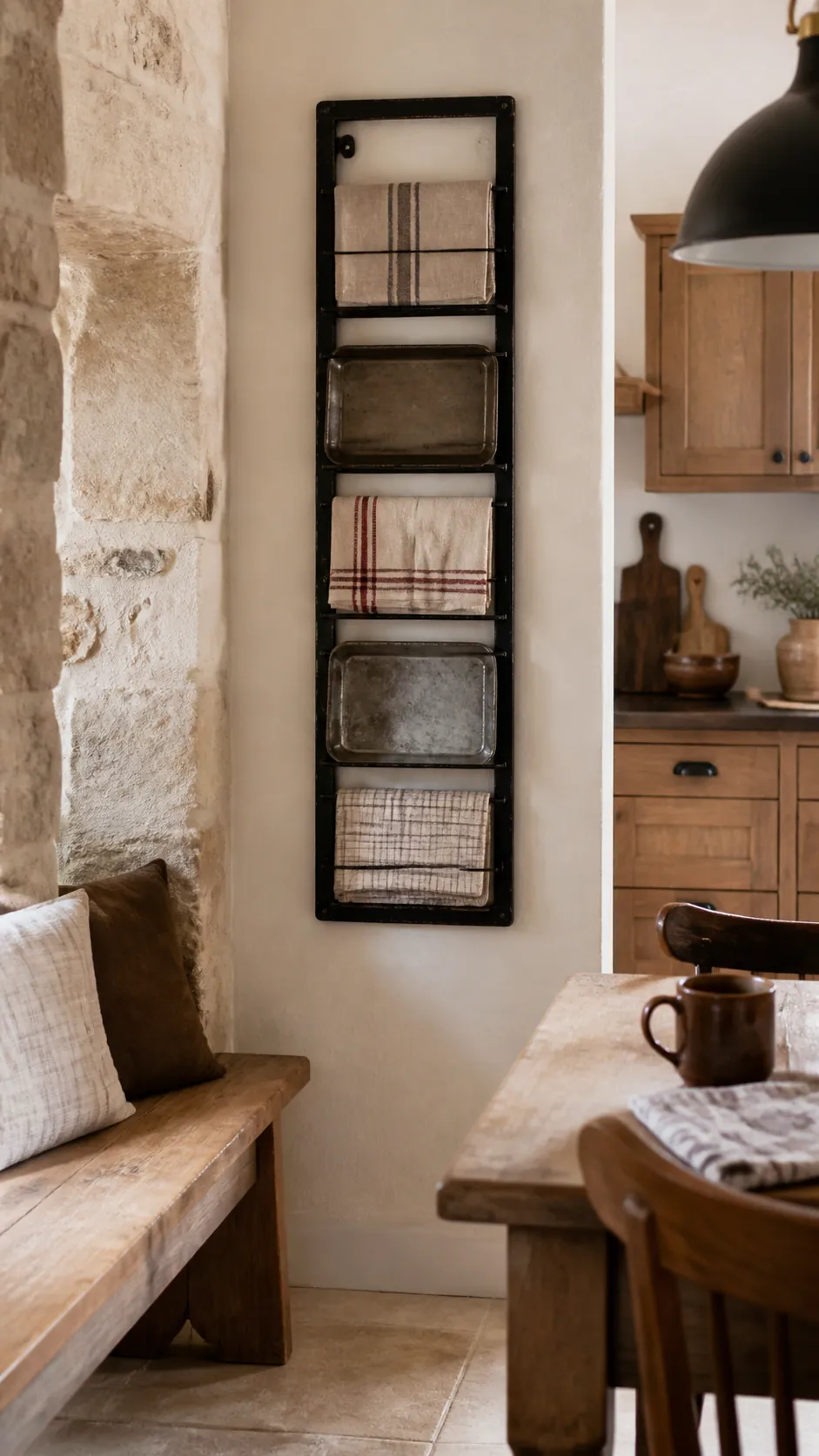
Remove active rust, blunt any rough projections, and confirm that old welds can still carry the intended contents. Several attachment points will keep the rack from levering away from the wall when a tray is removed. Place it above a bench or low cabinet rather than along an exposed walking edge, and wash stored textiles regularly if the nook is close to food preparation.
Limewashed Brick Wall
A thin cream limewash softens old brick without erasing the color shifts and mortar joints that give it history. It is especially effective at the end of a modern galley, where the mottled surface can offset flat cabinet fronts. Keep the rest of that wall spare so the masonry, not a collection of small signs, carries the room.
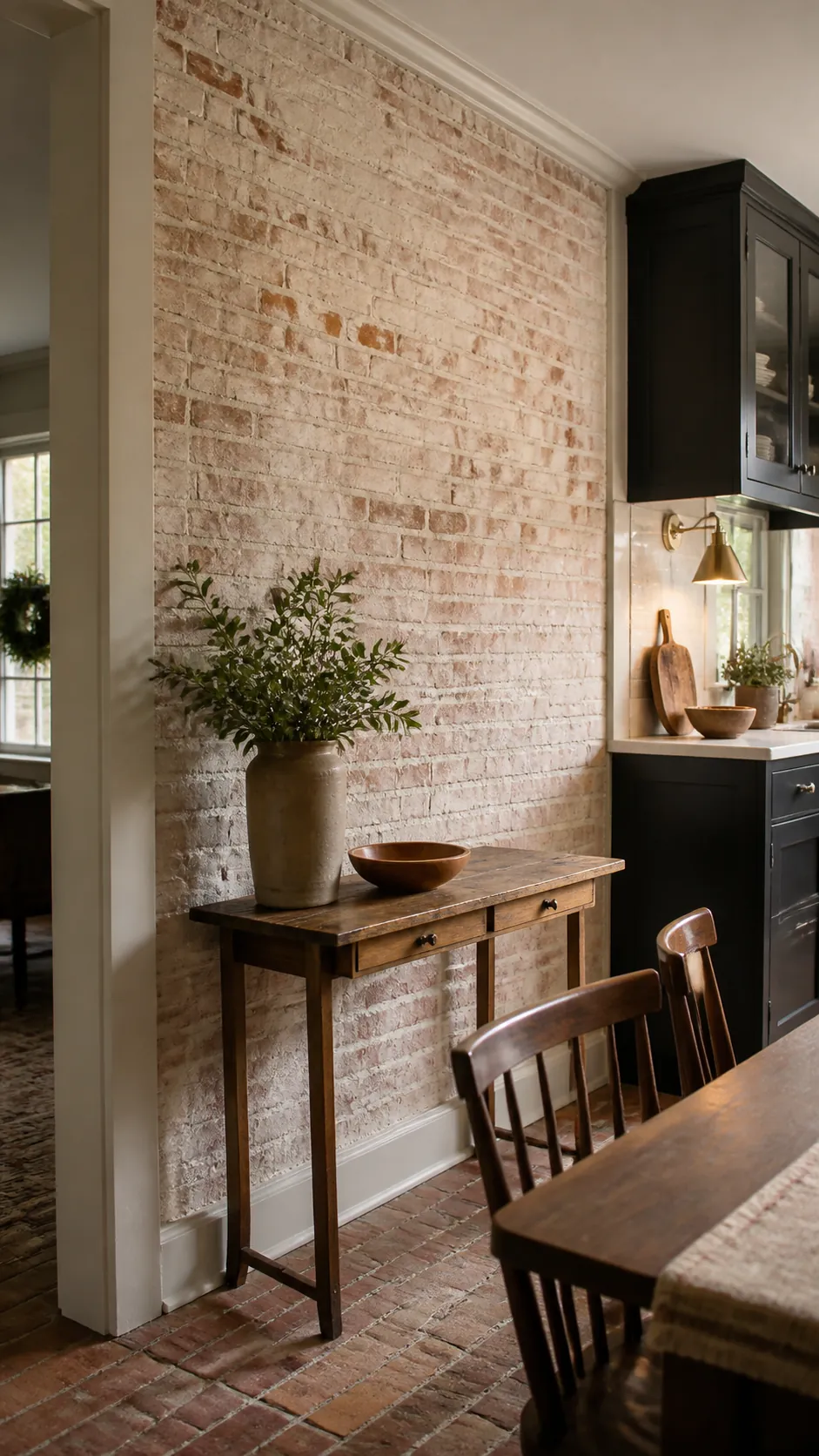
First identify whether the brick and mortar are stable and whether the wall has an existing coating that could interfere with a mineral finish. A test patch will reveal both the final opacity and how quickly the surface absorbs the wash; use a compatible breathable system, address moisture at its source, and expect the textured wall to need gentler cleaning than a smooth backsplash.
Primitive Still-Life Painting
One generous still life of pears and stoneware creates a calmer country dining wall than several undersized prints. Its dark ground can frame pale ceramics and timber furniture, while the imperfect painted forms keep the room from feeling formal. Size the canvas in relation to the table or sideboard below, leaving a visible margin at both ends.
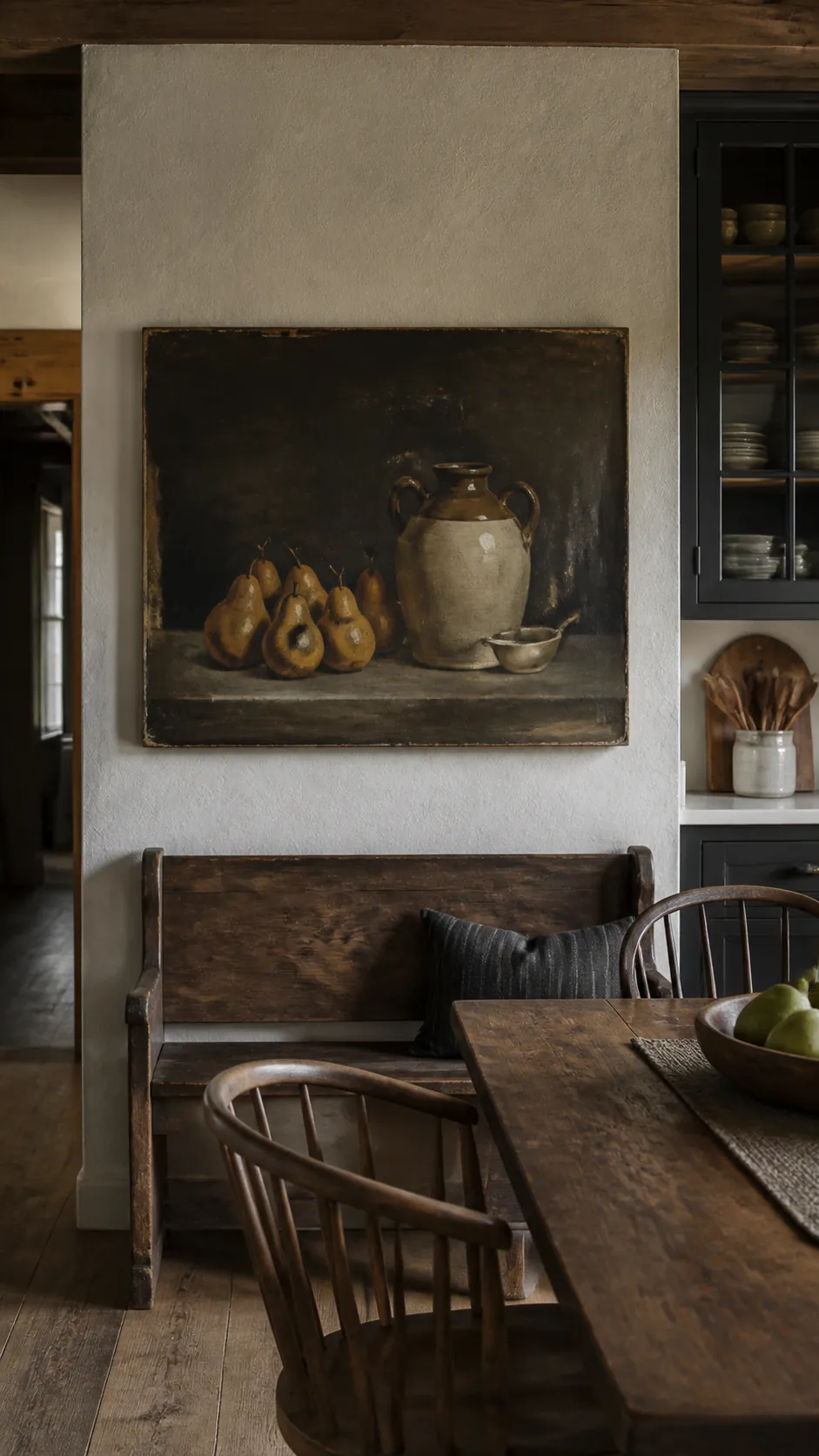
Use secure picture hardware suited to the frame, and add lower bumpers if passing chairs tend to knock the wall. Glazing is optional for an oil painting, but a fragile or valuable work deserves advice from a conservator rather than a casual kitchen treatment. Protect it from strong sun, persistent steam, and airborne grease so the surface does not become a cleaning project.
Wooden Dough Bowl Display
A monumental dough bowl mounted horizontally reads almost like carved sculpture in a barn-kitchen alcove. Its long oval is particularly useful above a low chest or bench, where it can echo the furniture width without adding visual clutter; let the worn interior face outward so the tool marks and honest repairs remain visible.
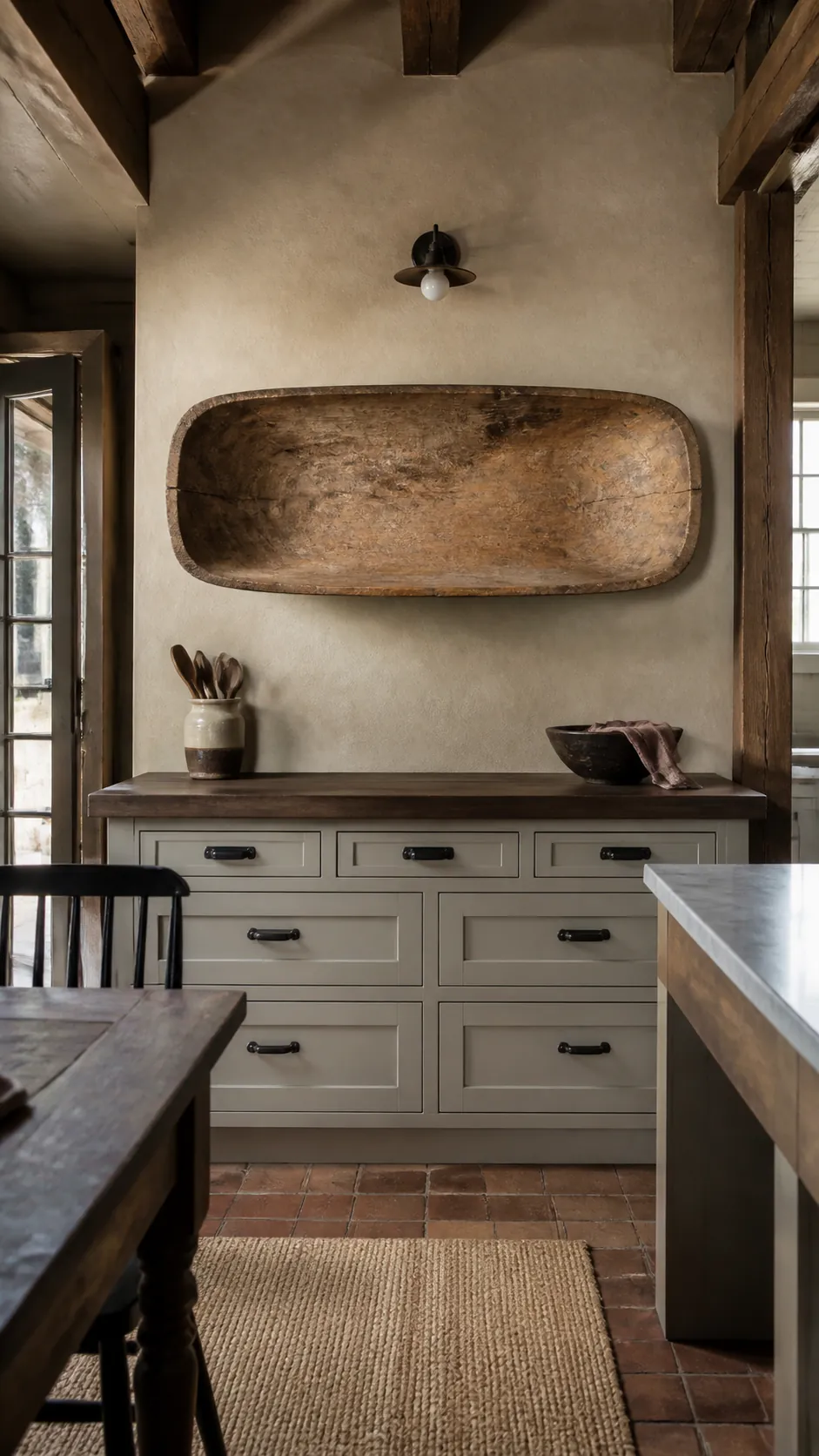
Examine the bowl for pests, unstable splits, and powdering wood before treating it as wall decor. A shaped cradle or concealed cleat should support the body rather than hanging the full weight from a thin rim. Keep the projection out of a busy passage and away from the stove, where heat and residue would be hard on an old wooden surface.
Aged Brass Plate Rack
An aged-brass rack gives cream transferware a crisp outline against a quiet wall and introduces warmth without relying on rustic motifs. Vary the plate patterns subtly, but keep their color family consistent so the row feels collected rather than busy. The display suits a slim passage because its profile is shallower than open shelving.
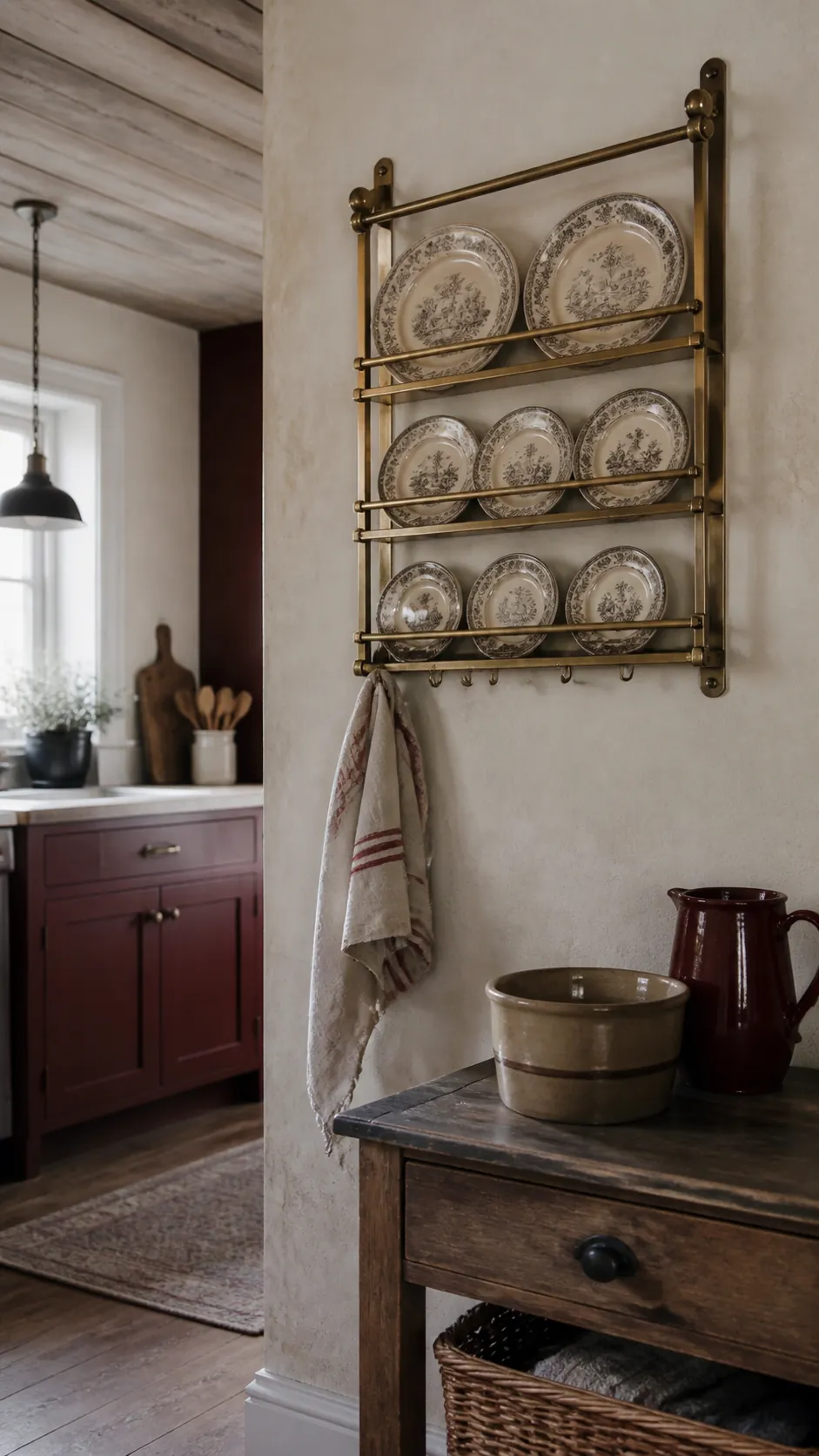
Make sure every slot has enough depth and a positive retaining edge for the plate it holds. Anchor the rack for the combined weight of metal and ceramics, then give nearby doors and shoulders room to pass without contact; pieces displayed near food preparation will need frequent wiping, so choose a dining-side wall where plates can be removed safely for cleaning.
Rustic Recipe Gallery
Family recipes carry more meaning than generic kitchen typography, especially when reproduced at a scale that reveals the handwriting. Coordinate mismatched frames through two or three related wood tones, then align their outer edges to give the grid discipline. Mixing a short note, a full recipe card, and a small ingredient sketch creates variation without inventing filler.
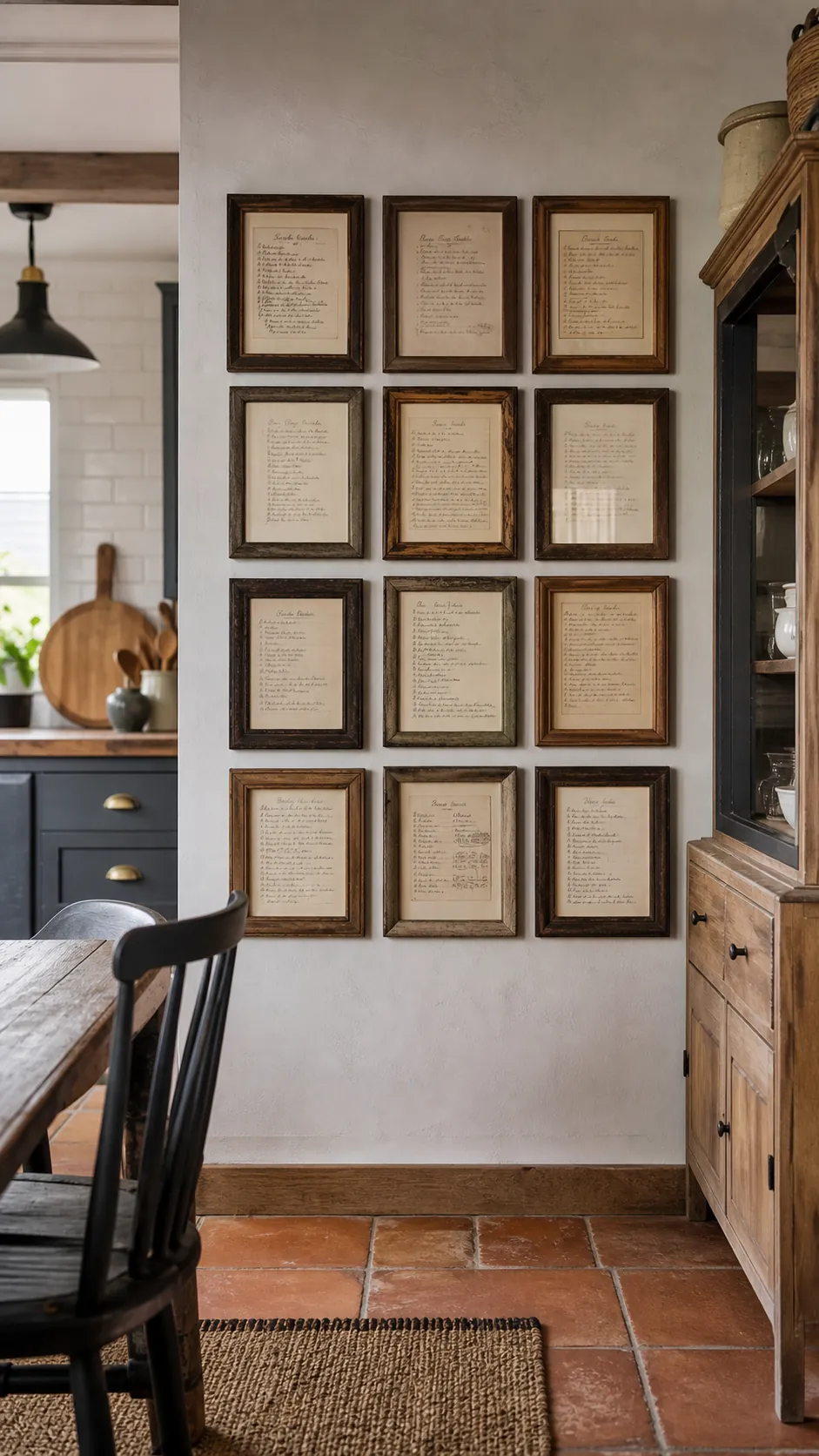
Display copies and store irreplaceable originals away from kitchen humidity, light, and airborne oils. Glazing makes the reproductions easier to wipe, although its reflections should be checked from the dining seats before the frames are fixed. Lay out the complete rectangle with paper templates so switches and cabinet doors do not force an awkward last-minute gap.
Woven Willow Trays
Four flat willow trays bring broad texture to a stone-cottage nook while remaining visually lighter than solid wood pieces. Choose distinctly different weave patterns, then repeat a similar honeyed tone to connect them; a slightly asymmetrical grouping lets the circles and ovals interact without resembling a set of matching baskets.
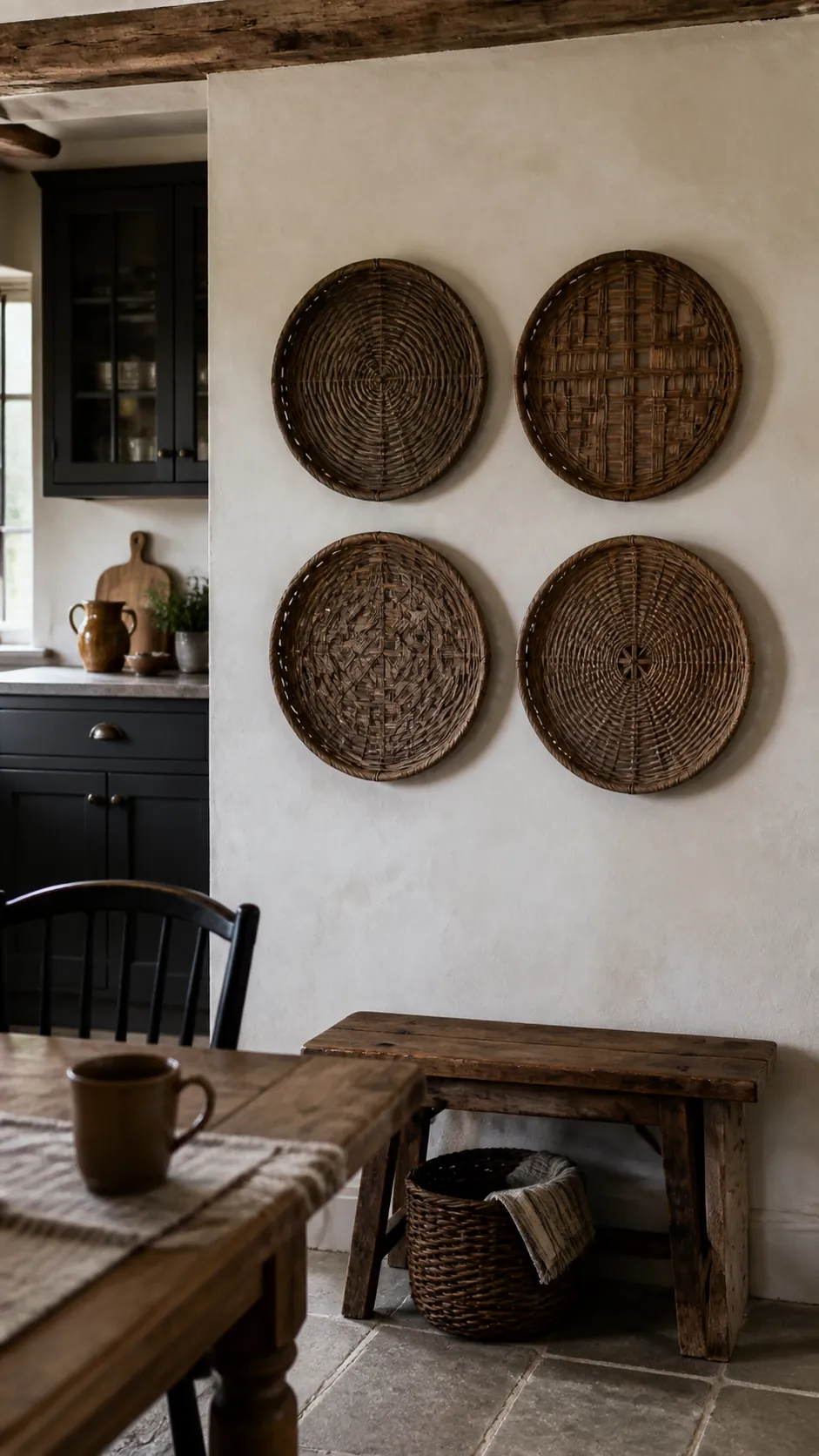
Vacuum old weaving gently and inspect the rims for broken ends that could snag clothing or collect dust. Hidden loops can hold these lightweight forms, provided each attachment is sound and the wall hook suits the substrate. Their porous fibers belong well beyond the splash and grease zones, with enough spacing to clean around every edge.
Charred Timber Panel
A single sealed charred-timber panel can add a dark, tactile pause at the end of a pale galley. Treat it as one architectural field rather than scattering black accents across the room. Light cabinetry and a narrow band of surrounding wall will sharpen the panel’s edges and keep the composition from becoming heavy.
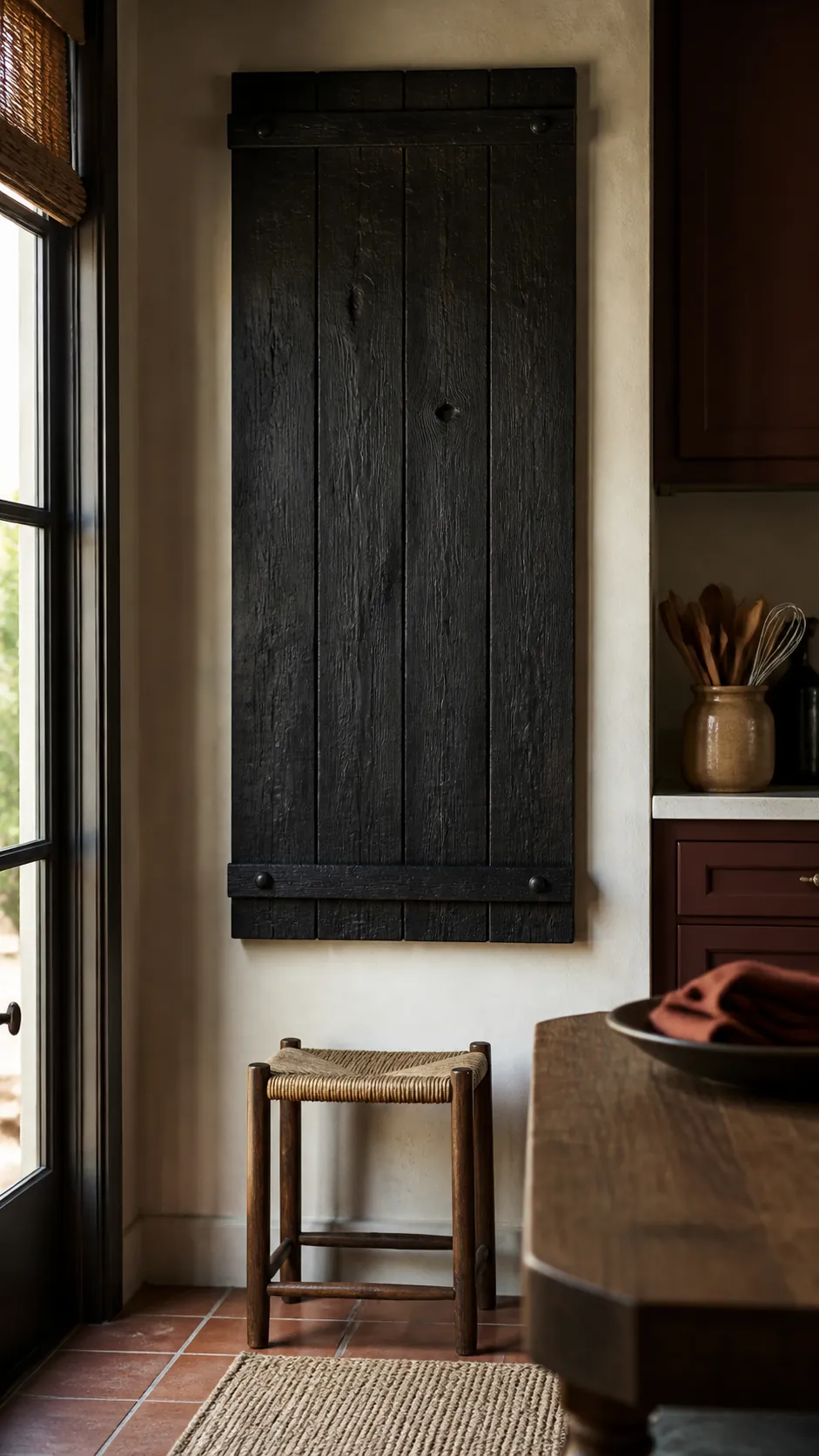
Order a sample to judge how much soot transfers and whether the chosen sealant changes the intended matte texture. The installed panel needs an appropriate backing and fastening method for its size, material, and local requirements; avoid placing this finish where repeated scrubbing, steam, or direct cooking residue would defeat its low-sheen character.
Vintage Enamelware Shelf
White enamelware with black rims makes a graphic shelf display that still feels at home in a country kitchen. Alternate low basins with taller pitchers so the arrangement has a readable skyline, and leave one deliberate gap instead of filling the board end to end. Honest chips can show age, but too many damaged pieces turn a clean contrast into visual noise.
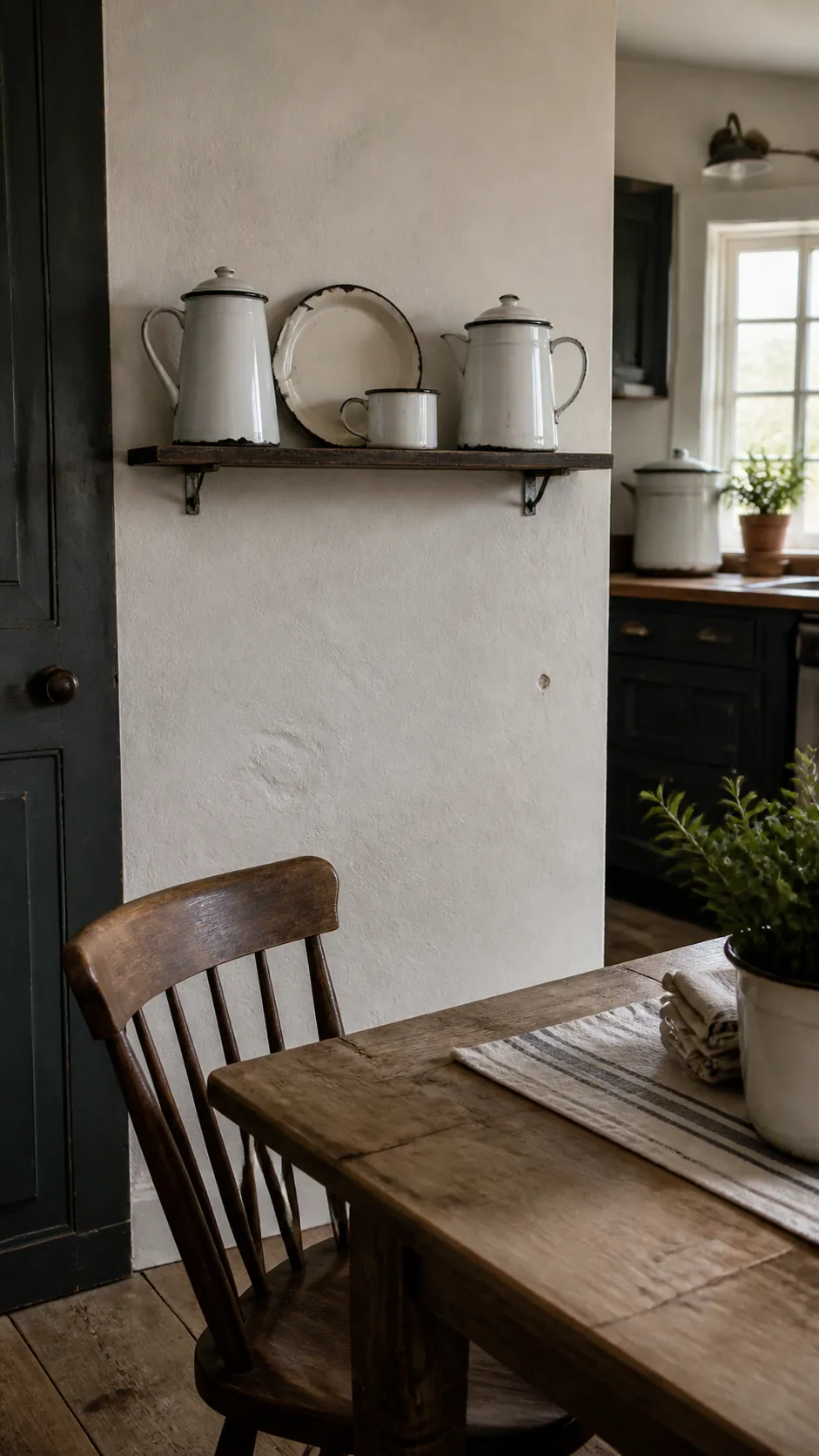
Reserve chipped or rusting vessels for display rather than food service, and clean them thoroughly before they go overhead. A front lip or discreet retainers will help keep the pieces stable if a chair bumps the wall. Mount the shelf to reliable structure and leave enough vertical room to lift out the tallest pitcher without tipping it forward.
Stone Ledger Ledge
A shallow ledge of locally textured stone gives a converted-barn alcove a convincing sense of permanence. One ceramic lamp is enough to reveal the mineral surface and create a useful pool of light below it; keeping the ledge nearly bare allows irregular edges and color variation to do the decorative work.
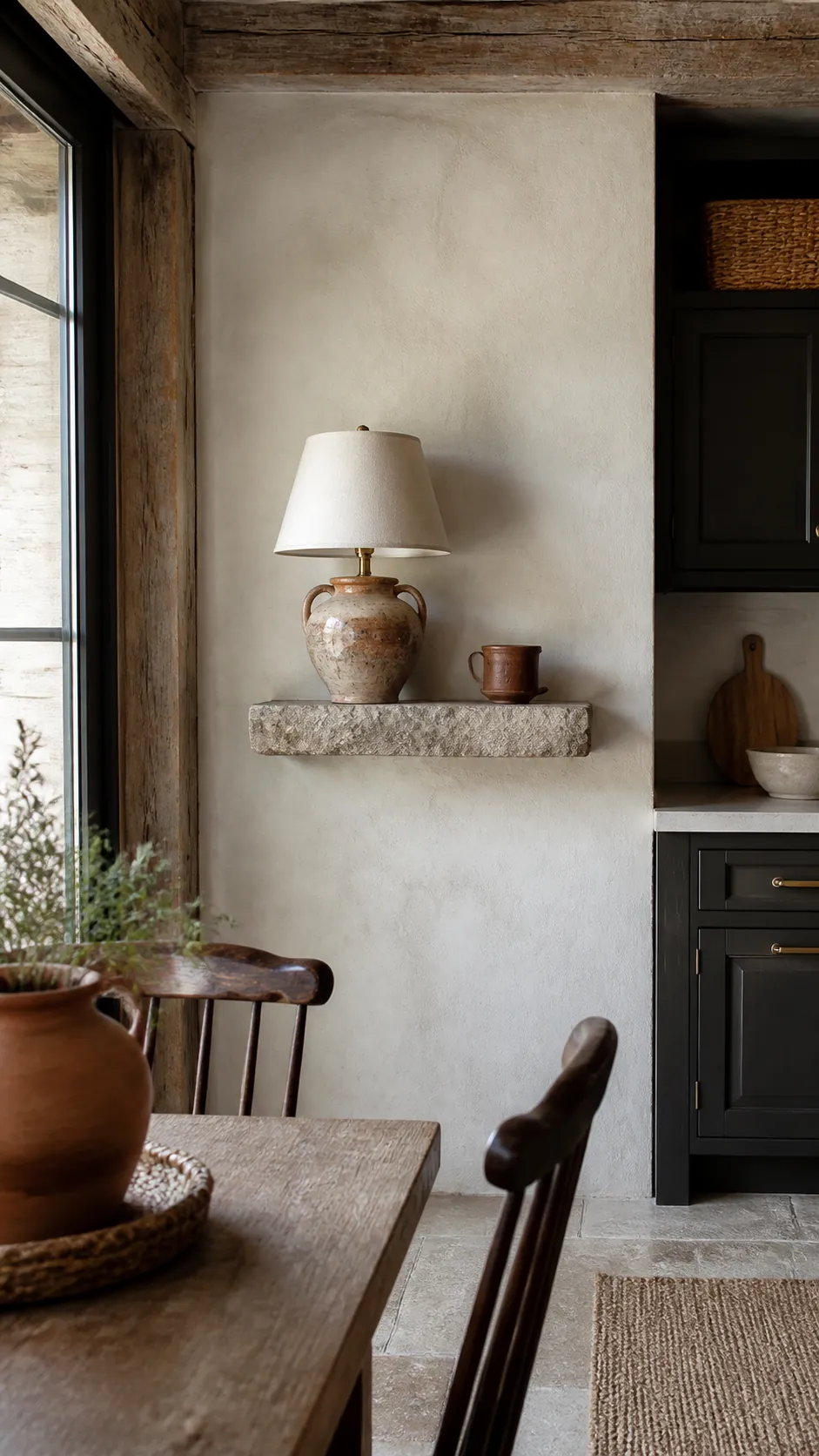
Stone and a lamp together can impose a substantial load, so the support should be designed for the actual slab and wall construction. Set the lamp well back from the edge, manage its cord without pinching it, and keep the switch easy to reach. A sealed or otherwise appropriate surface will simplify dusting, but the alcove should still sit outside the direct splash area.
Antique Grain Sieve Pair
Two round grain sieves can soften the straight lines of a tight vintage-kitchen passage. Pair different mesh densities and slightly different diameters, then offset them enough for each rim to remain legible. A plain plaster backdrop is preferable to patterned wallpaper because the old wire and wood already supply fine detail.
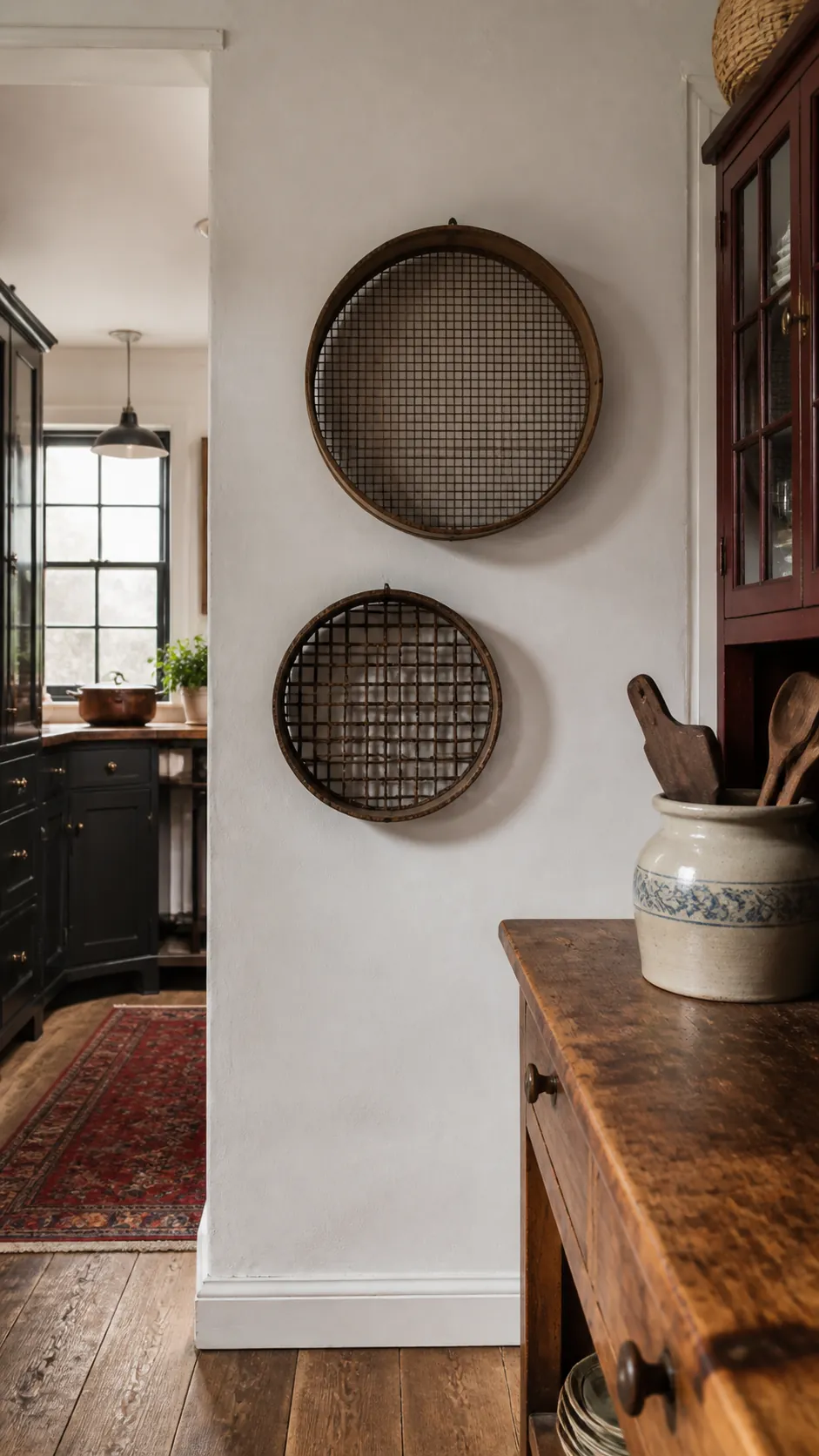
Brush and vacuum the sieves outdoors, checking for insects, loose mesh, and splintered bands before bringing them inside. Stabilize fragile rims and hang through secure points rather than stretching a weakened section of wire; because the mesh traps residue readily, choose a wall with low grease exposure and room to remove both pieces for periodic cleaning.
Leather Strap Shelves
Oak boards suspended on saddle-leather straps offer a softer alternative to black metal brackets on an open dining wall. The curve of each strap should look intentional, with both shelves kept level and their contents weighted toward the supports. Brass screws introduce just enough polish to distinguish the construction from improvised storage.
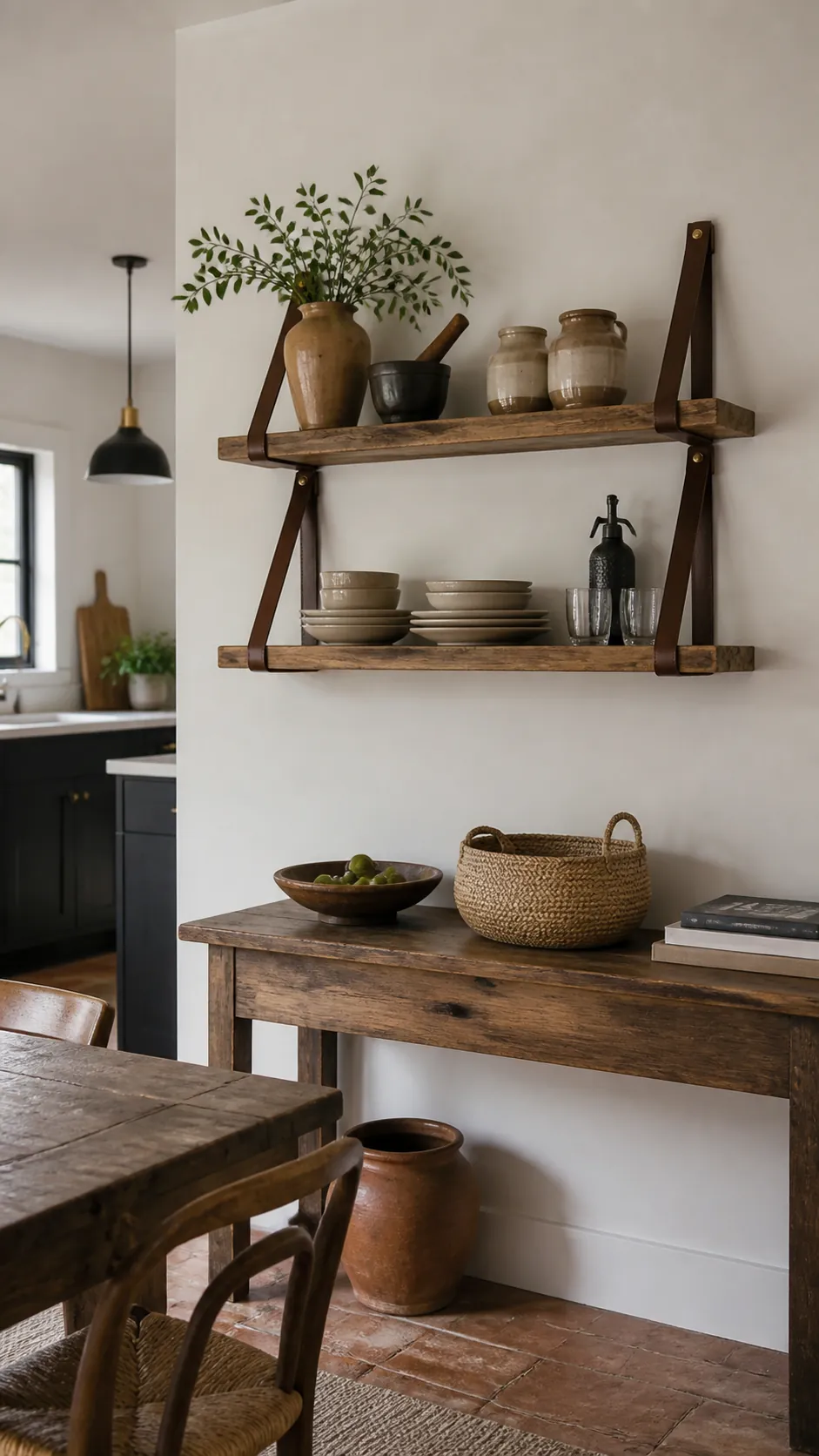
Leather can stretch, so use material and hardware intended for the shelf load rather than repurposed decorative belts. Fix the screws into appropriate structure, limit the display to lighter objects, and inspect the straps periodically for drying or deformation. Distance from steam and cooking oil will protect both the leather and unfinished-looking oak.
Handmade Terracotta Tiles
A framed field of handmade terracotta tiles brings subtle firing variation into a breakfast nook without covering the whole room. Lay the uneven pieces out by tone first, distributing darker and lighter tiles instead of creating accidental stripes; a simple border gives the patch a finished edge and makes it read as an intentional wall panel.
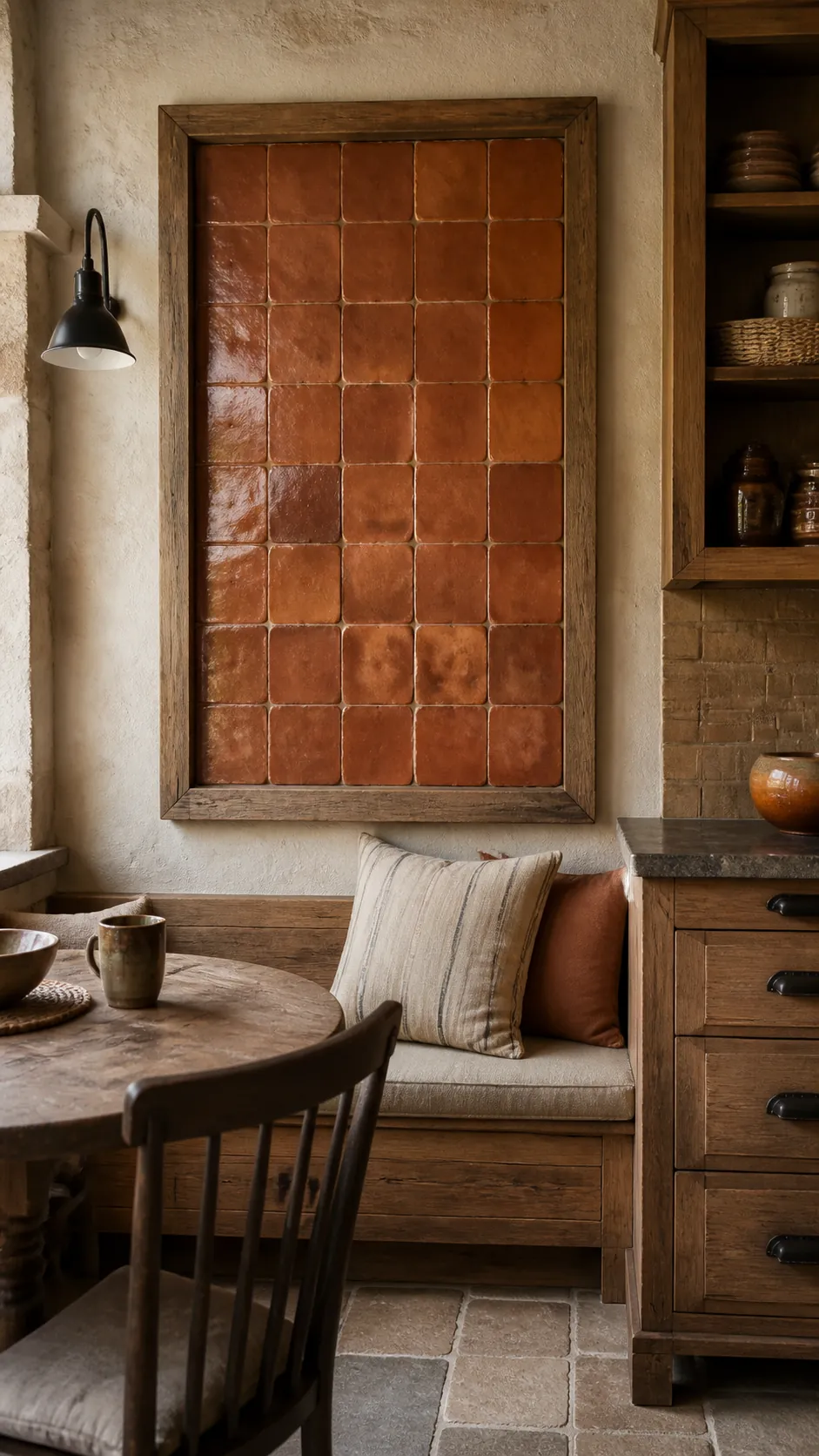
Mock up the panel dimensions at the wall so the bottom edge relates comfortably to the bench or table. Use setting materials, grout, and any sealer recommended for the specific tile and substrate; porous clay varies considerably. The finished surface will be easiest to live with on a dining wall where routine wiping is gentle rather than aggressive.
Old Window Herbarium
A salvaged window frame gives pressed rosemary and thyme the structure of a small herbarium. Keep each specimen sparse against a pale backing so its stems and leaves remain recognizable through the old divisions. The familiar frame shape also brings character to a modern galley end without pretending there is another view.
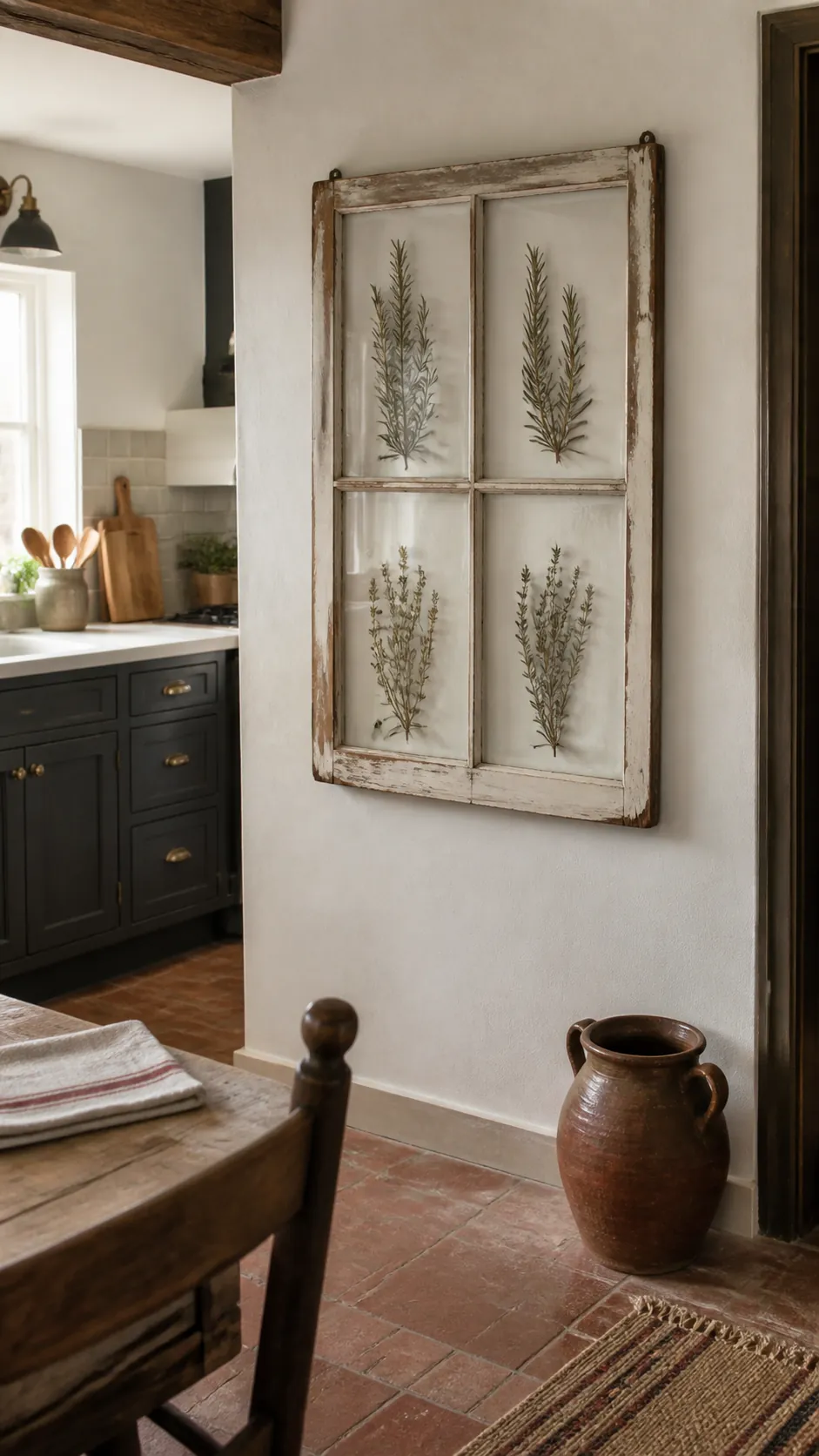
Check the frame and any old coating for hazards or instability, and repair loose joints before adding glazing or backing. Use fully dried display specimens, not herbs intended for later cooking; secure the completed piece for its combined weight and avoid a sunny, humid, or greasy position that would quickly fade the plants and cloud the glass.
Ironstone Pitcher Row
Five ironstone pitchers create a quiet rhythm when their whites are related but their bodies and handles are not identical. On a long country-dining shelf, stagger the heights gently rather than sorting them from smallest to largest. The restrained palette lets glaze crazing and softened edges supply the sense of age.
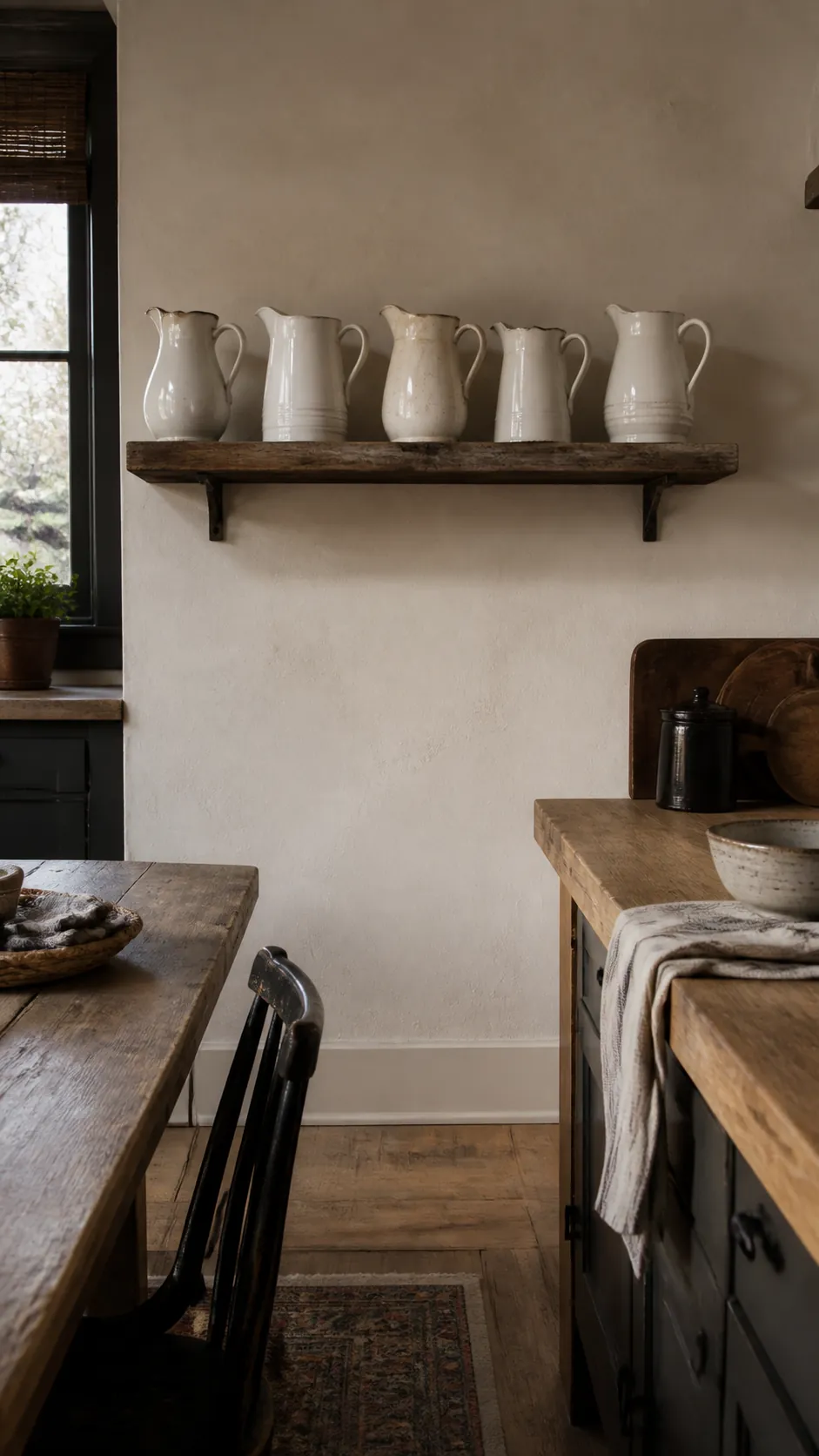
Set the shelf depth for the broadest base and include a small front lip or removable stabilizer where bumps are possible. Its brackets and anchors must carry the ceramics comfortably, not merely the empty board. Preserve space above each handle for safe lifting, and choose a location where occasional washing does not require reaching across a hot or active work zone.
Rustic Clock Face
An oversized clock face can fill a barn-kitchen alcove with one legible gesture, provided the numerals and finish stay quiet. Relate its diameter to the cabinet or bench below so it appears grounded rather than floating in empty wall; real patina is most persuasive when surrounding objects are edited and contemporary enough to provide contrast.
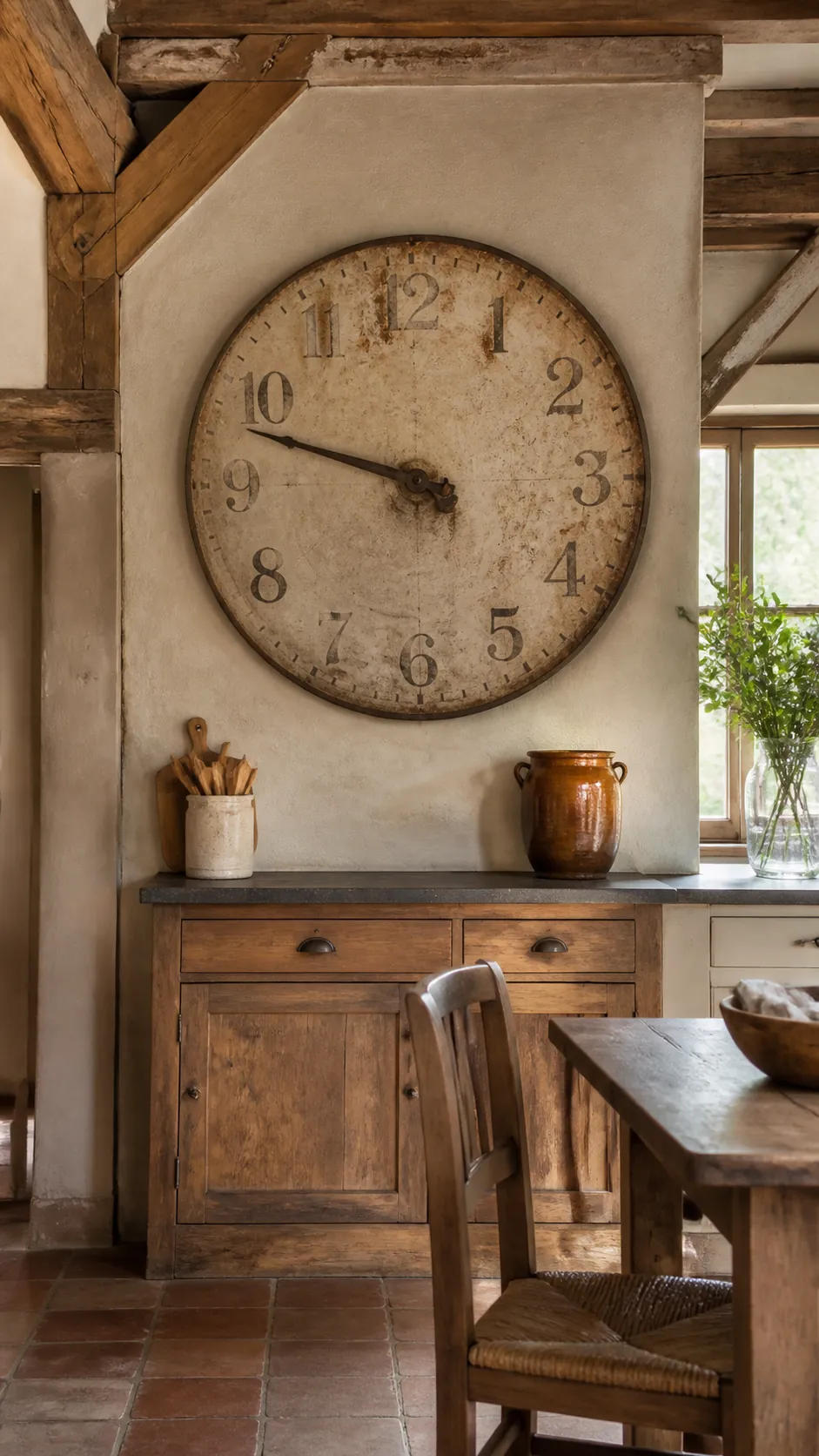
Confirm the weight, depth, and mechanism clearance before choosing the hanging system; large faces often need more than a standard picture hook. A template cut to the full diameter will show whether trim, doors, or sightlines crowd the circle. Install it where the time is useful from the table or prep area without projecting into anyone’s path.
Carved Wood Utensil Panel
Hand-carved spoons and paddles can form a shallow relief panel that celebrates tools without turning the wall into loose utensil storage. Vary the lengths and bowl shapes, but keep their handles aligned along a simple underlying axis. In a small passage, this ordered composition offers texture while staying closer to the wall than a deep shelf.
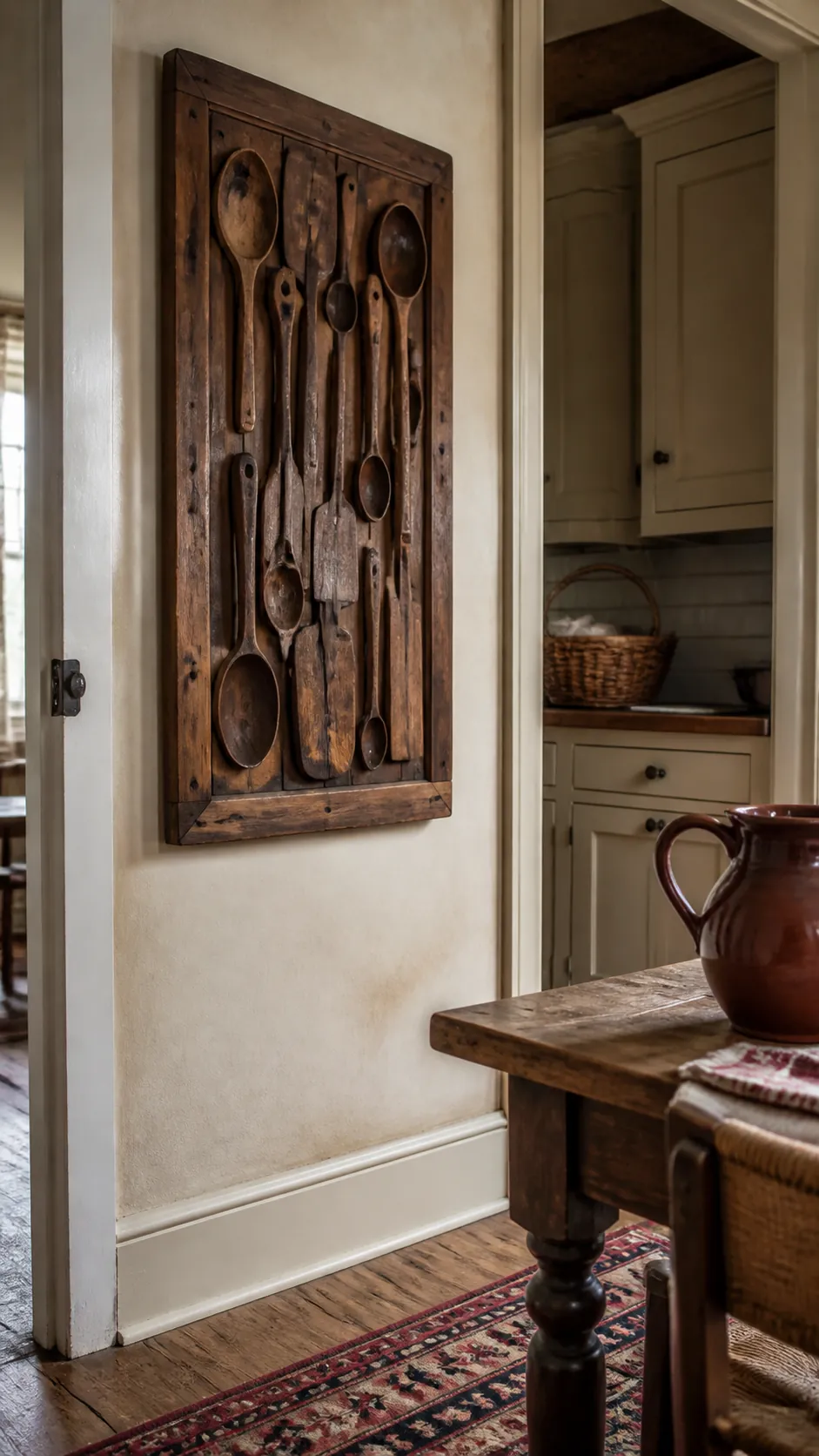
Clean, dry, sand, and stabilize every wooden piece before committing it to display. Fasten the utensils individually or to a sound backing so a failed tie cannot drop several at once; these should be retired display pieces rather than tools pulled down for cooking, and the panel needs distance from flame, steam, and splatter.
Vintage Farm Photograph
A single black-and-white photograph of an old barn worktable can evoke rural craft without resorting to slogans. Print it large enough to hold an open table wall, and choose a frame whose grain is visible but not aggressively distressed. A generous mat will separate the detailed documentary image from the wood tones elsewhere in the kitchen.
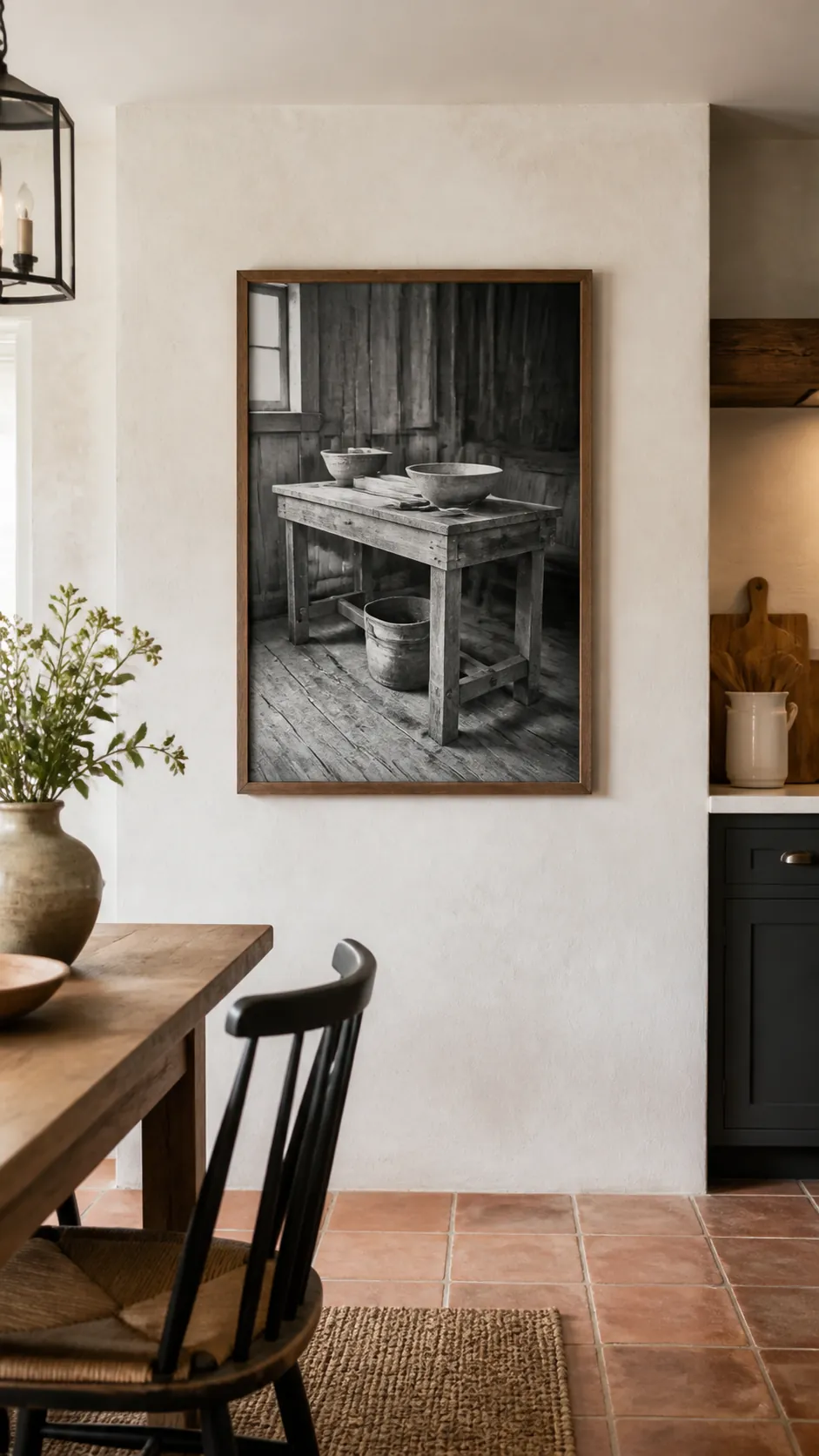
Use a good reproduction if the original is vulnerable, and select glazing that does not turn nearby windows into the dominant view. Centering the frame over a table or sideboard will tie its scale to something tangible. Keep the photograph away from cooking moisture and direct sun, with mounting hardware appropriate to the finished frame weight.
Plaster Niche Collection
Three hand-troweled niches make the wall itself the display, lending a cottage breakfast nook depth without projecting shelves. Give the openings related proportions but slight variations, then place only one simple earthenware vessel in each; shadow around the curved reveals will provide more interest than a dense collection ever could.
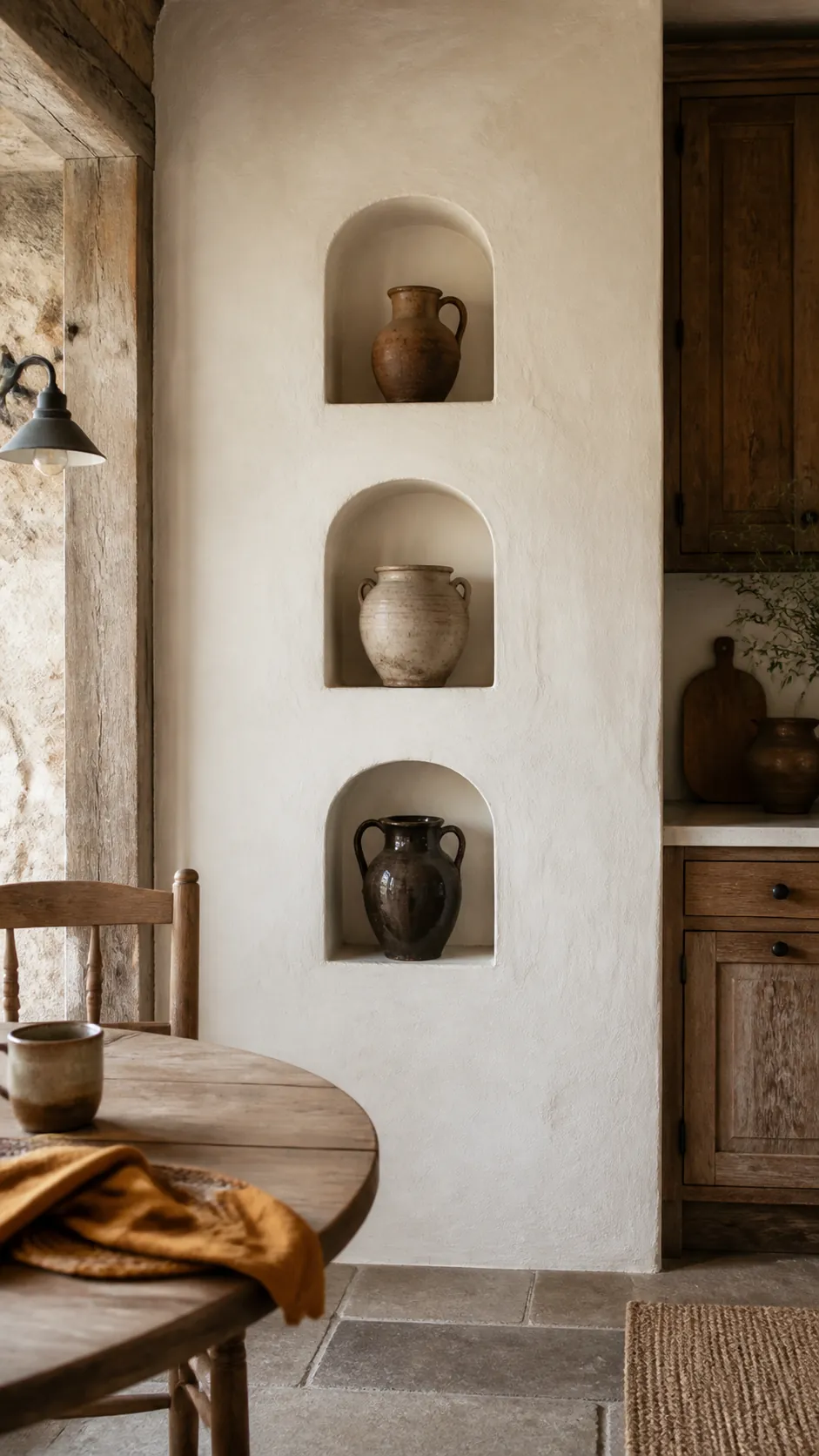
This is a construction project rather than a styling shortcut, so locate framing, wiring, plumbing, and masonry conditions before any recess is cut. Set the depth around the actual vessels and finish the interiors with a surface suitable for a kitchen-adjacent room. Wide lower ledges, stable pottery, and an accessible height will make dusting and handling far less precarious.
Canvas Market Sack Art
A washed grain sack stretched in dark oak adds woven texture to a rustic-modern galley without introducing another brown wooden object. Choose a section with mending, slubs, or faded color rather than readable branding, then let the textile sit against a simple backing. The frame turns humble fabric into a defined focal point instead of leaving it limp or craft-like.
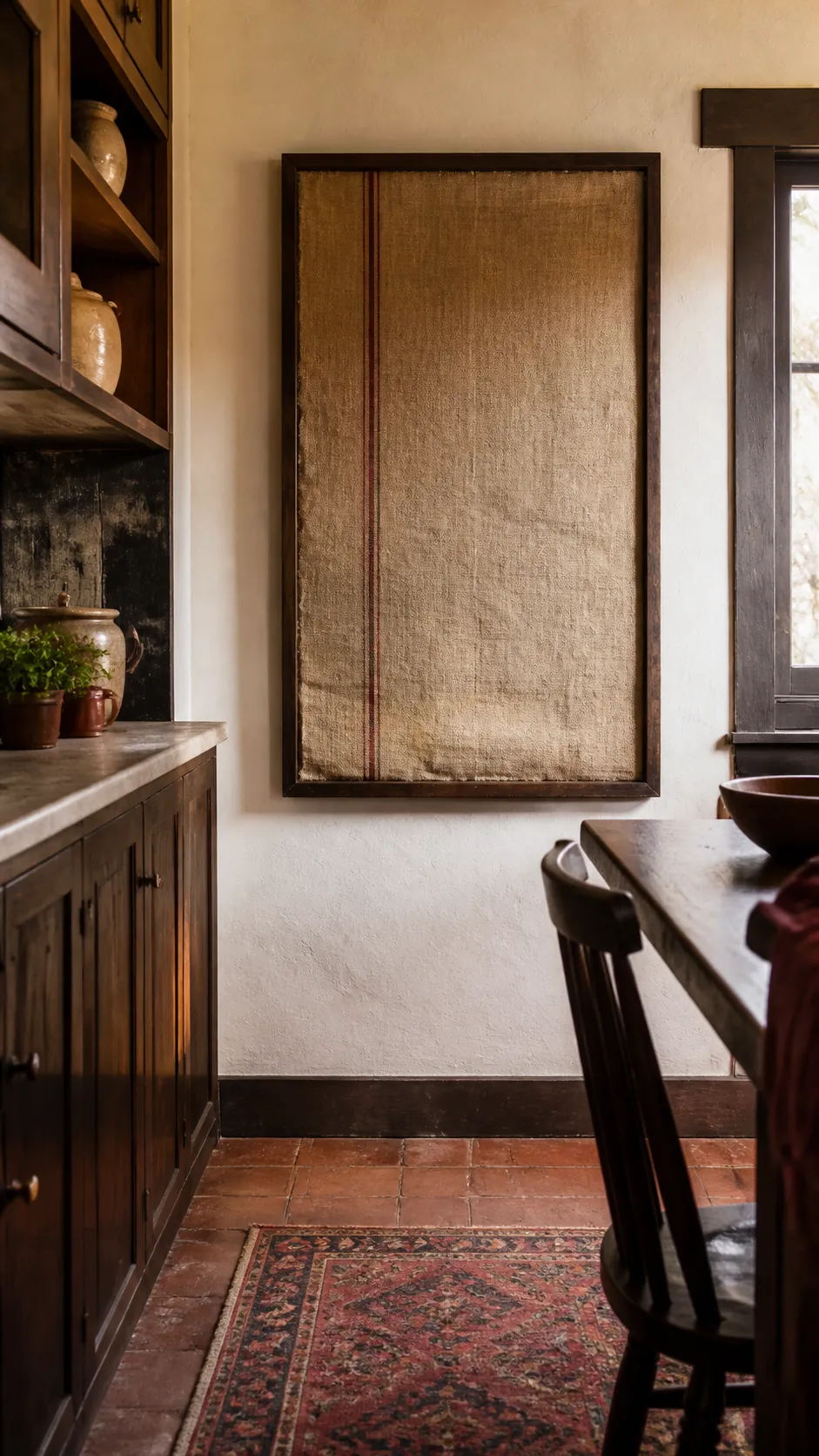
Wash or professionally clean the material only in a way its age and fibers can tolerate, and do not frame it while any dampness remains. A reversible mounting method and protective glazing can help in a kitchen, though the fabric should not press against the glass; hang the completed work beyond the cooking run and allow enough surrounding wall to appreciate its irregular weave.
Branch Peg Rack
A naturally branching limb can become a restrained peg rail when its shape is long, shallow, and carefully edited. Against a country-dining wall, the organic line offsets straight cabinetry without adding faux-farmhouse lettering. Hang only a few light linens or small handled tools so the branch remains visible as the main form.
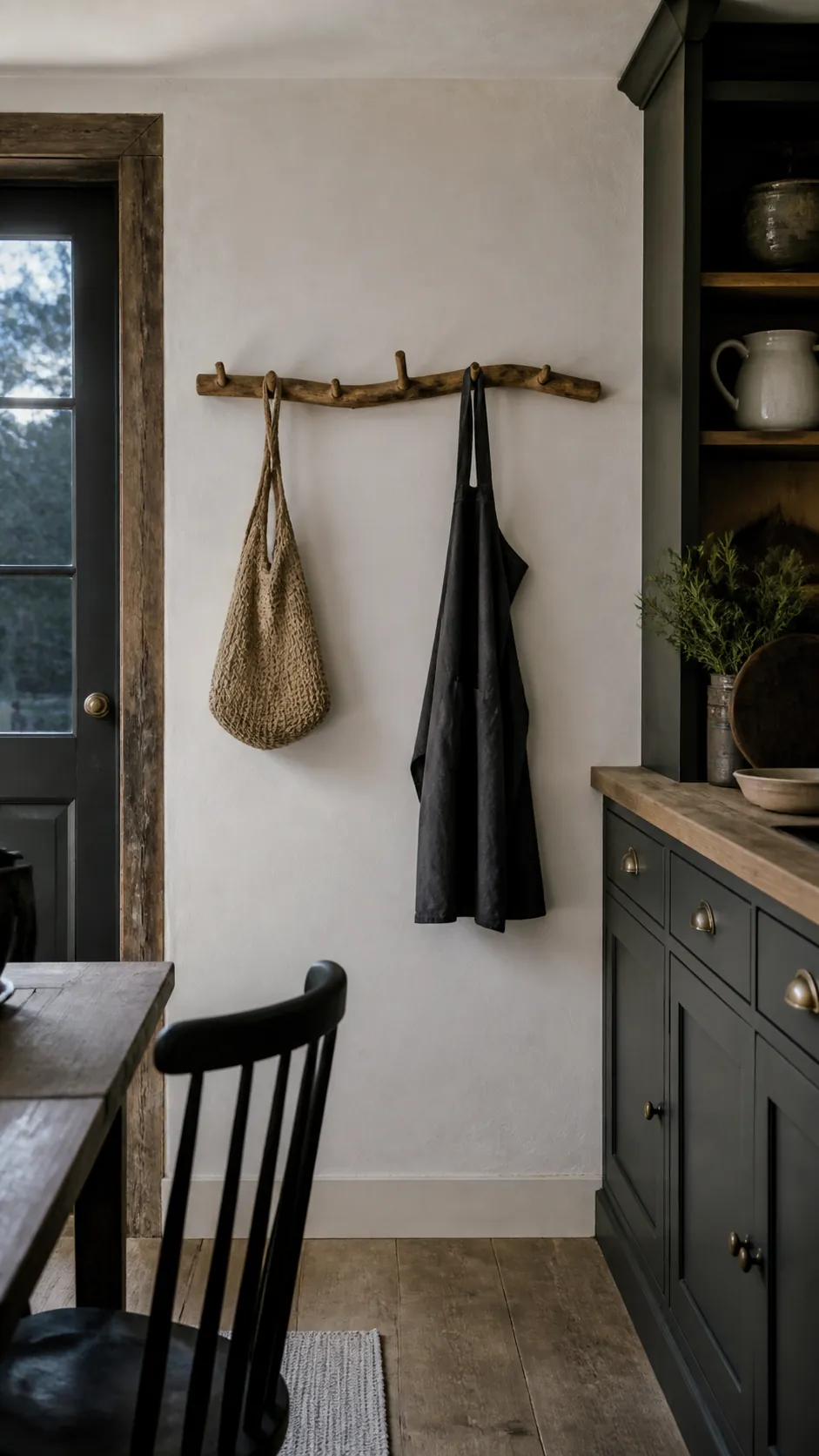
Begin with dry, sound wood, remove loose bark, soften sharp tips, and seal the surface after checking for pests. Use fixed stand-offs or brackets that prevent the branch from rolling under an uneven load. Keep every projection outside the walking line and reserve heavy pans or breakable objects for purpose-built storage.
Slate Menu Panel
A large honed-slate panel brings a deep mineral plane to a converted-barn alcove and can hold faint everyday chalk marks. Avoid a permanent headline or elaborate lettering; a grocery note, quick sketch, or nearly clean surface feels more credible, and the broad dark rectangle pairs well with pale plaster and timber because it gives both materials a clear edge.
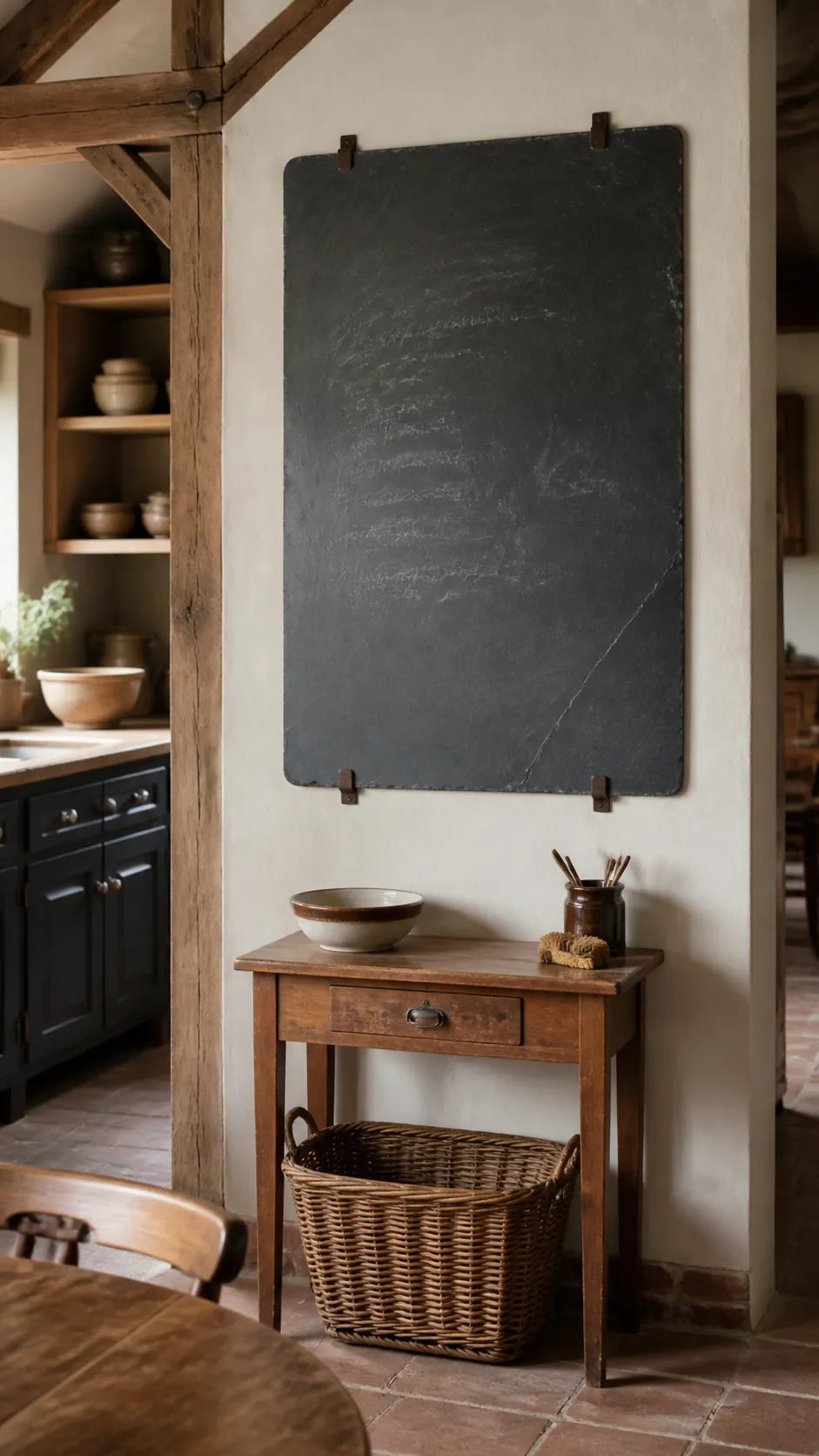
Slate is heavier than its thin profile suggests, so the panel needs a mounting assembly designed for the stone and substrate. Finish exposed edges and set the lower edge where adults can write without blocking a chair or doorway. Chalk dust argues for a planning wall near the table, not directly over food preparation or open shelving.
Rustic Sconce Pair
Forged-iron swing-arm sconces can give a charcoal onion study the presence of a small gallery installation. The arms add depth and movement, while the dark drawing bridges the space between the two fixtures. Keep the shades compact and the rest of the passage wall bare so the trio reads as one composition.
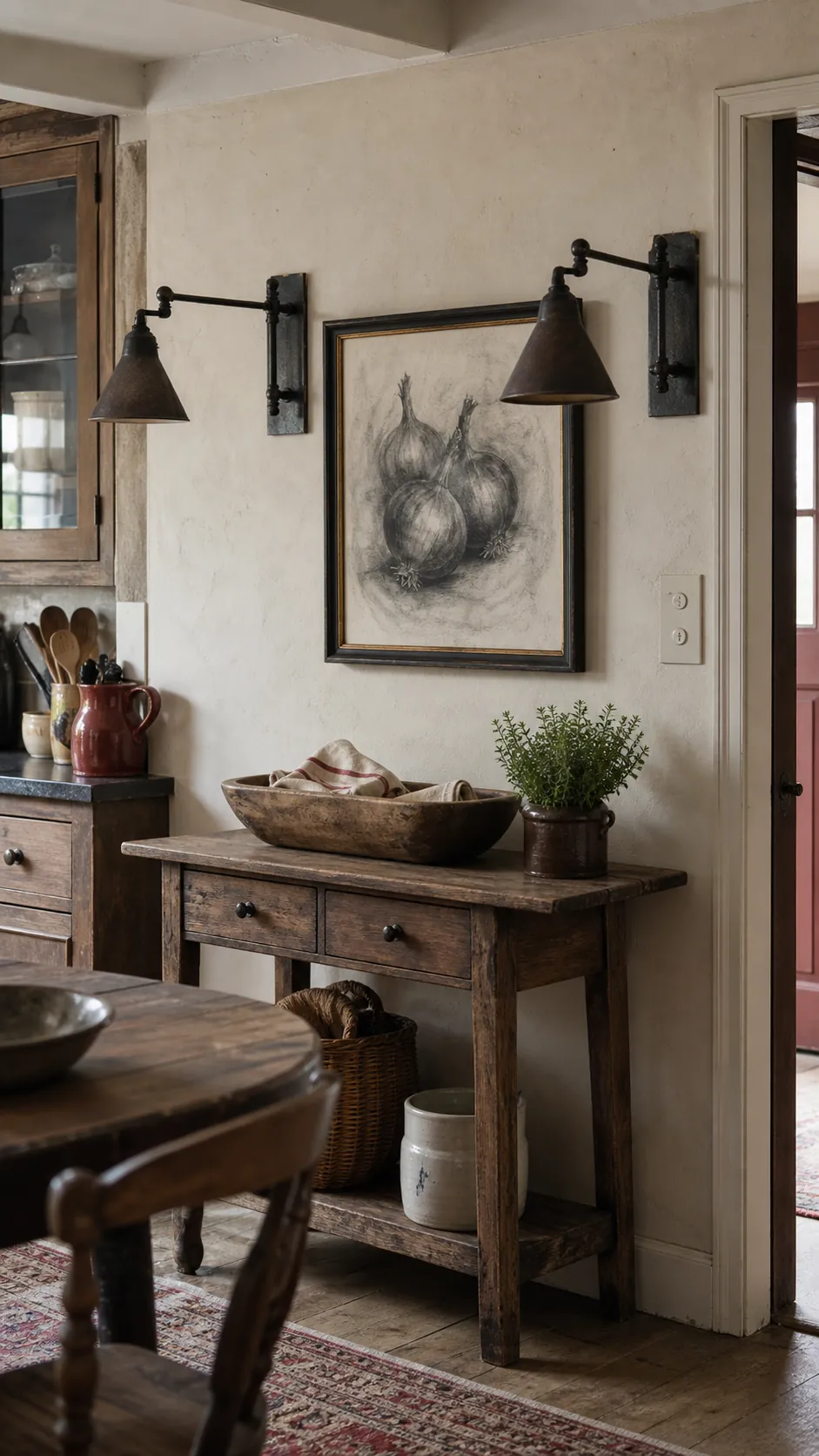
Move each arm through its entire range on a paper mockup to make sure it cannot intrude into the route or strike the frame. Specify lamps and shades that control glare from normal eye level, not bare bulbs reflected off nearby surfaces; hardwired work should follow the fixture instructions and applicable electrical requirements, with the pair kept clear of steam and direct heat.
Quiet Clay-Plaster Wall
Hand-troweled clay plaster can finish an open table wall without a single added object. Earthy taupe gains depth from small shifts in the plaster and from daylight grazing across the surface, so a perfectly uniform application is not the goal. Its restraint also gives timber furniture and everyday stoneware room to stand out.
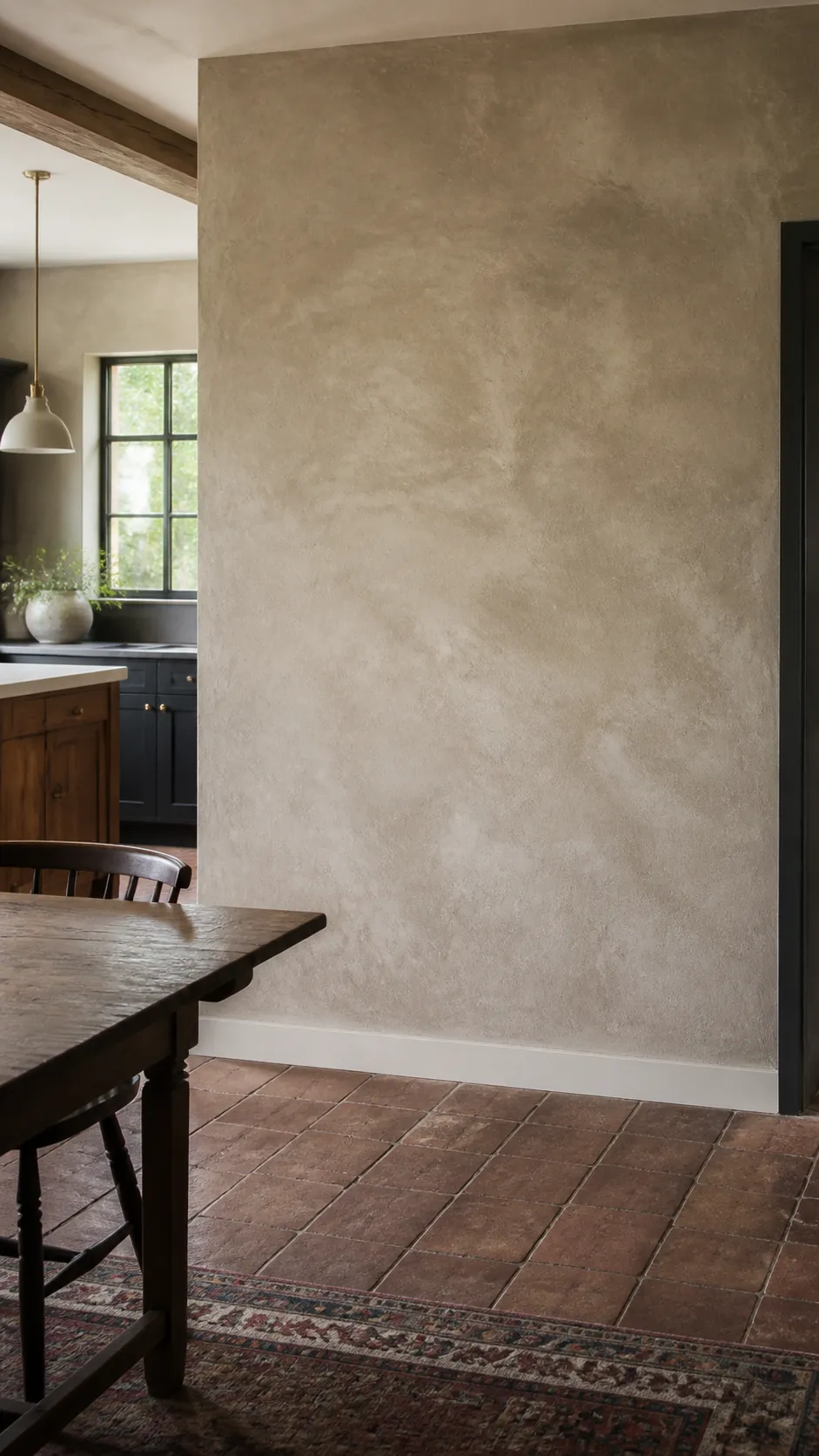
Sample the exact product on the existing substrate and view it through a full day, since texture and color change markedly with light. Follow the manufacturer’s preparation and finishing system, especially where the wall has previous paint or repairs. Use this breathable, tactile finish away from heavy splashes, and resist filling it later simply because the wall remains visually quiet.